|
It
may be presumptuous to liken Y'Barbo to Moses, but there is some merit
in the comparison. Their motives differed, of course, but both led
displaced persons to--or back to--a "promised land." At least the
children of Israel and many citizens of Nacogdoches
felt that way about their destination.
First, let's deal with the name. Most, including descendants, spell
it "Y'Barbo." Spelling was never the strong suit of pioneers, so one
also finds "Ibarbo," "y'Barvo and "y Barbo." Suffice it that most
East Texans pronounce Gil's name as if it was spelled "Wye-Bar-Bow."
And they say "gill" instead of "hile." A better writer once asked
"What's in a name?" so hereinafter you will read Y'Barbo.
(Editor's Note: Please see letter
below from a direct descendant of Dón Antonio Gil y' Barbo)
Anyway, Y'Barbo was born in Los
Adaes in 1729. His parents came from Andalusia, Spain, as colonists
and settled on Lobanillo Creek in an area now known as Sabine County.
In 1763, the Peace of Paris ended the Seven Year's War. A consequence
was the exclusion of French claims in North America, which made Spanish
and English territory meet at the Mississippi River. Rid of the French
threat in their northern provinces, Spanish authorities ordered all
East Texas missions
and settlers removed to San
Antonio in 1772.
Y'Barbo emerged as the natural leader of these displaced persons.
Soon after they arrived in San
Antonio, Y'Barbo pestered authorities to be allowed to return
to East Texas. In
1774, they consented, if he and those who accompanied him would go
only as far as the Trinity River. There they founded a settlement
named Bucareli
and endured several years of floods and Indian difficulties. Then,
in the spring of 1779, Y'Barbo and his followers packed up and moved
farther east.
They traveled as far as the site of the abandoned mission in Nacogdoches.
The move was unauthorized but approved after the fact. Y'Barbo was
named lieutenant governor, captain of militia, and judge of contraband
with jurisdiction over smuggling cases. |
|
|
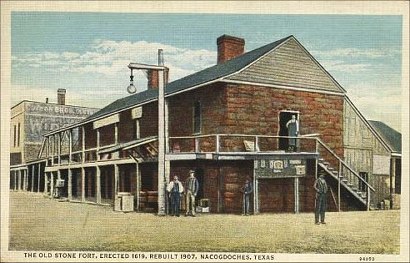
The
Old Stone Fort
Postcard courtesy rootsweb.com/~txgenweb// postcards/Index.html |
It
is impossible to overstate the importance of Y'Barbo to the founding
of Nacogdoches.
He built a "casa piedras," or Stone House, on Plaza Principal, and
a separate residence. The Stone House, though always private property,
became the seat of government and town gathering. Y'Barbo "fathered"
Nacogdoches.
He parceled property and provided leadership in all areas of development.
Then the trouble came. Complaints from convicted smugglers led to
Y'Barbo's resignation in 1790, and a year later, he, too, was accused
of the same offence. He was banned from Nacogdoches,
but permitted to live in Louisiana after several year's residence
in San Antonio
and eventually returned to Nacogdoches.
He died at his Rancho La Lucana, located on the Attoyac River, in
1809.
All Things Historical
-
April 14-20, 2002
A syndicated column in over 40 East Texas newspapers
(Archie P. McDonald is Director of the East Texas Historical Association
and author or editor of over 20 books on Texas) |
Forum:
Subject: Dón Antonio Gil y' Barbo
I am a direct descendant of Dón Antonio Gil y' Barbo.
My maiden name is Ebarb.
The purpose of my letter is to point out misspellings in my ancestor's
name:
Dón (a title of nobility that is passed down)
Antonio (given name)
Gil (a family name pronounced Hill)
y' (Spanish use y' to join both family names. See - http://wapedia.mobi/en/Spanish_naming_customs)
Barbo
- Denise Jones, May 31, 2010 |
|
|
 HOME
HOME