|
This
year marks the 270th anniversary of the removal of a Spanish outpost
which led to the civilization of East
Texas and the origin of word Texas.
Mission San Francisco de los Tejas was the first Catholic mission
established in East
Texas in 1690, but 41 years later -- after a series of ups and
downs -- the mission was moved to San
Antonio when Spain withdrew its military support from the mission.
If the original mission were still standing today, few buildings could
challenge it as Texas' oldest landmark. Even the Alamo
wasn't built until 1718. |
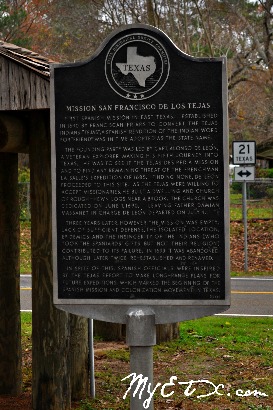
Mission Tejas
Historical Marker
Photo courtesy Dana
Goolsby, 2011 |
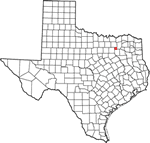
In 1690 Franciscan
priests, accompanied by soldiers, came to what is now Houston
County and established a small mission on San Pedro Creek, a few
miles west of the Neches
River.
The mission had religious and political motives. The priests sought
to bring Christianity to the forest-dwelling Indians and to secure
Spain's domination over the vast territory that would become Texas.
The presence of the mission reminded France, which occupied the territory
of Louisiana across the Sabine
River, that Texas belonged to Spain.
The Nabedache Indians the priests encountered in East
Texas were peaceful agrarians whose fields yielded corn, melons,
and beans. The Indians welcomed the priests and readily celebrated
the Catholic rites. A long-standing legend says the name Texas
came from the Indians' word for welcome, Tejas. But in three years
the relationship between the Spanish and the Nabedache had soured.
The Indians blamed the priests for bringing sickness to their tribe
and became hostile. The Spanish were forced to return to Spain and
burned the mission as they left.
In 1716 another Spanish expedition came to East
Texas and reestablished the mission, this time on the east bank
of the Neches
River. But it was abandoned again in 1719, rebuilt again in 1721,
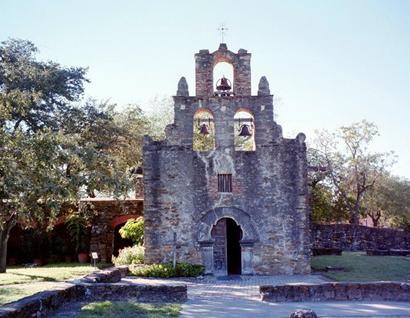
and finally abandoned for good in 1731 when the mission was relocated
to San Antonio
and renamed San Francisco de la Espada. |
 |
By
this time Spanish expeditions were more commonplace in East
Texas, leading to a well-traveled route from the Sabine
River to San
Antonio, a trail known today as El
Camino Real or the King's Highway. The route ran near the Tejas
mission.
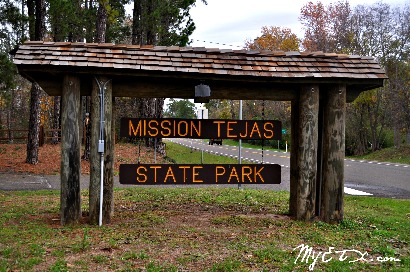
In 1935 as Texas prepared to celebrate
the centennial of its 1836 revolution from Mexico, the state founded
Mission
Tejas Historical Park and workers for the Civilian Conservation
Corps built a log church to commemorate the original mission. |
|
The builders
based their site selection near the Weches community on the discovery
of an old cannon believed to have been buried by the Spanish in
the late 1690s.
While the building is not a true replica of the first mission, it
is a fitting tribute to the early Spanish religious heritage of
East Texas and
the earliest efforts to civilize the region's Indians.
Bob Bowman's
East Texas August 12-18, 2001 Column
More Columns
|
|
|
 HOME
HOME