|
|
| In
the spring of 1779 a later-day Moses named
Antonio Gil Y'Barbo led some displaced persons back to East
Texas to found the community of Nacogdoches.
They had formerly lived in western Louisiana and eastern Texas near
Spanish missions, but a change in government policy had forced them
to move to San Antonio
in 1774. |
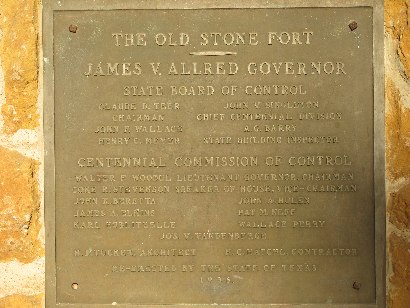 |
As soon as they arrived in San
Antonio, these East Texas Spaniards petitioned for permission
to return eastward. Their request granted, Y'Barbo led them to the
banks of the Trinity River where they established the community of
Bucareli. Four years of floods and trouble with the Comanche convinced
them to move eastward, where they founded Nacogdoches.
Soon after leading his wanderers to the valley of LaNana and Banita
Bayous, Y'Barbo erected a Stone House on the northeast corner of town
square. It was private property, but because of Y'Barbo's
civil and militia authority the Stone House took on a public nature
it never lost. There he conducted private and government business,
so it became the civic center of the community.
When Simon Herrera came to East
Texas in 1806 to negotiate the Neutral Ground agreement with General
James Wilkinson, he headquartered in Y'Barbo's
Stone House. In 1813, the Army of the North led by Augustus Magee
and Bernardo Gutierrez de Lara proclaimed Texas independent from Spain
while occupying the house, and within its walls A. Mower set type
for the Gaceta
de Tejas, the first -- if short lived -- newspaper in Texas,
before moving on to defeat in the southwest.
James Long led Americans across the Sabine
River in 1819 in violation of the Adams-Onis
Treaty, and again used the Stone House as the venue to declare
Texas independent, once more unsuccessfully. The story was repeated
by Haden Edwards and the Fredonians in the 1820s, again unsuccessfully.
|
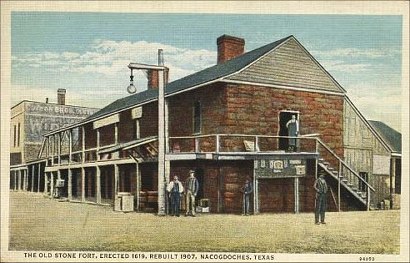 |
"The
Old Stone Fort, Erected 1619, Rebuilt 1907, Nacogdoches,
Texas"
Postcard courtesy www.rootsweb.com/%7Etxpstcrd/ |
| Y'Barbo's
Stone House hosted meetings of the Nacogdoches Committee of Public
Safety and the selection of representatives to the conventions and
the Consultation during the Texas Revolution and it witnessed the
Battle
of Nacogdoches in 1832. There mustered soldiers for service in
the Civil War. Towards the end of the nineteenth century, the Stone
House, by now known as the Stone Fort though it never served
as such, fell on bad times. By then it sheltered a saloon and was
consider quite unsavory. Still it was a shock to the community when
the Perkins brothers razed the old rock house and erected a modern
business building. |
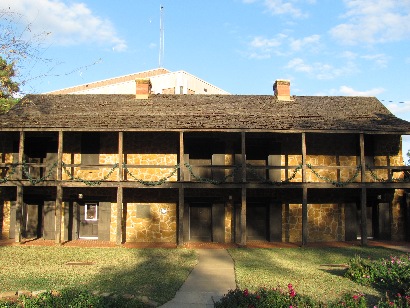
The Old Stone
Fort today
Photo courtesy Dana
Goolsby, November 2010 |
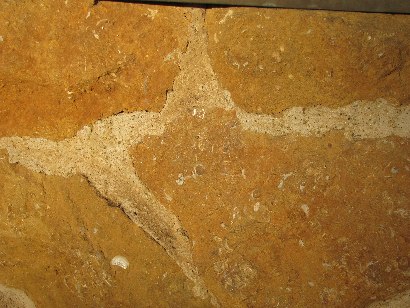
The Old Stone
Fort Stonework
Photo courtesy Dana
Goolsby, November 2010 |
The Cum Concilio
Club, a local women's group, salvaged the remains of the Stone House
and stored them on Washington Square. Later some were used in a building
on the public school campus. In 1936, a replica of the Old Stone Fort
was located on the campus of Stephen F. Austin State University, and
visitors can drop by and get a good idea of what the first building
in Nacogdoches
looked like.
All Things
Historical
MAY
13-19, 2001 Columns
(Archie P. McDonald is Director of the East Texas Historical Association
and author or editor of over 20 books on Texas) |
| Texas
Escapes, in its purpose to preserve historic, endangered and vanishing
Texas, asks that anyone wishing to share their local history
and vintage/historic photos, please contact
us. |
|
|
 HOME
HOME