|
INDIAN
HOT SPRINGS
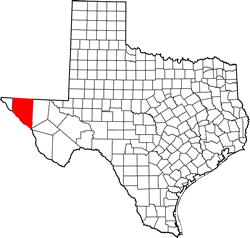
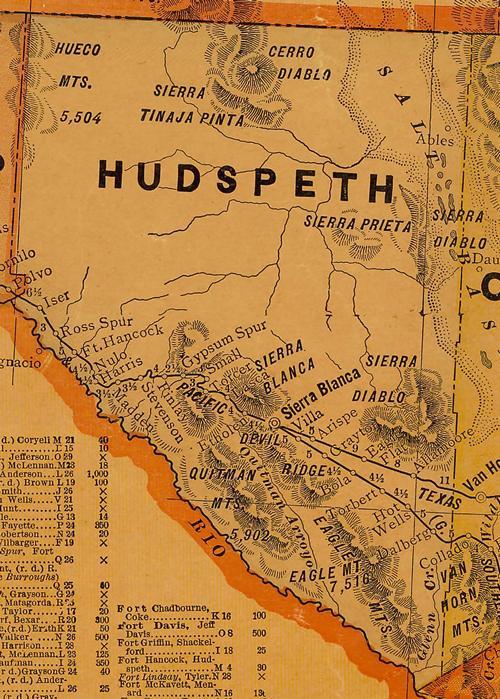
Hudspeth
County, West Texas
30°50' N, 105°19' W
25 miles S of Sierra
Blanca the countyn seat.
Lonesomeness Redefined
Fort Hancock, "Fort Unworthy", Victorio's Secret, the Buffalo Soldier's
graves and the skirmish that made them necessary.
Text by Otis Windburn
Photos by Jason Penney
Book Hotel Here › El
Paso Hotels |
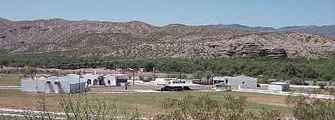
The Springs as
they appear today
50 Feet from the Rio Grande
Very far from everyplace else |
The Springs
First of all
the springs are privately owned. Let's get the disappointment out
of the way at the beginning. According to the excellent Handbook
of Texas, Indian Hot Springs consists of seven springs with
a high mineral content that are in the flood plain of the Rio Grande.
They are geothermal, however the water temperature at the "hottest"
spring (Stump Spring) is a mere 117 degrees. This is tepid compared
to the 140 degree water temperature at Hot Springs, Arkansas, but
it is the highest temperature of spring water anywhere in Texas.
The lowest temperature found here is Soda Springs with a temperature
of 81 degrees.
The Handbook of Texas states that "By 1988 local informants
related that only Soda Spring, Stump Spring, Mason's spring and
Squaw Spring had retained their previous designations." Dynamite
Spring had become Salt Cedar Spring, and Beauty Spring had been
changed to Itty Bitty Spring (what happens when you bring grandchildren
on naming expeditions).
Sierra Blancans used the springs just after the turn of the century,
and a commercial enterprise opened in the late 1920s.
|
Fort Hancock and
Fort Quitman were both subposts to the "Mother Fort" at Fort
Davis. Hancock had originally been called Camp Rice
and was established in 1881. It was near what had been Ft. Quitman,
but was established near the railroad in 1882. It was one of the few
forts to be purchased by the US War Department. The Handbook of
Texas graciously supplies the purchase price of $2,370, which
answers the nagging question: What's a Fort Worth?"
Hancock was frequently flooded, despite small dams that had been built
by the soldiers to prevent this. They also endured several fires before
pulling out in 1895.
A town sprang up just East of the Fort and the post office opened
in 1886, the year the Fort's name changed from Camp Rice to Fort Hancock.
The town of Fort
Hancock today has an estimated population of 400 and had its 15
minutes of fame recently, when it was mentioned as a border crossing
point in the end of the movie "The Shawshank Redemption."
|
Fort Quitman
"Fort Unworthy"
Fort Quitman
was the place Army recruiters never mentioned. Its description was
"forlorn and tumble-down" and that was the kindest thing anyone
ever said about it. The absence of doors and windows caused Army
Surgeon John Culver to say it was "entirely unworthy of the name
of fort, post, or station for United States troops." He did however,
say that it was well ventilated.
Since this part of Hudspeth
County is not known as a garden spot, vegetables and other foodstuffs
had to be brought from San Ignacio, Chihuahua. The Army left in
1877 and told their suppliers in Chihuahua what to do with their
expensive produce. They reopened the fort in 1880 and told their
produce suppliers in Chihuahua they were only kidding.
|
|
Victorio's
Secret
The year 1880 saw the start of a campaign against
the Mescalero Apache chief Victorio, AKA "The Apache Napoleon."
The Mescaleros had been misbehaving and (besides littering the desert
with Mescal bottles*) had robbed a stagecoach and killed
Maj. General James Byrne. After a skirmish that was more demoralizing
than causality inflicting (Rattlesnake Springs), Victorio and his
followers crossed into Mexico to lick their wounds and build up
their self-esteem. Victorio was killed in October of 1880 by Mexican
forces somewhere in Chihuahua. His gravesite is unknown. That's
Victorio's secret.
*It is a fact that this faction of the Apache tribe was named Mescaleros
because of their fondness for Tequila's little (and more potent)
cousin.
|
|
|
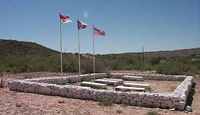
The
Graves of the 10th Cavalry Soldiers
Photo courtesy Jason
Penney |
The Buffalo
Soldier's graves
and
the skirmish that made them necessary
So now you have
the background. Fort Quitman was abandoned in 1882 and Ft.
Hancock was opened near the railroad the same year. During the
1880 campaign against Victorio (October 28, according to the
excellent Handbook of Texas), two groups of the major participants
in this campaign met near the springs. Soldiers from Fort Quitman
were on patrol when an estimated group of 30 to 40 Mescaleros
attacked them. Six soldiers of the 10th Cavalry were buried above
ground, close to where they fell nearly 120 years ago.
While you may think of these soldiers as being among the unluckiest
and most forgotten, consider the fate that befell some of their brothers
a few years before about 1873. |
|
|
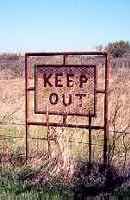
Keep
Out sign at 10th Cavalry Creek
Hwy 240, 14 miles west of Burkburnett
TE Photo |
10th Cavalry
Creek
Way up in Wichita
County (very close to another river that's a state boundary) there's
a place called 10th Cavalry Creek. It's about 12 miles west of the
ghost town of Clara; about
14 miles west of Burkburnett.
The stream had been called Getty's Creek, but settlers found
the ruins of an Army outpost here on the banks. The soldier's bodies
were all buried in a common grave (including the horses that were
killed) and the exact location has never been determined.
It just so happens that we have a photo of a Keep Out sign that was
taken a few feet west of the Historical Marker at 10th Cavalry Creek.
Evidently the property owners are adamant enough to have the sign
welded together from drilling pipe. |
Reader's Comments
Thank you for the piece on Fort Hancock. I was raised there
and can tell you that it is a great place to grow up. - Patricia W.
|
| Texas
Escapes, in its purpose to preserve historic, endangered and vanishing
Texas, asks that anyone wishing to share their local history, stories,
landmarks and recent or vintage photos, please contact
us. |
|
|
 HOME
HOME

 Texas
Gulf Coast
Texas
Gulf Coast East
Texas
East
Texas Central
Texas North
Central
Texas North Central
Texas South
Central
Texas South Texas
Panhandle
Texas
Panhandle South
Texas
South
Texas Texas
Hill Country
Texas
Hill Country West
Texas
West
Texas Texas
Ghost Towns
Texas
Ghost Towns Texas
Counties
Texas
Counties