|
Texas
Monuments & Statues
DICK DOWLING
STATUE
First Public
Monument in Houston,
Turns 100 Years Old on St. Patrick’s Day
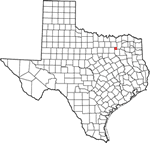
Houston,
Texas
by Edward T. Cotham, Jr.
Update:
The Dick Dowling statue has been removed from Hermann Park on June
17, 2020 ahead of Juneteenth
celebration |
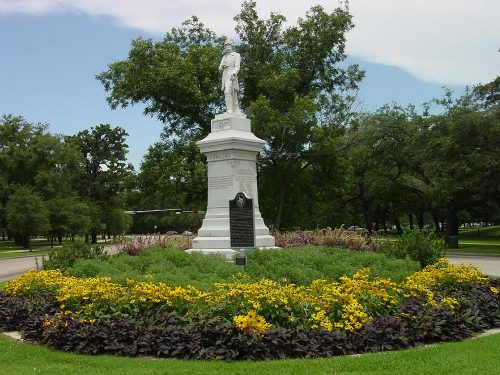
The Dick Dowling
Monument in Hermann Park.
Dedicated on St. Patrick’s Day in 1905
Photo courtesy Edward T. Cotham, Jr. |
On
March 17, 2005, the Dick Dowling Statue in Hermann Park will celebrate
the 100th anniversary of its unveiling on St. Patrick’s Day in 1905.
It was Houston’s first public monument,
coming even before the statue of Sam
Houston for whom the city was named. Standing today on a triangle
near the intersection of Hermann Park Loop, Holcombe, and North MacGregor,
the monument consists of an eight-foot statue made of Italian marble
sitting atop a twenty-foot granite base. The creator of the monument
was German sculptor Frank
Teich, who sculpted the statue at his studio near Llano.
Richard “Dick” Dowling was one of the most interesting figures
in Houston and Texas
history. Dowling Street was named in his honor, as was Tuam Avenue,
the place in County Galway, Ireland, near which he was born in 1837.
Because of the Great Famine in Ireland, Dowling and his family came
to America some time after 1846 and eventually settled in Houston.
Dowling made his name and fortune in a number of saloon businesses.
The most notable of these establishments was the “Bank of Bacchus,”
which he shrewdly located across the street from Houston’s
courthouse. “The Bank,” as Dowling’s bar was fondly known, became
an immediate success, making its owner one of the most prominent Irishmen
in Houston.
Dowling was a man of great compassion and vision. He was the first
person in Houston to install gas lighting
at his business. He also became one of the founding members of Houston
Hook and Ladder Company No. 1, the predecessor of Houston’s
fire department. Finally, Dowling and his associates bought some of
the earliest oil and gas leases in Texas,
foreseeing the great oil boom that would eventually begin to change
the world at the turn of the century.
Although his business and civic accomplishments are impressive, Dowling
is remembered today primarily for his role in leading a group of unruly
Irish dockworkers to one of the greatest upsets in military history
at the Civil War Battle
of Sabine Pass. Dick Dowling was the 26-year-old lieutenant in
charge of a Confederate fort (Fort Griffin) at Sabine
Pass on September 8, 1863, when a Union invasion fleet of 27 ships
and almost 6,000 men attempted to capture the fort as part of a planned
invasion of Texas. In a battle that took
less than an hour, Dowling and his fewer than fifty men repelled the
invasion, capturing two Union gunboats and winning a victory that
Jefferson Davis later called the most amazing feat in military history.
The names of Dowling’s small artillery company (the Davis Guard) are
inscribed on the side of the Dowling monument.
Not long after Dowling’s death in 1867 from yellow fever, the Dick
Dowling Camp of the United Confederate Veterans decided to begin raising
money to build a statue of Dowling in Houston
. A number of Irish societies such as the Ancient Order of Hibernians
wanted to participate in the project so the Dowling Monument Association
was created to coordinate and lead the effort. After a lengthy period
of planning, design, and construction the statue was finally finished
in early 1905. It was placed originally at City Hall on Market Square.
In 1939, it was moved to Sam Houston Park. In 1958 the Dowling monument
was relocated to its present location near Hermann Park. |
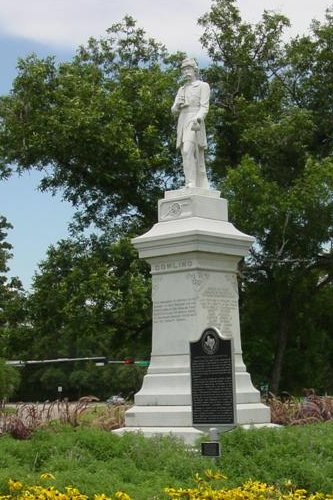 |
Dick Dowling
Statue
Photo
courtesy Edward T. Cotham, Jr. |
The
Dowling statue shows the mustached lieutenant with his binoculars
in one hand and a sword in the other. The sword has caused problems
though the years. By 1958, a Houston newspaper reported that “Dick
Dowling’s sword is missing again. [Nobody] has the faintest idea where
it went. Five times now swords have vanished from the cupped left
hand of Dowling’s statue.” Speculating that leprechauns might have
a stash of the rusted swords somewhere in Ireland, the reporter noted
that in some ways the missing sword was an improvement since Dowling
did not actually own a sword at the time of his famous battle.
Because of the Irish heritage of Dowling and most of his men it was
decided to formally dedicate the statue on St. Patrick’s Day, 1905.
One of the largest crowds in Houston
history participated in a parade and a large ceremony to dedicate
the monument. When the parade finally reached the statue about 3 p.m.,
bands played “God Save Ireland” and “Dixie.” After a series of speeches,
Mrs. W. F. “Annie” Robertson, Dowling’s daughter, pulled the silken
cord to remove the canvas from the statue of her father amid deafening
cheers from the massive crowd of dignitaries, Confederate veterans,
school children, and interested citizens.
Edward T. Cotham, Jr., author of Sabine Pass; The Confederacy’s
Thermopylae, a book recently published about Dowling and his famous
battle, explained the reason that the people of Houston
found it appropriate to so enthusiastically dedicate such a large
monument to Dowling and his men. “The Union invasion thwarted at Sabine
Pass was not actually aimed at that part of Texas. Sabine
Pass was merely planned to be the initial landing point for a
Union invasion that would have rapidly marched west with the intention
of capturing Houston and Galveston.
The people of Houston knew that by
stopping that invasion before it even landed Dowling and his men had
saved their city from occupation and possible destruction. To express
their gratitude, Houstonians shortly after the battle raised funds
to issue a special silver medal for Dowling and each of his men. This
medal (extremely rare today) is sometimes said to have been the Confederate
equivalent of the Medal of Honor that was awarded to Union heroes.
After the war, the people of Houston
banded together to build a statue of Dick Dowling and thus permanently
honor a man who had meant so much to the city and its early history.”
Edward T. Cotham, Jr., former President of the Houston Civil War Round
Table, is the author of Sabine Pass: The Confederacy’s Thermopylae
(University of Texas Press, 2004).
March 1, 2005 |
Related Articles:
Dick Dowling
by Archie McDonald ("All Things Historical" column)
|
|
|
 HOME
HOME