|
Books by
Jeffery Robenalt
|
|
One
of the most storied events in the historic past of Lockhart,
Texas occurred two miles south of town along the wooded banks
of Plum Creek, when a small group of volunteers defeated more than
600 Comanche and Kiowa warriors who had participated in the Great
Comanche Raid of 1840. The volunteers, militia, and Texas Rangers
who fought the battle answered the call from Gonzales,
Seguin, San
Antonio, Austin, Bastrop,
Goliad,
Victoria,
and La Grange, and from
scattered homesteads all across central
Texas.
In early August of 1840, under the silvery light of a brilliant full
moon, referred to by early Texas settlers for good reason as a Comanche
moon, a war party of more than 600 Comanche and Kiowa warriors swept
out of the Comancheria and rode for the heart of the Republic of Texas.
The massive raid was launched in retaliation for what the Comanches
perceived to be the unprovoked killing of twelve Penateka war chiefs
and many innocent women and children at the Council House peace talks
in San Antonio.
Initially the citizens of San
Antonio had lived in fear of retribution after the incident at
the Council House,
expecting the Comanches to immediately retaliate for their losses.
However, after a few quiet months had passed the Texans began to grow
complacent, sure that the savages had learned a hard lesson. This
assumption could not have been further from the truth. The dreaded
horse warriors were a fierce people who would never allow such an
insult to freely pass. They had simply withdrawn deeper into the northern
reaches of the Comancheria to gather their widely scattered bands
in council and plot a course of revenge. |
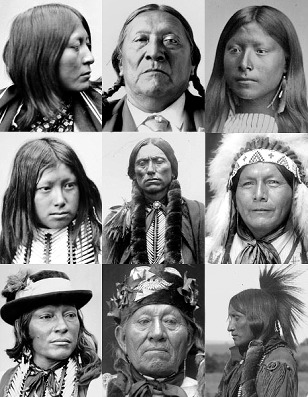 |
Comanche
Portraits
wikipedia |
B
uffalo Hump, one
of the few surviving Penateka war chiefs, led the massive war party
on a trail that passed well to the east of San
Antonio into an area of the Republic that was relatively uninhabited.
This cunning strategy allowed the Comanches to achieve the element
of surprise before spreading out and cutting a wide swath of destruction
across the fertile lands that stretched to the southeast along the
Guadalupe River. Killing and burning as they rode, the Comanches didn’t
halt their movement southeast until they reached the old settlement
of Victoria
late in the afternoon of August 6.
Instead of bypassing Victoria
in the usual mode of roving Comanche war parties, Buffalo Hump convinced
his warriors to surround the town. He then did something few other
war chiefs had done before or since when he led an attack that overran
the settlement. Most of the citizens saved themselves by banding together
and forting up in the south part of town, but fifteen people, including
seven slaves lost their scalps as the Comanches galloped through the
streets howling their war cries and launching arrows at anything that
moved.
Before
the smoke of the fight had cleared Victoria,
the Comanches were again on the move to the southeast, by now driving
a herd of nearly two thousand stolen horses and mules ahead of them.
This vast herd of “Comanche Gold” would eventually lead to their undoing.
Proceeding down the Guadalupe
River bottomlands unhindered, the savage hoard burned and killed
as the opportunity arose.
Once word of the raid began to slowly spread across the valley, scattered
militia companies and volunteers turned out, but they were few and
far between, and at first their only contribution consisted of burying
the dead. In the meantime, all along the Guadalupe,
houses burned and unwary settlers died.
n the morning of August 8, as the war party neared Lavaca Bay on the
Gulf Coast, Buffalo
Hump formed the warriors into a huge half-moon arc. The target of
their hostilities was the quiet little seaport town of Linnville
which served as the port of entry for San
Antonio. A few of the town’s citizens spotted the Comanches from
a distance, but they mistook the warriors for Mexican traders until
the savages began their screaming charge.
By then, there was little for the bewildered inhabitants to do except
row for their lives in small boats or flee for the safety of larger
craft anchored in the bay. Some found refuge on the steamer Mustang
lying just offshore, but others were cut down and immediately scalped
before they reached the water. Those who did manage to escape were
forced to sit and watch as their homes and businesses were looted
and burned before their eyes.
The Comanches spent the entire day pillaging and burning Linnville.
Warehouses packed with goods destined for shipment to San
Antonio were a special delight for the frenzied looters. Warriors
dressed themselves up in top hats and fancy frockcoats. Some even
paraded with parasols, wearing women’s dresses and petticoats, their
ponies’ tails braided with entire bolts of colorful cloth streaming
out behind them as they galloped back and forth through town. Other
warriors occupied themselves slaughtering the town’s livestock.
One citizen was so distraught and angry over the ransacking and destruction
of Linnville
that he waded ashore waving an old muzzle-loading shotgun above his
head, bravely challenging the galloping warriors to meet him in combat.
The bewildered Comanches, thinking the man must be crazy for facing
them as he did and therefore untouchable, simply rode around him,
acting as if he didn’t exist. When the man finally gave up and waded
back out to his boat he discovered the shotgun had never been loaded.
Finally
satisfied that Comanche blood spilled by the Texans during the Council
House fight had been fully avenged, Buffalo Hump called for a
return to the Comancheria. However, as heavily burdened as the Comanches
now were with dozens of fully loaded pack mules, many prisoners, and
well over two thousand stolen horses and mules, the trail home would
prove to be treacherous. To make matters even worse, at that moment
riders were galloping all over central
Texas spreading news of the raid and seeking volunteers to confront
the marauders. A militia company under the command of Captain Tumlinson
began using hit and run tactics to press the savages hard from the
rear. |
 |
 |
Further west,
veteran frontier leaders like Matthew “Old Paint” Caldwell and
Ben McCulloch were busy gathering the scattered volunteers
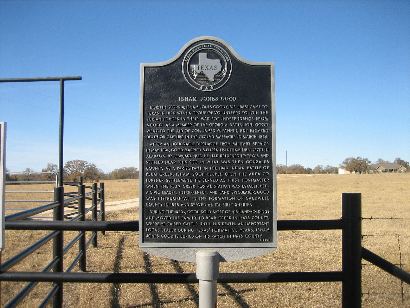
at the cabin of Isham
Good, one of only two settlers who were brave enough to settle
in the remote area of central
Texas. Good’s cabin stood a mile east of Plum Creek, near the
road that led from Gonzales
to the new capital of Austin.
If Buffalo Hump had led the war party west from Linnville
and circled south of San
Antonio on the return ride, the Comanches may well have escaped
the trap being laid for them by the Texans. Instead, the war chief
continued to lead his warriors to the northwest on the same trail
the war party used to enter the Republic. The Comanches were heading
straight into the arms of impending disaster.
Late in the afternoon of August 11, Jack Hays rode up to Isham
Good’s cabin at the head of a company of Texas Rangers from San
Antonio. The presence of the hardened veterans lifted the volunteers’
spirits and helped bolster their confidence. However, Hays’s arrival
was soon followed by General Felix Huston who rode in from Austin.
Huston insisted that since he was a General in the regular Texas Army,
he and not Caldwell, who had been selected by an earlier election
of the men, should take command. Loud and angry protests immediately
erupted from the volunteers.
Unlike General Huston, who was virtually unknown and had little experience
in dealing with Indians, “Paint” Caldwell was a familiar figure to
most men on the frontier, and a veteran of countless engagements with
the Comanches. The Texans both knew and trusted him. However, in spite
of the objections expressed by the volunteers, Caldwell felt Houston
was entitled to take command, and the men reluctantly accepted his
decision. |
 |
| Before first
light the following morning of August 12, the volunteers saddled up
and rode west. After fording Plum Creek at Good’s crossing,
the Texans sent out scouts and followed the course of the creek south.
The sky in the east was beginning to pale with the coming of dawn
when the scouts returned and reported the Comanches had already forded
the creek and were heading northwest on a collision course. At Caldwell’s
suggestion, General Huston dismounted the Texans and ordered them
to take cover in the trees and heavy brush that grew along the creek.
The war party, never suspecting danger lurked so near, soon made an
appearance, driving the huge herd of stolen horses before them. |
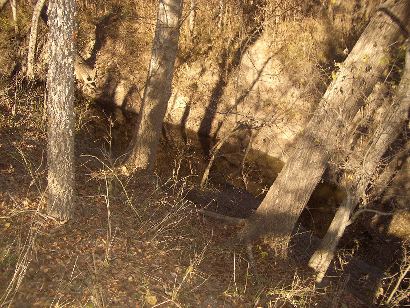
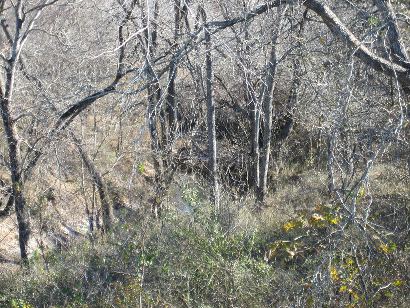
The
west bank of Plum creek looking east
Photo by Jeffery
Robenalt, December 2010 |
| When the Comanches
drew abreast of the Texas positions along the creek, Caldwell urged
Huston to attack the war party by surprise. The General was about
to follow his suggestion when a courier arrived from Bastrop
with word that Colonel Burleson was on his way with nearly a hundred
more men. Huston decided to wait for Burleson. The men grumbled their
displeasure, but they grudgingly accepted the General’s decision.
By the time Burleson and his men rode in nearly two hours later, only
the rear guard of the huge war party remained. |
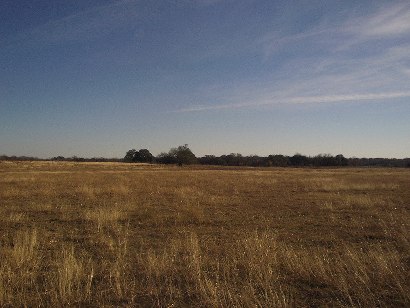
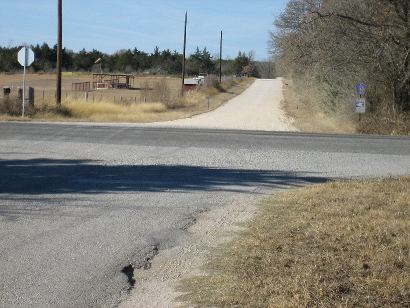
Looking
northwest towards Kelly Springs
- the site of the main battle
Photo by Jeffery
Robenalt, December 2010 |
Caldwell suggested
the Comanches could be delayed with an attack on their rear guard,
and after pausing to gather his thoughts, General Huston agreed. When
the volunteers emerged from the trees along Plum Creek and
struck the surprised war party, a running skirmish developed that
covered the next few miles, with the Comanches fighting a series of
delaying actions until they reached Kelly Springs, a mile west
of present day Lockhart
and not far from the entrance to Lockhart
State Park.
After urging the younger warriors to hurry on west with the loot and
the stolen herd, the remainder of the Comanches emerged from the trees
surrounding the springs and formed a battle line facing the Texans.
The Comanches presented quite a spectacle dressed as many of them
were in the fancy clothing stolen from the Linnville
warehouses, and the fierce horse warriors began to gallop back and
forth between the lines, putting on a display of horsemanship that
would have rivaled any show in the world.
General Huston appeared to be content to sit his saddle and watch
the show, but the experienced Indian fighters like Caldwell quickly
realized loot, not combat, was the uppermost thing in the minds of
Buffalo Hump and his warriors. The Comanches were attempting to delay
the fight until the younger warriors had time to drive the huge herd
of stolen horses and mules further to the northwest out of the reach
of the Texans. Caldwell insisted it was time to press the attack home,
but General Huston once again hesitated.
In the midst of the confusion, a Comanche war chief wearing a magnificent
feathered headdress solved the dilemma by trotting his painted pony
out of the ranks and boldly challenging the Texas leaders to individual
combat. Suddenly a shot rang out from an unknown marksman, and the
impact of a heavy rifle ball flipped the war chief off the back of
his pony as if he had been swatted across the chest with an ax handle.
A low groan of dismay arose from the Comanches at this sign of bad
medicine.
“Now, General, is your time to charge them!” Caldwell shouted.
Without waiting for an order from General Huston, the Texans, screaming
and shooting, spurred their mounts forward. The herd stampeded and
the Comanche battle line dissolved as the warriors attempted to regain
control of the stolen animals. With the warriors dispersed to the
winds, the Texans began to pick them off one at a time. The struggle
was close and cruel, and a running fight ensued that stretched to
the headwaters of the San Marcos River. |
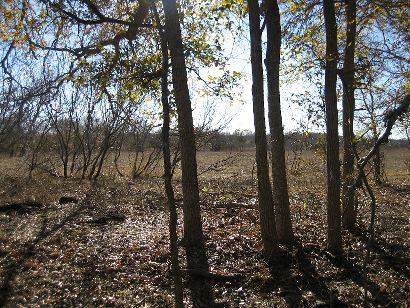 |
Looking
west out of the trees along the west bank of Plum Creek where the
Rangers and volunteers concealed themselves before striking the Comanche
rear guard
- Photo by Jeffery
Robenalt, December 2010 |
|
Unfortunately
for the Comanches, the untimely death of the war chief had ripped
the fighting heart out of the warriors and the day quickly became
a massacre rather than a battle. Before the fighting was over more
than eighty Comanche dead lay strewn along the fifteen mile battlefield.
Only one Texan was killed in the fighting, however the white prisoners
weren’t as lucky. Many of them were put to death before they could
be rescued.
The heavy losses suffered by the Penateka Comanches severely crippled
their fighting ability. Never again would they attack in such force
or raid so deep into Texas territory.
Instead the horse warriors resumed their old hit and run guerrilla
tactics that would continue to prove a formidable obstacle to westward
expansion for many years to come.
President Lamar was now convinced that the Comanches must be taught
a lesson for their effrontery, and he ordered Texas Ranger Colonel
John Moore to prepare an expedition for a retaliatory attack
on a Comanche winter village far up the Colorado. The Texas Rangers
would now carry the fight deep into the heart of the Comancheria.
The Great Raid and the Battle of Plum Creek remain a colorful part
of the history of Lockhart.
© Jeffery
Robenalt
"'A Glimpse of Texas Past"'
January 9, 2011 Column
About Jeffery Robenalt
jeffrobenalt@yahoo.com
|
|
|
 HOME
HOME