|
|
The
sun was shining, the breeze was gentle and Mark Alvarez was in a really
good mood. "People call me all day when it starts raining," he said,
"but not today." They call when it rains because they need to find
out if they'll be able to get to work that day; the Los
Ebanos Ferry Mark Alvarez operates doesn't run in heavy winds
and rain.
Mark is the operator of the only
international ferry connecting the United States and Mexico
at the Texas-Mexico
border. No cell-phone holding, Hummer-driving, Gulfstream jet-flying
big shots are involved. Bill Gates and Donald Trump have nothing at
all to do with it. Not even Oprah Winfrey is interested in the goings-on
of this relaxing mode of transportation. There's a reason for their
lack of interest. |
The
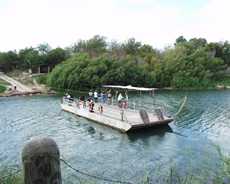
steel ferry, which shuttles three cars and a dozen or so people over
muddy waters, is operated by five men heaving hand over hand on a
rope and pulley. They may not be captains of industry, but they get
the job done. And since they're in the waters of the Rio Grande and
not the Caribbean, it's not likely they'll ever be taken over by Johnny
Depp's Jack Sparrow.
Like the Little Engine That Could, The
Los Ebanos Ferry doesn't have it easy. She has to answer to the
U.S. Coast Guard since, technically, it operates in international
waters, no matter how short the distance which in this case is a mere
25 yards.
"It's almost as if time has stood still, and it continues to operate
and function," said Mark Alvarez's uncle, Ed Reyna Jr., the son of
the farmer and local politician who started the ferry in 1950.
Like everything else connected with the southern border of the U.S.,
there has been a lot of talk by politicians who want people to think
they're going to make things better. When it comes to this historic
ferry, they want to replace it with a bridge. However, we won't
have to worry about losing all that charm, not to mention hunky men
pulling on a big rope. Remember that it's politicians -- all talk
and no action.
Locals on both sides of the river also enjoy talking about replacing
the ferry with something else, but they have no plans to do anything
about it either. They're pretty happy, all things considered, with
the slow pace of life there so why should the way they travel across
the river be changed?
In the meantime, five men haul that rope every single day from 8 a.m.
to 3:30 p.m., except in heavy winds and rain. In such weather, pedestrians
(with or without three cars) have to drive to Rio Grande City to cross.
These days, if there's no waiting line, and the crew isn't on their
15-minute lunch break, it takes roughly 8 minutes to cross this narrow
place, costing 50 cents for pedestrians and $2.50 USD per car. Long
ago in this very spot, Spanish explorers exported salt, Mexican soldiers
crossed to fight the U.S. and in the Roaring Twenties, booze worked
its way over via enterprising smugglers.
Mr. Reyna's philosophy is probably too logical for U.S. politicians
to understand. He says the key to the ferry's
continual operation is simple: "People use it." |
|
|
 HOME
HOME