|
Bluffton
by Mike Cox
( "Texas Tales" Column)
Isaac B. Maxwell had been on the road so long he had taken to talking
to his mule.
Born in Tennessee and raised in Arkansas, some months earlier the
17-year-old had saddled a mule and started riding southwest toward
Texas. He didn't stop until he got to the Colorado River in Burnet
County. Looking at the high limestone cliffs across the river
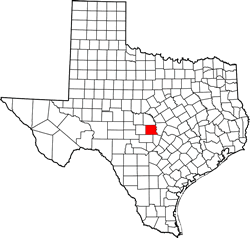
in what would become Llano
County, he told his mule, "This is the place I've dreamed of all
my life."
Whether his mule had an opinion on the subject is not recorded, but
Maxwell was ready to establish roots.
He settled about a half-mile from the future site of Bluffton, a town
he and one of his shirttail kin, Bob Davis, founded in 1854. When
a petition went to Washington in 1858 requesting a post office for
Bluffton, a town he named either for Bluffton, Ark. or for the bluffs
on the river, Maxwell's name was prominently signed. Maxwell also
had a hand in organizing Llano
County.
Once the new political subdivision had its first county clerk, Maxwell
purchased the first marriage license issued in the county. And he
got his money's worth out of the document, going on to father 19 children
and outliving (no wonder) three wives.
Located near an easy river crossing, Bluffton became a stopping place
for stagecoaches and horseback travelers. When the water was high,
the owner of a 30-foot flatboat ferried horses and wagons across the
river, the minimum fee being a quarter for a horse and rider.
Hostile Indians were more troublesome than high water. Maxwell was
in the party of citizens who trailed Indians after a raid on July
6, 1859. For the next 15 years, Indians stole every horse they found
loose or unguarded in the area.
No dummy, Maxwell devised a theft prevention system that worked so
well others soon adapted the technique. What he did was stuff an old
coat with grass, stick a hat on it and prop the "Scare Indian" next
to a stump. Soon many livestock owners in the county were making what
came to be called "Maxwell dummies."
By the time the Indian threat ended in the mid-1870s, Bluffton was
a substantial town with a hotel, a church, a number of stores, two
blacksmith shops and four saloons. Some cowboys' overindulgence at
one of those establishments led to a fire that spread rapidly through
the town. The 1883 blaze, as one writer later put it, destroyed just
about everything but the spirit of the townspeople. Unperturbed, the
citizenry and business community built a new town about a mile from
the ashes of the first Bluffton.
Maxwell, meanwhile, was elected to the Legislature in 1884. He played
a role in convincing state officials to use granite from Burnet
County rather than limestone from Indiana in the construction
of the new capitol.
For those who lived in and around Bluffton, a problem nearly as enduring
as granite was periodic flooding along the Colorado. To permanently
deal with that issue, and to generate electricity through hydropower,
far-sighted folks for years had talked about damming the river. A
private effort to build a dam failed, but federal money made available
during the New Deal was sufficient to do the job.
When all the engineering work for the long-contemplated dam was completed
in the mid-1930s, residents of Bluffton received some hard news -
the town would be inundated by the new lake. |
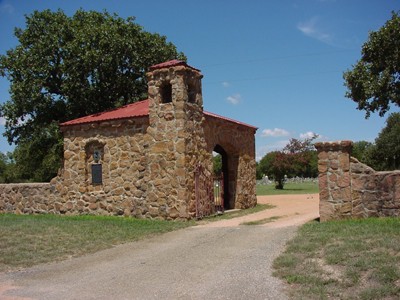 |
"The
stone entry way to the Bluffton Cemetery. The Historical Marker makes
mention of the cemetery being build in 1930 by the Emery, Peck and
Rockwood Development company and donated to the town in anticipation
of the construction of the Buchanan Damn." - Erik Whetstone
Photo courtesy Erik
Whetstone, August 2005 |
The first to
leave were the occupants of the Bluffton Cemetery, who were exhumed
and reburied. Then the living moved to a new town site five miles
west of the then 72-year-old community. Finally, all the old oaks
in the vicinity were cut and burned so that the new lake would not
have any hidden obstacles to recreational navigation.
The dam was completed in 1937, creating a lake 32 miles long and 8
miles wide. That necessitated the moving of State Highway 29 between
Burnet and
Llano.
But the new route did not pass through Bluffton No. 3, stunting its
chance for any growth. These days, even most of the memories are gone.
|
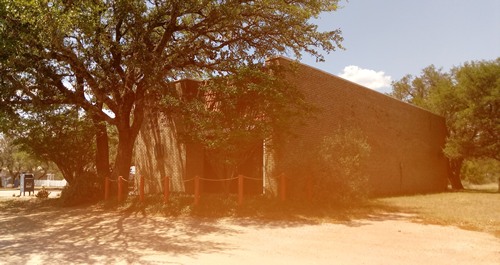
Bluffton
Post Office, TX 78607
Photo courtesy Dustin
Martin, April 2018 |
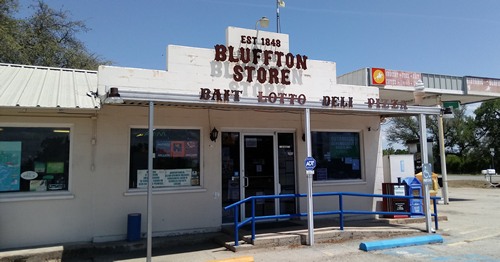
Bluffton
Store, Est 1848
Photo courtesy Dustin
Martin, April 2018 |
© Mike
Cox
"Texas Tales" August
17, 2003 Column
Photographer's Note:
"The Lady at the store told us that the original town which had
been submerged resurfaced about 10 years ago when the lake dried up,
but was no longer the case since floods in 2015 refilled it. However
they did sell me a book of photos taken in 2009." - Dustin
Martin, July 08, 2018 |
Related Article
Bluffton
Reappears by Mike Cox
At this writing, the normally sprawling Lake
Buchanan is only 51 per cent full... While a few traces of the
old town have become visible, most of it is still under water...
|
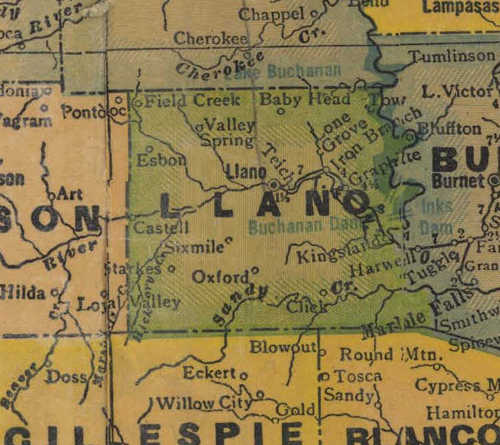
1940s Llano
County map showing Bluffton (near Burnet
County line),
Llano
and Buchanan Dam
From Texas state map #4335
Courtesy Texas General Land Office |
| Texas
Escapes, in its purpose to preserve historic, endangered and vanishing
Texas, asks that anyone wishing to share their local history, stories,
landmarks and recent or vintage photos, please contact
us. |
|
|
 HOME
HOME