|
One
of the more bizarre events in Texas collegiate history took place
in Austin on a January night
in 1920.
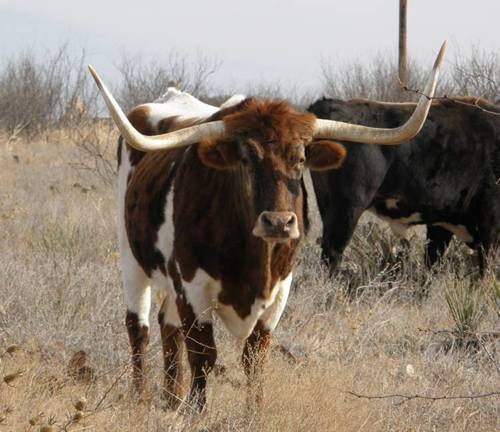
The occasion was a tribute to Bevo, the University of Texas' longhorn
mascot. More than 200 "wearers of the T" and their guests attended
a feed at the men's gymnasium in the steer's honor.
The UT football team had been called the Longhorns since 1904, but
another 12 years went by before an orange-blooded alum (class of '11)
decided the school needed a flesh-and-blood longhorn stomping around
on the sidelines during football games.
Steve Pinckney, referred to in one newspaper account as "the grandfather
of the Longhorn
steer," collected $1 from 124 UT graduates to buy the brute. The transaction
occurred in the Panhandle,
where the seller loaded the longhorn onto a cattle car for shipment
to Austin.
This longhorn already had an impressive history. The steer had been
captured by a posse of Texans in a raid on Mexican cattle rustlers
near Juarez in the fall of 1916. Presumably, the animal had been stolen
from the Texas side of the river some
time prior to his repatriation. |
 |
Pinckney presented the well-traveled steer to the UT student body
on Thanksgiving Day 1916. The two-legged Longhorns went on to defeat
Texas A&M 21-7, avenging a 13-0 loss to the Aggies the year before.
For a time there was talk of branding the steer with a big T and the
numbers 21-7, but the notion was overridden as cruel. The holidays
came and went and then it was February. On the morning of Feb. 11,
1917 the owner of the stockyard where the longhorn was kept made a
startling discovery: Intruders, presumably Aggies, had slipped up
on the penned mascot and used a red hot running iron to sear the 13-0
score from 1915 on the steer's flank.
The steer's embarrassed student handlers, in turn, soon came up with
a clever way to save face for their school, though it was a little
hard on their mascot. The UT partisans converted the 13 into a B,
the hyphen into an e and inserted a V in front of the zero. That spelled
Bevo, the brand name of a popular near beer.
But that was all history three years later when UT students and supporters
gathered to honor their twice-branded mascot, now well known as Bevo.
Dr.
Charles W. Ramsdell, master of ceremonies at the event, introduced
Dr. Robert E. Vinson, president of UT. Vinson went on to give a flag-waving
oration concerning "the qualities of the true American citizen."
Though the university faculty was doing its best, in Vinson's judgment
civilization "thus far has failed to develop to the fullest the three
essentials of true manhood and womanhood - the spirit, the mind, and
the body."
As perhaps only a highly educated academician could do, the UT president
came up with a way to claim that Bevo "typified all three qualities."
Dropping the bull metaphor, he concluded his remarks with the assertion
that "education should broaden the student in all three essentials."
Next to speak was Pinckney, who related the steer's colorful pedigree.
He was followed by Tom Inglehart, Bevo's custodian for the past three
years. Finally, aptly named Alfred Bull stood to tell how Bevo got
his name.
After that, the celebrants were treated to rope tricks, a wild Indian
act and music. Where was Bevo while all the speechifying in his honor
went on? Well, to paraphrase the modern beef industry, Bevo...he's
what's for dinner.
The headline in the next day's Austin
newspaper pretty well summed it up: "Famous Longhorn Steer Is Eaten
By Varsity Students: Bevo of Fond, But Sometimes Unpleasant, Memories,
Served At Barbeque."
The newspaper story went on to say that the demise of the steer (why
Bevo was available to barbecue was not explained) marked the end of
a tradition, which just goes to show the importance of not believing
everything you read in the newspapers.
Bevo I's descendant, Bevo XIII currently reigns as one of college
football's most notable mascots. But so far as is known, the gathering
that winter evening in 1920 marked the only time Bevo ended up in
a barbecue pit.
© Mike Cox
"Texas Tales"
January 20, 2004 column |
| Books
by Mike Cox - Order Here |
|
|
 HOME
HOME