|
Even
city folks who can't tell an emu from a turkey can spot a Texas longhorn
cow when they see one. There's no such thing as an Oklahoma longhorn
or California longhorn. Longhorns are as Texan as it gets.
Like the people who forged the state, the longhorn is a product of
the land. Or as Frank
Dobie put it, "The Texas longhorn was bred not by man but shaped
by nature and man benefited." |
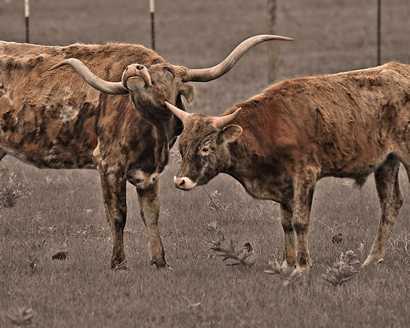
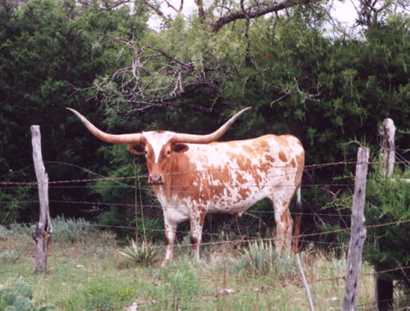
"Ahhhhh"
Photo courtesy John Stankewitz 04-25-2006 |
Texans
benefited the most. The longhorn is credited with lifting the state
from economic ruin wrought by the Civil War and becoming the foundation
of a vast cattle empire. The longhorn gave us cattle drives and folk
heroes we called cowboys. More than any other creature, the longhorn
gave Texas an identity separate from
the rest of the country.
Other breeds of cattle, like the Hereford and Angus, were created
by selective crossbreeding. The longhorn's evolution began in 1493
when Columbus made a return voyage to the New World and dropped off
a load of Spanish cattle at Santo Domingo. |
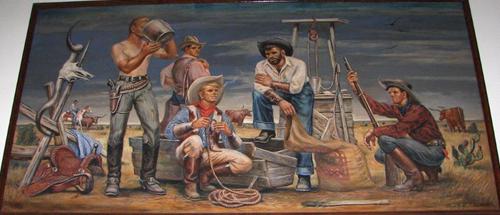 |
A couple of hundred
years later cattle were driven across the Rio Grande into Texas
to provide meat for the missions. By the time of Republic
of Texas, wild cattle roamed all over the state, as wild as buffalo
or bear
or any other creature eking out a hardscrabble existence from an often
unforgiving land.
English cattle were brought here by some of the early settlers, but
some of those cows wandered off or were chased off by Indians. The
various bloodlines contributed to what would become known as the Texas
Longhorn, a creature every bit a match for the state that created
it. |
 |
Historian
Joe B. Frantz wrote of the Longhorns: "They were built for travel,
because they had strolled their way a thousand miles from Vera Cruz;
and they grew long horns because they had to learn to fight off predators
in the brush.
"In the days of the Republic
of Texas and thereafter they cross-bred somewhat with cattle brought
in from the Old South, which helped their beef content without destroying
their mobility.
"Like two-legged Texans, they operated best when left essentially
alone, and they need looking after only at twice-a-year roundups -
one for branding and one for slaughter."
Their toughness and endurance made them perfect candidates for the
fabled cattle drives out of Texas on
the Chisholm Trail. They
had long legs, hard hooves and endured hunger and thirst better than
other breeds. Long-horns ate grass that other cattle wouldn't. Cattle
drives that would have decimated lesser breeds suited the longhorns
just fine. Most even gained weight on the drives.
Just as the gunslinger, Comanches, buffalo
and Indian fighters had seen their day come and go, so it seemed to
be with the longhorns. Barbed
wire and the end of the open range made such tough and durable
cattle not so necessary, especially after people started breeding
them with Durhams and Herefords. By the 1920s, the longhorn had been
almost been bred out of existence. |
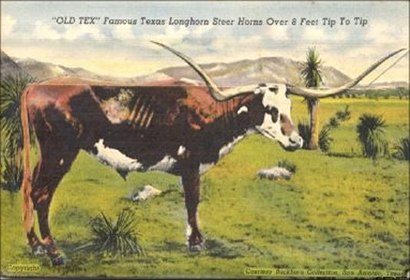 |
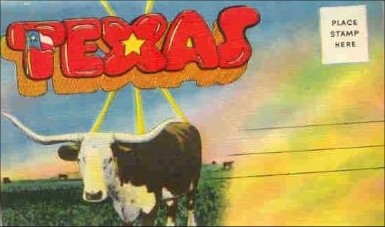
"OLD TEX"
Famous Texas Longhorn Steer Horns Over 8 Feet Tip to Tip
Postcard courtesy www.rootsweb.com/%7Etxpstcrd/ |
In
1927, the Forest Service collected a small herd of breeding stock
and moved them to the Wichita Mountain Wildlife Refuge in - gasp!
- Oklahoma. Small herds were gathered for state parks. Ranchers started
buying them again.
At first the longhorns were considered a novelty, a nostalgic throwback,
but the breed's endurance, strong immune system, fertility and its
ability to live on less than ideal pastures began endearing it to
another generation of cattle men. |
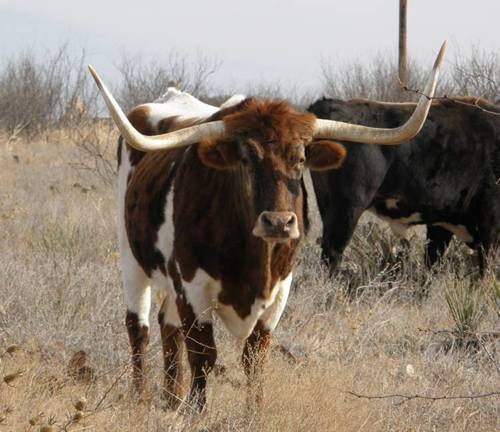
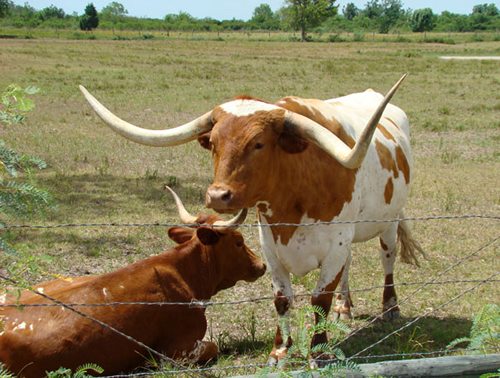
Texas Longhorn
Postcard courtesy www.rootsweb.com/%7Etxpstcrd/ |
The
Texas Longhorn Breeders Association of America in Fort
Worth has grown from an initial membership of 12 in 1964 into
an organization with more than 5,000 members.
The association's website lists about 50 Texas breeders, including
Larry Stewart of Lazy L Long-horns in Lampasas
County. On his website, Stewart has this to say about Texas longhorns:
"These impressive creatures will prosper on grass that other cattle
could not survive, go without water for days on end, protect each
other from harm, attend to a member of their herd that is sick or
wounded, calve effortlessly and amaze you with their intelligence.
But these are not the real reasons we are so fascinated with them. |
 |
"The glint of
sunlight off a crown of burnished horn, the profusion of bright earthy
colors of a herd moving, the sights and sounds of the herd as it grazes,
the fact they are just plain easy on the eyes, or the certain knowledge
that you are in contact with a piece of Texas
history, and any of these or all of these are why we are drawn
to these gentle giants.
"I know of no other breed that captures the imagination quite like
longhorns do."
© Clay Coppedge
"Letters from Central Texas"
August 7, 2006 column |
Related
Articles:
Longhorn:
Texas' first industry by Delbert Trew
The book "The Long Trail" by Gardner Sowle, published in 1976 by
McGraw-Hill, tells the real story of early cowboys, longhorns and
the first industry developed in Texas. This was the chore of capturing,
branding, taming, raising and driving longhorns to market...
Bevo,
the University of Texas' Longhorn Mascot by Mike Cox
|
|
|
 HOME
HOME