|
Knowing
their love can never be, the young couple stare at the swirling river
far below. One last kiss, and then, holding hands, they leap off the
cliff, united forever in death - and legend.
Texas has at least four landmarks known as Lover's Leaps, and probably
more. Telling the story of the Lover's Leap at Junction,
in 1916 J.E. Grinstead fell back on verse in his magazine, Grinstead's
Graphic:
"Thus they stood a single moment,
On that rocky, towering heap;
Then, they named the place forever -
As they made the Lover's Leap." |
|
|
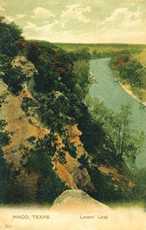
Lover's
Leap in Waco
1906 photo
courtesy texasoldphotos.com |
The tales associated with precipices are touching, to be sure, but
believing them takes a considerable leap of faith. Unrequited love
has produced many a suicide, but jumping couples are far less common
in fact than fiction.
Even so, mankind has been enthralled by Lover's Leap stories for a
long time. Sappho of the Isle of Lesbos leaped into the Ionian Sea
from a towering white rock because she had fallen in love with Phaon.
In another ancient story, Hero, a young priestess of Apollo, hurled
herself into the sea when she learned of her lover Leander's death.
Marlowe transformed Hero's story into poetry in the 16th century.
The basic story crossed the Atlantic to North America, then slowly
moved west with the development of the continent. Americans westernized
the tale in an interesting way: Instead of American girls and boys
leaping from cliffs, most of the legends centered on the double suicide
of Indians.
Why Indians? Some scholars have suggested the preoccupation came from
the American desire to romanticize the displaced noble red man. In
other words, we will take your land but give you some enduring legends. |
|
|
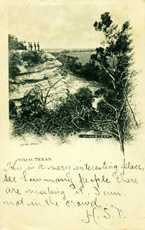
Lover's
Leap in Waco
Writing on the postcard: "This is a very interesting place, See how
many people there are visiting it, I am not in the crowd. - H. S.
T." Addressed to: Miss Nell Brown, Dallas
1908 photo
courtesy texasoldphotos.com |
The
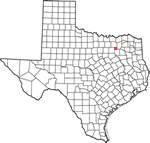
best known Lover's Leap in Texas is the cliff overlooking the Brazos
River in Waco's
Cameron Park. It's such a well known landmark that there's a church
named after it - Lover's Leap Baptist. (No, this column is not a work
of fiction. Check the Waco phone book.)
As one early account summarized the story of this spot, "Here an Indian
brave and his sweetheart jumped to their death because their parents
would not let them marry." |
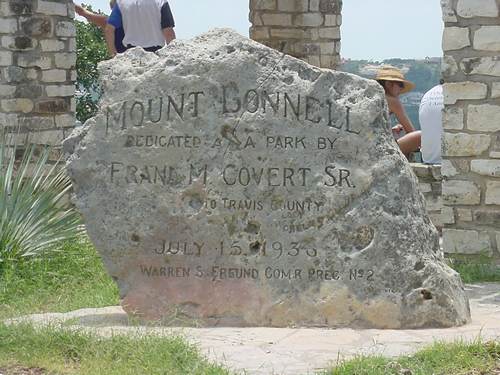
Mount
Bonnell stone marker
TE photo,
7-2001 |
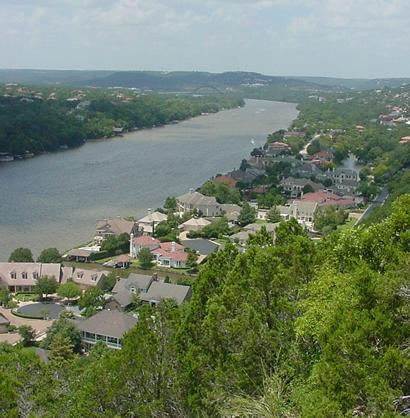
A hundred miles south of Waco, Austin's
Lover's Leap is Mount Bonnell. Austin being notable for doing things
its own, weird way, the story here is backward.
The woman who plunges to her doom from Mount Bonnell, a prominent
feature above the Colorado River, is one Antonette, a European woman
captured by the Comanches from the Spanish settlement of San Antonio.
When her lover came to rescue her from the Indians, they killed him.
Seeing that, Antonette opted for death.
The Austin story may be Texas' oldest example of a variety of the
Lover's Leap legend. Newspaper writer and novelist James Burchett
Ransom told the story for the first time in "Antonette's Leap and
the Death of Legrand, or, A legend of the Colorado," in the Austin
Gazette of March 18, 1840. |
A
view of Austin from Mount Bonnell
TE photo,
7-2001 |
West Texas has
two Lover's Leaps. One is the precipice two miles from Junction
in Kimble County,
first written about by Grinstead.
Texas' least-known Lover's Leap is a cliff on the Devil's
River. Again, the story here is a little different: An overly-protective
Indian chief and his warriors attacked the chief's daughter and her
lover, both of them having fallen out of tribal favor.
The smitten couple leaped to their death in the river just ahead of
dad and his friends. The chief got to the bluff just in time to see
the love-sick couple sink beneath the water for the final time. At
that, the chief called out that this must be the Devil's river and
dropped dead, taken by a guilty conscience-induced heart attack.
Of course, Indians of long ago did not practice Christianity and had
no concept of hell. In truth, Texas
Ranger Capt. Jack Hays is credited with giving the Devil's River
its name, but that's another
story.
[See The Naming of Devils River
by Mike Cox]
© Mike Cox
- May 12, 2004 column
More "Texas Tales" |
Forum:
Subject: Lovers' Leaps
Just read Mike
Cox's story on lovers' leaps in Texas. There used to be a 5th.
It was a rise just east of East Avenue in Austin,
across from where the Austin police station stands at E. 6th & Interregional.
This rise was maybe 30 feet high, no more, & it was topped with a
sort of concrete platform with a decorative concrete railing around
it. It was known locally as 'Lovers' Leap' but no one seemed to know
why. It was demolished & the mound leveled in '53 or '54 when what
was then East Avenue, the original east city limit of Austin,
was turned into the first stretch of Interstate highway built in the
country. Yes, Brown & Root got the contract.
As a sidenote, the Interstate system was the brainchild of
President Eisenhower. It was patterned after the autobahnen in Germany.
When Ike saw how efficiently the Germans used the autobahnen to move
troops & equipment, he decided the US needed a similar highway system.
The actual name of the Interstate system is the 'National Defense
Highway System,' & all initial construction is financed by the
Department of Defense.
When the first stretch was completed, in Austin, Brown & Root had
to go back & tear out all the underpasses & lower the road. They'd
cut corners & the underpasses weren't low enough to allow the largest
truck-carried missiles to pass under them.
As late as the mid-60s, Austin had the only railroad grade crossing
on an Interstate in the country. It used to tie up traffic every morning
as a slow freight crossed the Interstate just north of where the Hancock
Shopping Center is now.
The center is built on what was originally the back 9 of the old Austin
Country Club. The Hancock Recreation Center at 41st & Red River was
the front 9.
At the time 38 1/2 street stopped on both sides of Waller Creek and
there was a footbridge at Waller Creek. There was a la llorona
story about that footbridge when I was a kid living on 42nd, but we
didn't call it la llorona. We had a story about a crazy woman with
a lantern who used to go to the footbridge & call for her children,
who supposedly drowned in Waller Creek. Austin's la llorona was 'the
donkey lady' on deep East 6th. - C.
F. Eckhardt, June 08, 2006 |
|
|
 HOME
HOME