|
|
I
guess you could
say that Mr. Parker was very successful man. After all, he had made
some $40,000 dealing in railroad stock - he was a prominent rancher
and entrepreneur - a leader of men. Not too bad for a man once looked
upon by the people of Texas as a "half-breed savage."
According to information acquired from the Handbook of Texas,
Quanah Parker was born around 1845 near the Wichita Mountains in what
is now Oklahoma. He was the son of Peta
Nocona, a war chief of the Nocone Comanches, and Cynthia Ann Parker,
a white captive. Cynthia was captured in 1836, when she was eight
years old, during a Comanche raid on Parker's Fort.
History has recorded that Chief
Nocona later married Cynthia and made her his only wife. It was
the way of the Comanche for a man to have several wives but Nocona
went against this tradition. It seems that over the years Cynthia
Ann converted to the Indian way of life. She went on to have two more
children, a girl named Topasannah (Flower) and a son named Pecos.
|
|
In
his book, They Rode for the Lone Star, author Thomas W. Knowles
describes Quanah Parker's childhood as fairly normal, but this all
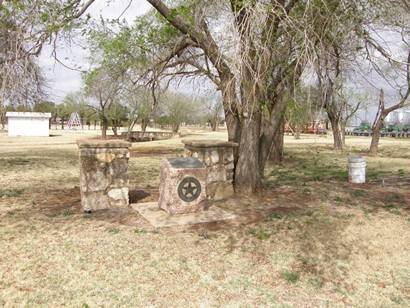
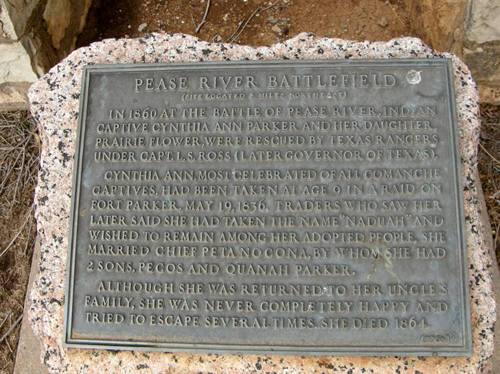
changed in December of 1860. While Chief
Nocona was away on a hunting trip, Texas Rangers under the command
of Capt. Lawrence Sullivan Ross attacked the Comanche camp. Cynthia
Ann and Topasannah were captured and returned to the Parker
family. There are conflicting reports as to what happened to
Nocona, one version has it that he returned during the battle
and was killed. |
|
Cynthia and
her young daughter remained with the Parker
family - despite her pleas to be returned to the Indians she was
not allowed to do so. She tried to escape several times and was placed
under guard. Cynthia had been raised by and lived with the Comanches
for over 20 years. She couldn't speak English and she longed to take
her young daughter and return home.
Things got worse for Cynthia Ann; her little girl became ill with
a "white man's" disease and died. And in the way of the Comanche,
Cynthia grieved with wailing prayers and self-mutilation. She eventually
starved herself to death. |
 |
 |
Now
an orphan, Quanah Parker was taken in by the Quahadi Comanches of
the Llano Estacado. This band was described as the most warlike of
all the tribes. It seems young Quanah adapted well to his new family
and later became a war chief of the Quahadis. He swore vengeance against
the white man for the death of his parents and sister. Quanah's Comanche
band created havoc on the plains, raiding white settlements at every
opportunity. Although constantly pursued by units of the United States
Army, the Comanches continued to terrorize the frontier and were never
captured.
The end was near for the Comanches however, as the buffalo hunters
poured onto the plains and slaughtered the animals so important to
the Indian's survival. Again Quanah gathered his people for one last
attempt to drive the white man from the plains. He formed an alliance
with the Cheyennes, Arapahos, and Kiowas. This group was made up of
about 700 warriors.
Finally, an attack by the Indians on buffalo hunters at Adobe
Walls was a disaster for the tribes. The superior firepower of
the hunters proved to be too much for Quanah's men and they were soundly
defeated. Fifteen were killed and many more were wounded, including
Quanah Parker.
There was no fight left in the Indians - they were constantly on the
run and near starvation. Parker and his men finally gave up and allowed
themselves to be moved onto the Kiowa-Comanche reservation in southwestern
Oklahoma. |
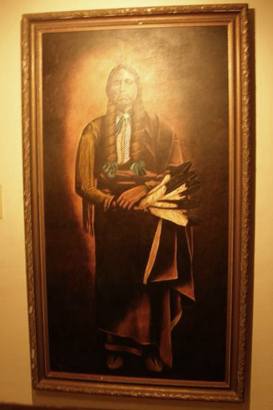 |
Portrait of Quanah
Parker in Borger's
Hutchinson County Historical Museum
Photo courtesy Barclay
Gibson, August 2009 |
Quanah
Parker was a smart, resourceful man and a great leader. Again he urged
his people to make a transition; this time to the white man's way
of life. Under his direction, schools were built and children educated.
He created a ranching industry on the reservation and leased grazing
land to the white ranchers. He showed his people how to build houses
and plant crops. Quanah advocated cooperation with the whites but
maintained that the Indians should never abandon their own traditions.
Parker went on to become a wealthy man. Although he embraced the white
culture, to some extent, he continued the Comanche way. He refused
to become a Christian or become monogamous. Quanah maintained a 22-room
house and had seven wives and numerous children. One of his sons,
White Parker, became a Methodist minister.
The federal government decided in 1901 that Quanah's Comanches were
becoming too powerful, in an economic sense. They decided to break
up the reservation into individual holdings and open it up to settlement
by outsiders. Parker continued to make money with his ranch however,
and he maintained his position as the most influential man among his
people. They honored him in 1902, by electing him sheriff of Lawton,
Oklahoma.
On February 23, 1911, the white man's disease did what their bullets
couldn't do - Quanah Parker died of an "undiagnosed ailment."
History
has been kind to Quanah Parker. He has been remembered as a splendid
warrior and leader of men - an outspoken lobbyist using the white
man's own law to gain rights for the Indians. Perhaps his greatest
accomplishment of all came when he won full American citizenship for
all of his people.
Author Thomas W. Knowles said it best, "In the person of Quanah Parker,
an extraordinary man in whom the blood of two strong peoples flowed,
the Lone Star and the Comanche Moon at last found common ground."
The last great chief of the Comanche Nation is buried near his mother
in a cemetery at Fort Sill, Oklahoma.
© Murray
Montgomery
Lone
Star Diary April
20, 2006 column |
Forum
Subject:
Descendant's of Quanah Parker
I have been to Omaha and Palestine,
Texas in search of confirmation to no avail. I have been told
by family before their passing that my grandmother Nancy Louise
Johnson, born July 17, 1921 in Omaha,
Texas, was a direct descendant of Quanah Parker. All birth records
from this time, were destroyed in a fire. Her parents were Oliver
Vanner Johnson and Margaret Hayden. Margaret Hayden passed away
when Nancy was just 2 years old.
As the story goes, my grandmother, Nancy Louise Johnson, was sent
to live with a Hispanic family until she was 15 and Oliver Johnson
had remarried. She has a sister Rebecca Parker, who preceded her
in death. I don't know her birth. It was never clear to anyone exactly
how or if the connection is true. However, until the day she passed,
my grandmother, Nancy Louise Johnson held the look of a Comanche.
If there are any resources or information available that can help
us make some kind of connection to our heritage, I would greatly
appreciate. I am more concerned in validating our Native American
heritage. But, as I mentioned, there are no birth records available
(to my knowledge) that identify/confirm my grandmother's birth and
the nationalities of her and her parents. Please and thank you in
advance. - Sincerely, Jillian Hampton, Houston, Texas, July 24,
2017
|
|
|
 HOME
HOME


