|
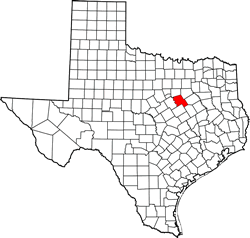
County
- Hill
County Seat - Hillsboro
County Population - (2000) 32,321
Location - 32.011°N, 97.130°W
Elevation - 631 feet
Hill County Courthouse
Constructed 1890
Architect W. C. Dodson
Designation National Register Listing - 1971
Texas Historic Landmark – 1964 |
Hill County
History
In 1852 doctor
Josephus Murray Steiner and Elijah Sterling Clack Robinson devised
a plan to stimulate land speculation by creating a new county. This
new county would be created by subdividing Navarro County. As a result
of some help from Governor Bell, a special session of the Texas Legislature
was called and a bill to divide Navarro County was signed into law
on February 7, 1853. Hill
County was named for Dr. George Washington Hill who had served
as Secretary of War for President Sam
Houston, and also had been elected to the state legislature from
Navarro County in 1851.
During a special session of the Hill County Commissioners Court on
August 23, 1853 a parcel of land near the center of the county was
donated to form the county seat. The county seat was originally called
Hillsborough but the town's name was changed to Hillsboro
in 1854 when the Post Office declared names ending in “borough” should
be changed to “boro”.
In 1881 the railroads arrived in Hillsboro
and along with them came jobs and prosperity. As a result of the railroads,
county population grew after 1881 and well into the early decades
of the Twentieth Century. Because of the available rail transportation
and jobs, German and other European immigrants came to the county
to settle. Cotton also contributed
to the prosperity of Hill
County, but after the 1930's Cotton
production declined probably because of the Depression, and the advent
of synthetic fabrics.
As a result of the exit of the railroads from the area in the 1930's
followed by the demise of agriculture and then manufacturing, population
declined in the county until the 1970's. Today agriculture, manufacturing,
and retail operations all contribute to the prosperity of Hill
County. Hillsboro's location at the convergence/split of Interstate
Highway 35 East and West provides plenty of traffic for the the Prime
Outlet Mall and many other local retail establishments.
In 1981 Hillsboro was one of the first
Texas towns selected by The Texas Historical Commission for the Main
Street Program. Hillsboro's special status
as a Main Street Community makes it eligible for grant money and other
planning and assessment services through the THC. The Texas Main Street
Program's purpose is to encourage economic development through historic
preservation and renovation of buildings and property. The Hillsboro
Main Street Program's mission is to create, restore, and inspire the
quality growth of downtown Hillsboro.
Hillsboro
Hotels > Book Here |
 |
Courthouse
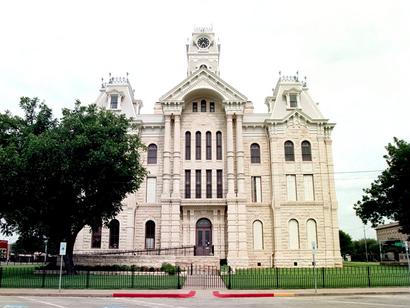
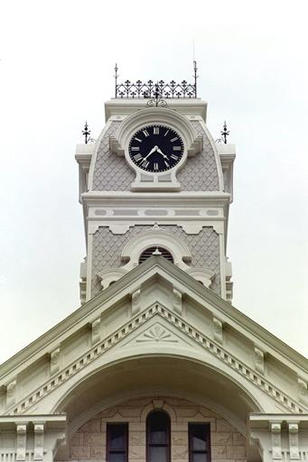
The Hill County
Courthouse is a three-story limestone structure of Second Empire style,
but it also incorporates Classical Revival and Italianate influences.
Two story high Corinthian columns, mansard roof treatment, and a wood
framed three-tier 70 foot high clock tower covered with ornate tin
work are the most conspicuous details of this regionally influenced
architectural marvel. This building is the third and arguably the
grandest of three similar courthouses designed by Waco
architect W. C. Dodson in the last half of the 1880's. Nearby Hood
and Parker counties also have W.C Dodson courthouses of the same vintage.
The Hood
County Courthouse was actually constructed at about the same time
as the Hill County Courthouse, and both buildings were completed in
1890. The Hood
County Courthouse was, by design, a lesser structure and originally
didn't even have a clock tower included in its plan. The Parker
County Courthouse was built several years earlier and although
it's a grand building, it lacks some of the ornate details present
in the Hill County Courthouse.
The first floor of the courthouse is roughly divided into quarters
by intersecting halls. The second floor contains office space and
the District Courtroom. The two story high ceiling of this courtroom
extends up to the third floor balcony where additional seating is
provides.
The courthouse also has a basement. Evident from below the first floor
is corrugated iron arches laid on the bottom flanges of iron beams.
Concrete was poured onto this iron structure to form floors. This
construction method was relatively new in 1889 and you won't find
it in buildings built much before this time. |
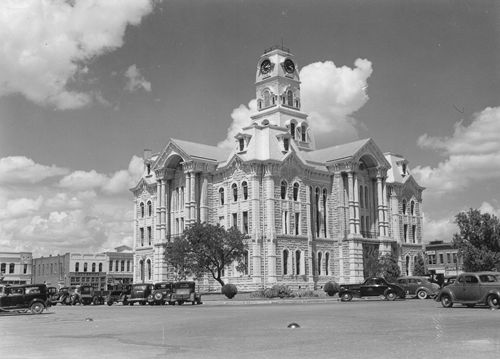 |
Hill County Courthouse
in 1939
Photo courtesyTXDoT |
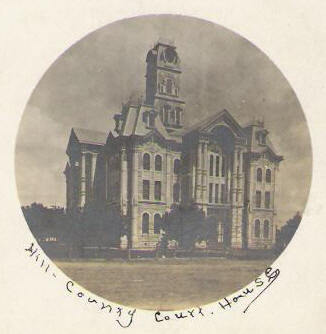
Hill County Courthouse
in 1907
Photo courtesy texasoldphotos.com |
| The Hill County
Courthouse was destroyed by fire on the night of January 1, 1993.
The destruction was nearly complete. All that remained standing was
the four limestone walls. The courthouse was a wooden frame structure
and the clock tower and wooden truss supported interior collapsed
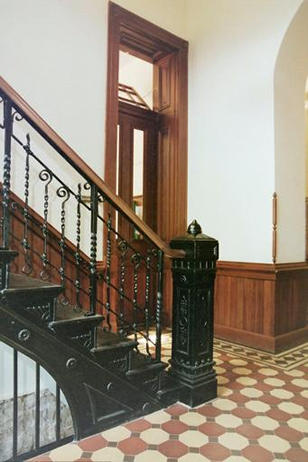
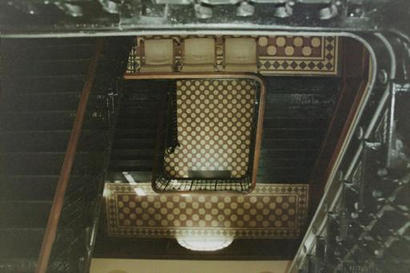
onto the basement. The massive iron staircases survived, but I don't
think much of anything else could be salvaged. It's a testament to
the determination of the residents and elected officials of Hill
County that they were able to rebuild their beloved courthouse
during the rest of the decade of the 1990's. Today, the Hill County
Courthouse is again perfect in nearly every detail. |
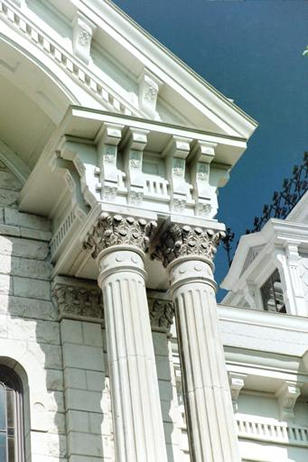
Two story high
Corinthian columns on the Hill County Courthouse.
Photo courtesy Sam
Fenstermacher, August 2003 |
Iron staircase
and door on first floor of Hill County Courthouse.
Photo courtesy Sam
Fenstermacher, August 2003 |
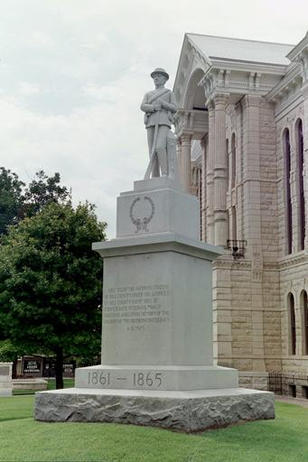
Confederate
Monument on the courthouse lawn
Photo courtesy Sam
Fenstermacher, August 2003 |
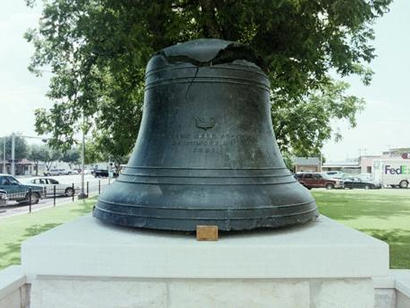
Original Hill
County Courthouse bell showing damage from fire.
Photo courtesy Sam
Fenstermacher, August 2003 |
Courthouse
Square
Because Hillsboro
had a period of growth in the late 1800's and the early 1900's followed
by an extended period of economic decline, many vintage buildings
remain in an unmodified state around the town square. Today many of
these buildings are occupied by merchants that provide products and
services valuable to tourists and Hillsboro
residents. Tourism is wonderful, but there's just something refreshing
about a town square with a mix of merchants that appeal to the locals
and tourists.
The Old Rock Saloon was the first building to be restored under the
Texas Main Street Program. Judging from the cornerstone date of 1876
the building is probably the oldest surviving commercial structure
in Hillsboro. This saloon was at one time
owned by J. E. Ballard, Mayor of Hillsboro
from 1889 to 1893. Originally there was a cockfighting pit at the
rear of the building and a gambling hall upstairs.
Today the Old Rock Saloon at 58 W. Elm St. houses law offices. This
building is interesting for its age alone. The cornerstone with 1876
date can be seen clearly from the entrance to Bond's Alley. Some stone
mason chiseled the left side of the cornerstone off during a renovation
but the date is still legible.
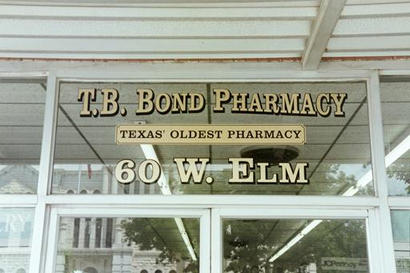
The Old Rock Saloon and Bond's Drug Store set on opposite sides of
the entrance to Bond's Alley, on the south side of the courthouse
square. This alley has been a popular spot for public gathering over
the years. Bond's Alley is names for Bond's Drug Store which has been
in business at this location since 1881. One can only imagine all
the forms of camaraderie, larceny, and politics that have occurred
in this alley over the years.
Hillsboro
Hotels > Book Here |
 |
Sign over front
entrance at Bond Pharmacy
Photo courtesy Sam
Fenstermacher, August 2003 |
Other
Attractions
The Cell Block Museum: Old county jail house located one block
north of the Courthouse. Open Saturdays April through November.
254-582-8912
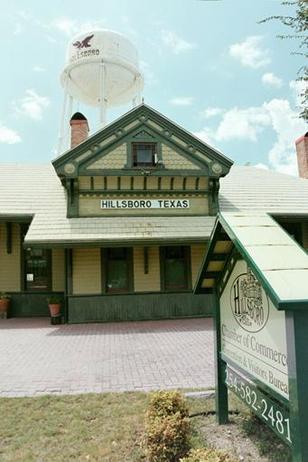
Katy Depot: Built to serve the Missouri-Kansas-Texas (Katy)
Rail Line. Today, home of the Hillsboro Area Chamber of Commerce.
A great place to gather information for your visit!
Tourist information:
www.hillsborochamber.org/
1-800-Hillsboro |
Bibliography:
Texas Historical Commission, Texas Historic Sites Atlas.
http://atlas.thc.state.tx.us/, 2003.
“Hill County.” The Handbook of Texas Online.
http://www.tsha.utexas.edu/handbook/online/articles/view/HH/hch15.html,
2003.
2003
© Sam
Fenstermacher All rights reserved. |
|
|
 HOME
HOME