Books
by
Byron Brown
Order Here |
|
|
I
first heard of the Chinati Hot Springs from a former student of mine.
Because of the source and my own ignorance of the place, I was suspicious
that the name had been both mispronounced and, subsequently, misspelled
in my mind. So, when I tried to locate the area, I formed every variation
of the word that I could imagine. Most likely, the consonants were
appropriately placed. The vowels, however, were suspect. After only
a couple of days, I had trouble remembering exactly what the student
had said. Was it Chinouti or Chuneté? Chanootoo or Chanitu? More troubling
was the notion that maybe a diphthong was at play, Chaeniti perhaps.
Who could tell? Well, a Google search proved both my student and my
ignorance correct.
The resort spans 640 acres and rests on the side of a ravine in the
Chihuahuan mountains. It is concealed by the lesser peaks even from
the seven miles of almost paved road that lead to it. The route is
a wide, white- rocked shaving of a trail, which has an upward, circuitous
direction and must be handled with some delicacy. If entering after
night fall (not a good idea if you're unfamiliar with the area. I
mean, really, not a good idea) be prepared for near total blackness
when shutting off your car's lights. While there are campers, and
the caretakers, David and Krissy Fines, are almost always available,
most everyone turns in early. Out here, night's black cauldron, lacking
the urban staples of radio, computers and television, brews a somniferous
stew. We tried to arrive before nightfall (my unspoken goal) and almost
made it.
My wife and I arrived at Marfa
in the mid-afternoon, pleased that we had passed the interstate portion
of the trip so quickly. I-10 has an 80-mile an hour posting now and
the rental car we drove took us from Fredericksburg
to Fort
Stockton in just over two and half hours. We ate lunch at Conchita's,
one of the few restaurants on Marfa's
main street (Hwy. 90) which seemed unmolested by the recent wave of
renovation. I ordered a torta that was slow in coming, but worth the
wait-a sandwich equal parts avocado and beef inside of a tear of bread
that tasted fresh baked although the kitchen seemed too small for
such an enterprise.
Heading
south on Texas highway 2810 is more of an adventure than a drive.
There is such a lack of human activity out there that the cows stared
at our car as we drove by, the hawks did not bother to leave their
posts and twice we had to steer around rancher-shot javelinas, one
of which was so large that it demanded, even in death's rigor, one
of the two available lanes. The springs' web site has described the
Pinto Canyon road, the unpaved portion of the highway and a relative
"short-cut", as a journey though, "deep canyons, across creeks and
high peaks". An off-road vehicle with a "high clearance" was recommended.
I thought that probably, the site's author was erring on the side
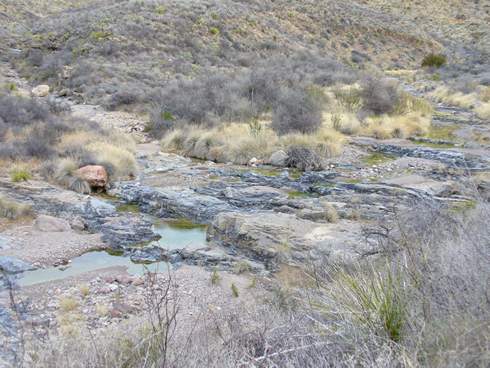
of safety and common sense. We decided to make the attempt. |
 |
After
a couple of miles on the unpaved road we came to an open gate, guarded
by a cattle grate and a large, sun-blanched sign that read that the
road beyond was "private property" for ten miles. Stopping the car,
we got out and stood bewildered in the open country looking back and
ahead for some sort of ethereal assistance, a comedy for the cattle
and horses. Had we taken a wrong turn? Impossible. There had been
absolutely nowhere to turn. We researched the map more times than
needed and decided that we were probably pretty close to our
goal and should try simply moving forward. If we were right, we would
make the springs well before nightfall. As we inched the car ahead,
the road on the other side of the grate became nothing more than a
pocked rock path, clearly created for and by vehicles and animalia
foreign to ourselves. After a few hundred yards we saw the canyon
beneath and the path that extended through it, a brown ripple of a
trail with more curves and bends than a burlesque dancer. The car
panicked. The afternoon's sunlight was wearing away and we quickly
saw that our supplies (a hot twelve pack of beer, two diet cokes,
three sticks of gum and half a tank of gas) would probably not suffice
if we became stuck. Besides, hadn't we read something about wild cats
and black bears? Our pioneering spirit was fading with the sunlight
and we retreated back to the paved section of the highway.
While we had seen no one on the drive south, we now passed a sole
white truck, which quickly turned in behind us. Evidently, the Border
Patrol casts an inquiring eye on cars coming up from the border. We
were followed, nose to butt, for a couple of miles. While my wife
asked repeatedly whether she should, "just go ahead and pull over"
I tried to display an insouciant attitude. Of course, we were eventually
stopped. I honestly thought that when the officer heard our story
and saw our whimpering, dusty rental car, he would send us on our
way. However, the Homeland Security insignia on the trucks now require
officers to dismiss what is highly probable for what is remotely possible.
Our licenses were taken back to the truck for at least ten minutes,
during which time my wife tried to show me the day's pictures on our
digital camera. When the officer returned, he approached the passenger
side and asked me to come to the back of the car. With my mind in
a tumult, he began to ask, through his sunglasses, what my wife had
handed to me while he had been in his truck. Unsatisfied with the
camera explanation, he pursued that it had been drugs. I denied the
charge and was soon exposed to the onset of what would become 30 minutes
of the best laconic stare-down technique that our tax dollars can
coach. Offering again that we had no drugs brought the declaration
that if I were to simply produce my drugs he would, "toss them on
the road and there [would] be no arrests". While I wondered if twelve
hot Coors in the trunk constituted a felony and whether or not I was
willing to part with them, our officer (by now, in the middle of this
desert, he had indeed, become solely, ours) once again allowed
his sunglasses, unnecessary at this point in the day, to speak truth
and justice to my heart. I'm afraid that all I could confess was a
weak smile of discomfiture, which I was more than willing to let fall
to the grass. Undeterred, he asked me to fetch my wife to the back
of the car and we stood, statues on the steppes, while he searched
our still exhausted car. Satisfied that we posed no immediate threat
to state or country, our officer let slip that, "there is an ungodly
amount of narcotics" that travel north on this highway. Undoubtedly,
he is right. Also, undoubtedly, we looked alien to the landscape as
he knows it. Any cow out there could tell you that. Ten minutes of
small talk, replete with the same intent staring and several instances
of holster checking, bought us a one-way ticket back to Marfa
and a longer journey to a destination obscured by mountains and a
darkening sky. |
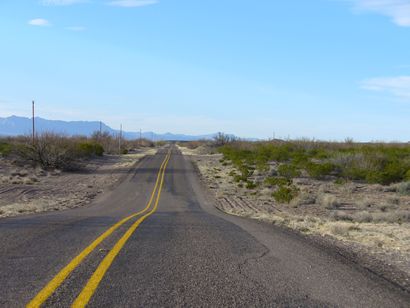 |
The
path to the Chinati Hot Springs lies just west of Ruidosa
off of highway 170, an arrow straight road that is nevertheless, savagely
water warped and undulating. The road is so close to the border that
you can smell the Rio Grande. If you were of a mind to run drugs from
Mexico, you
would be ideally situated. The road is roughly seven miles long, and
in the dark feels like many more. However, the Springs are one of
those destinations that make you truly glad to have endured such a
harsh path.
As we entered through a metal gate, still unsure about where, exactly,
we had landed, the kitchen cabin became visible by its soft interior
light, left on perhaps, by accident. The cabin seemed the lone-lighted
spot for miles in any direction. We parked and found ourselves wondering
what to do next. The kitchen was empty of people and, while I knew
the caretakers were expecting us, there was not a sign of anyone.
My wife and I walked to a cabin that seemed to be more official than
the others due to its size, and knocked, startling a couple of dogs
who charged the door and chased away what was left of my reserve.
David, half of the husband and wife managerial team, hushed the dogs,
pronounced them harmless, and walked us, and the limping car down
to our cabin, the El Presidente. David ignored my comment (it
was a compliment) on the black velvet Matador tapestry hanging above
the bed, wished us a goodnight, and disappeared like Batman into the
darkness. Left to ourselves, we went to fish our bags from the trunk
of the car. In all honesty, I can relate that neither my wife nor
myself, from Puerto Rico and Lubbock,
respectively, had ever witnessed a night's sky such as this one. I
could not remember when I had seen the Milky Way so clearly, when
a star's flaming could be seen without myopia, when space seemed so
perfectly real and close at hand. We stood that way, backs arched,
necks cocked to the car's roof for longer than a Border Patrol agent
can stare. When we finally did lie down, the stars were the conversation
that sleep faded. |
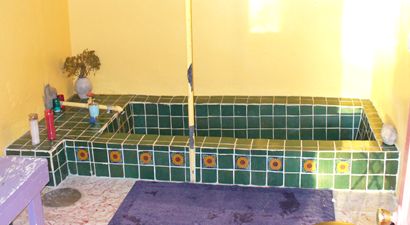 |
The El Presidente
cabin at the Chinati Hot Springs is one of two on site with its own
private tub. The other, the El Patron, has a bath sharing a
wall with the El Presidente's. Additionally, five other rooms share
three semi-private baths available on a first-come-first-serve basis.
The water contains several trace minerals as well as lithium, sulfur
and arsenic. The tubs are close to three feet below the level of the
floor and relaxing into them is akin to a sort of rural isolation
chamber (Was I the only one who remembered Dr. Lily's salt water sensory
deprivation chambers from the '80's? And the movie Altered States?
My wife said yes). The water's spigot was little more than the terminus
of a lead pipe extending from the cistern. The water flows, unfiltered,
for both drink and wash. There is a certain majesty to the fact that
the waters rise from a single source, a sulfur orange cavity in the
rock directly behind the cabin. I couldn't help but imagine that I
was being healed of some of my afflictions; the lithium would lighten
my personality, the minerals could reproduce my arthritic knee into
a fixture as smooth and white as Pelop's shoulder. A common, local
tale concerns a relative of the Kingston family, the owners of the
property in the early twentieth century. The man was cured of his
crippling arthritis after bathing in the spring water. Out in the
Chihuahan desert, the improbable frequently seems possible.
The communal kitchen at the Chinati Hot Springs is the one area where
you are likely to run into others who have ventured away from their
urban environs. However, if you're looking for a protracted conversation
you will need to find your car keys, because, you're driving back
to town. Aside from volleying "good morning", the only talk I nearly
had with another visitor was when I found myself wanting to thank
whoever had made the coffee early that first morning. The individuals
who travel to this spot are here to be with the mountains, the sky,
and their own thoughts. |
 |
Chinati Foundation
in Marfa
We
left the Springs for an afternoon to visit the Chinati Foundation
in Marfa. The Foundation is home to permanent installations of various
Minimalist artists of whom Donald Judd is the most prominent and indeed,
the Pater Familias of the entire site. It was Judd who, in
the late 1970's, bought the land and converted the barracks and hangers
of the former military base into a museum. Indeed, the huge scale
of the museum almost defies the Minimalist effort. The museum offers
a two-round tour, Wednesday though Sunday, that begins at 10:00 a.m.
and then again at 2:00 p.m. In addition to Judd's work there are works
by Donald Flavin, John Chamberlain (located at a sight away from the
main buildings and the reason for the second round of the tour), Ingólfur
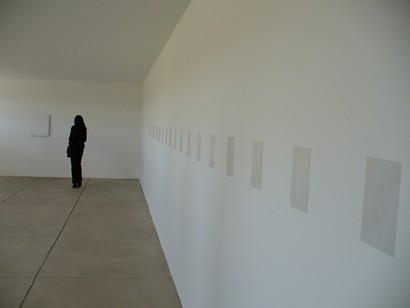
Arnarsson, John Wesley, Ilya Kabakov and others. Mr. Arnarsson's exhibit,
Untitled Works 1991-1992, is ghost-white, a rectangular room
with thirty-six, grey, frameless drawings that seem to hang suspended
from the walls like phantasms. At either end are two concrete rectangles
painted white, the focal points of the room. The entire work projects
a deceptive warmth with an underlying fragility. |
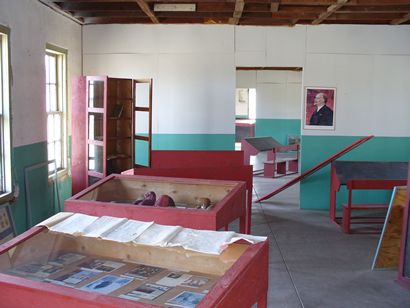 |
Mr. Kabakov's
installation is much less abstract. School No. 6 is a study
in Kabakov's childhood, Soviet era memories. The entire work is a
representation of a failed and abandoned schoolroom. Scraps of paper,
photographs, magazine articles, musical instruments and faded, broken
furniture are strewn about the floor. The Foundation's intern and
tour guide asked all of the visitors to, "please [not] touch anything.
Even the dirt is placed exactly where the artist wants it". Indeed,
the courtyard of the U-shaped building includes grasses and weeds
that are let alone to further add to the perception of rejection and
neglect.
The
Chinati Foundation opened in 1986 and since that time Donald Judd
has become the same sort of totem for Marfa,
Texas that John Steinbeck became for Salinas, California. I am
quite sure that if Marfa were large enough to warrant a Chevrolet
dealership, the name Judd would certainly blaze across the façade.
In fact, the town, at one time a backwater that hung precariously
close to extinction, has witnessed a re-flowering with the migration
of affluent artists from all over the country. My wife and I noticed,
with some trepidation, the similarities between Marfa
and south Austin. Remodeled,
split-level, tri-colored studios are replacing the prairie homes as
quickly as the west Texas wind can blow them in. Perhaps unfortunately,
the wind is simultaneously blowing the veteran residents to parts
unknown. Counting the for sale signs (our count was 16 in one
section of town) was a lesson in applied mathematics; many Marfans
are taking full advantage of the swell in housing prices. |
 |
|
Between tours at
the Foundation we headed west on highway 90 towards the town of Valentine.
About thirty minutes from Marfa,
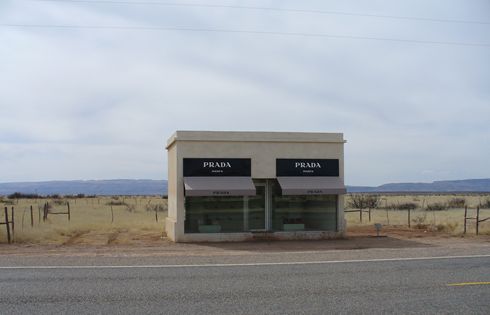
many know the area today as the overseer of the Prada
Marfa, a permanent art installation that has the semblance of
being an outlet of the famous Italian boutique. Designed and erected
by Berlin-based artists Michael Elmgreen and Ingar Dragset, the work
contains six handbags and fourteen right shoes, hand picked by Miuccia
Prada herself. Originally "opened" in October 2005 (and badly vandalized
three days later) the structure appears as out of place in the chaos
of west Texas' ranch lands as the camel we saw, grazing alongside
longhorns, just south of town. |
The
Chinati Hot Springs are run by the husband and wife team of Krissy
and David Fines. Both are transplants from Dallas'
Deep Ellum area. Asked by a friend four years ago if they wanted
a, "life changing experience" they accepted the challenge and have
been living at the Springs ever since. Both told us that a recent
story about the Springs on Texas Country Reporter has increased
business like never before. "The phone rings constantly now," David
proclaimed.
The couple were more welcoming and warm than anyone we encountered
on the trip. When I told them about the Border Patrol stop, Krissy,
looking towards her husband, produced a preemptive, knowing smile
to allay the controlled rage that she knew was stewing inside David.
Evidently, he had had some of his own unpleasant encounters with the
local Patrol. |
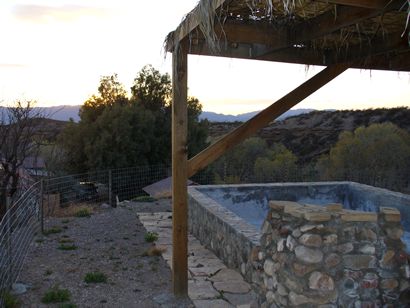 |
Near the end
of our second night at the Chinati Hot Springs, Krissy led my wife
and I to the newest addition at the resort--a 15' x 20' pool situated
on the hill behind the office cabin. Krissy was obviously pleased
with the pool and after sharing her satisfaction, left us to admire
the embers of the setting sun from this new citadel.
The following morning we reluctantly packed and I made a last stop
at the kitchen cabin in search of coffee. All I found were the paper
towels that I had to use trying to clean up the mess I made while
attempting to brew the day's first pot. No one would be thanking me
for this. |
 |
| Leaving
the resort, we passed, once again, the Pinto Canyon Road detour that
we had been so easily swayed from a couple of days before; literally,
we had come to a crossroads. David had told us the previous day that
a van had made the trip through the pass only recently and, encouraged
by this information (I wasn't about to let a minivan outclass
our rental) we decided to give it a try. Besides, Krissy had mentioned
a few times that the road was, "just beautiful" and not to be missed.
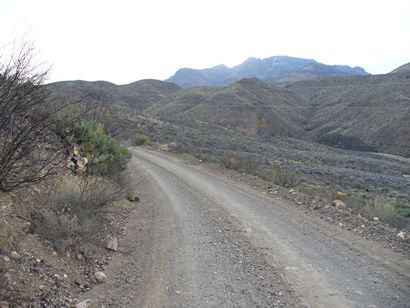
Truer words have rarely been spoken. Driving the route in the early
morning's light was an ethereal experience. We rolled down a dirt
path and up into the canyon on a smooth, sandy trail, crossing streams
and draws, over divots and rocks. The mountains embraced us on either
side and we felt completely relaxed and assured in their company.
Even my constant anxiety about being blind-sided by deer ("buck-shot"
as a friend of mine calls it) was mollified by this extraordinary
landscape. The proverbial cream was the fact that the Chinati Mountain
was still snow capped from a storm over a week prior. We stopped the
car twice to get a better view from outside. Just as with the stars
a couple of nights earlier, my wife and I found ourselves voluntarily
abandoning speech as a method of communication; there was simply no
need. |
 |
Pinto Canyon
Road, mountain and stream
Photo courtesy Byron
Browne, 2006 |
The
Chinati Hot Springs is a "peaceful and restorative place" according
to the brochure. I assume that this might be an adequate description
from someone who has been there more than once and become accustomed.
To the uninitiated it is near heaven. The Chihuahan desert is an area
of Texas that is surreal, detached from
our usual, suspected realities. The divine inclusion of the hot springs
only augments the majesty. In fact, all things Chinati, whether the
Springs, the museum, or even the mountain, guarantee obsequious attention,
an unspoken devotion. In fact, if I ever open my own business, I'll
brand the word across the front of the building knowing that the initiates
will come.
May 6, 2007
© Byron
Browne
Special thanks to. Ballroom Marfa, Emilia and Ilya
Karbakov and Ingólfur Arnarsson for photo permissions. Many thanks
also to the Chinati Foundation's Director Nick Terry. |
|
|
 HOME
HOME


