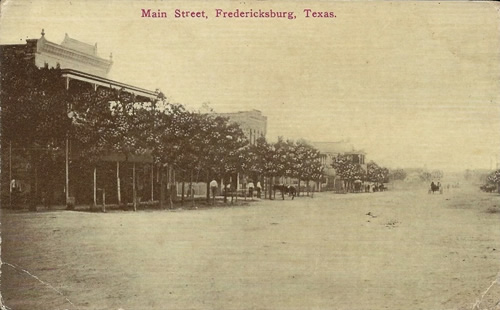
|
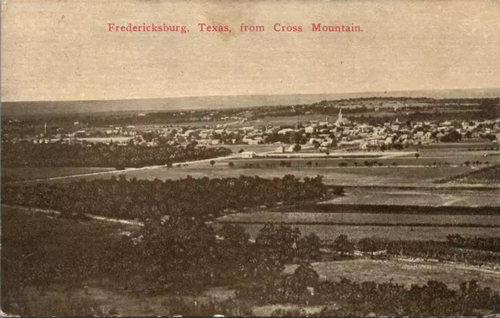 |
History in
a Pecan Shell
Named in honor
of Prince Frederick of Prussia, Fredericksburg had been the inland
destination of the German immigrants who came to Texas through the
port of Indianola. John O. Meusebach left New
Braunfels in the summer of 1845 to survey the area with the first
120 settlers arriving the next spring.
The trip which now takes an hour took the settlers 16 days.
After the town was platted, each family settler received a town lot
and ten acres outside of town. plan was a replica of the villages
back in Germany. The earliest houses were log cabins that were soon
replaced with Fachwerk buildings.
Despite an epidemic that killed a tenth of the settlers, Fredericksburg
soon had a respectible population of nearly 1,000. A road was built
connecting Fredericksburg and Austin;
and John Meusebach brokered a successful treaty with the Comanches.
|
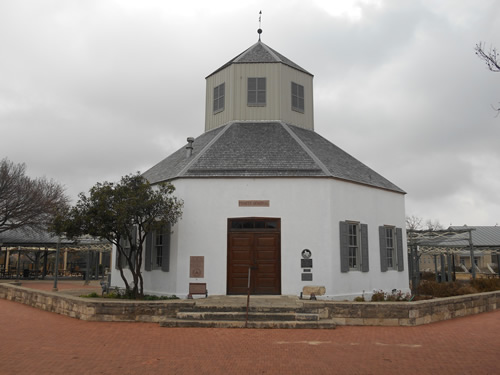 |
Frederickburgs most important building was the Vereins-Kirche.
Before it was razed in 1897, the structure had served as fort, church,
school, and town hall. Restored in 1936 for the Centennial, the replica
building now serves as offices for the Gillespie County Historical
Society.
Religious services had all been held in the Vereins-Kirche, until
1848 when Catholics built their own church. |
| Photo
Courtesy Shannon Yarbrough, May 2005 |
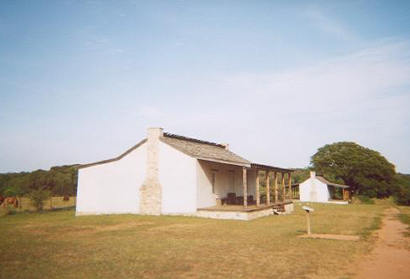
The
United States Army established Fort
Martin Scott, which became a boon to the local economy. Once cannibalized
for its building stone, the fort is now defined by a reconstructed
building - with more planned. Soon after the Texas legislature made
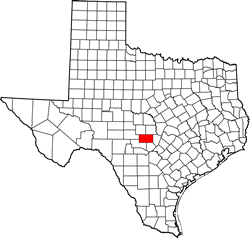
Fredericksburg the Gillespie
county seat.
The Forgotten
Indian Traveler by Mike Cox
The men were Richard Irving Dodge, a young Army officer who would
serve in the military for 41 years and John Conner, a noted Delaware
Indian. The meeting happened at Fort Martin Scott...
Thirty years went by before Dodge got around to writing about his
experiences at Fort Martin Scott in his classic book, “The Wild Indians.”
The first newspaper appeared (in German) in 1877, and it wasn't until
after 1900 that were the first purely English-speaking teachers employed
in Fredericksburg's public schools.
The first Gillespie County Fair (also believed to be the first in
Texas) was held at Fort Martin
Scott in 1881. By 1904 the population was 1,632. The San Antonio,
Fredericksburg and Northern Railway, arrived in November of 1913.
The railroad later became the Fredericksburg and Northern and stayed
in business until WWII.
In 1928 citizens voted to incorporate. Up until then Fredericksburg
had been the largest unincorporated town in the United States. It
participated in a census for the first time in 1930 (giving a number
of 2,416).
Fredericksburg became the counties manufacturing center and local
quarries supplied both granite and limestone. The Gillespie County
Historical Society was founded in 1934 to preserve local history and
traditions.
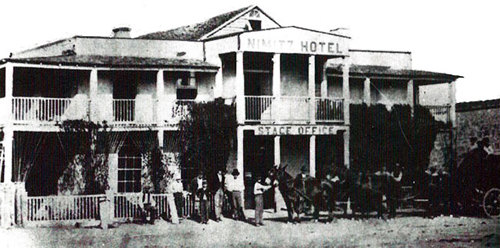
Another historic building is the former Nimitz
Hotel - the boyhood home of Admiral Chester Nimitz, Commander
of the Pacific Fleet during WWII.
|
Fredericksburg,
Texas
Landmarks / Attractions
|
|
The Fredericksburg Historic District was added to the National Register
of Historic Places in Texas on October 14, 1970. |
|
|
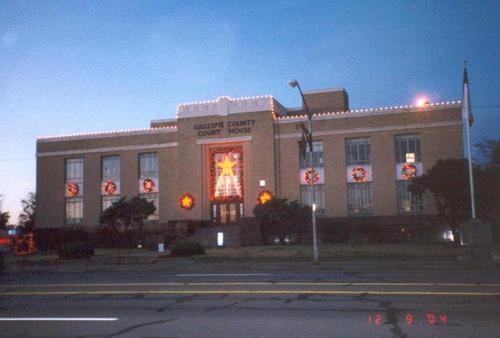
The
1882 Gillespie County Courthouse now used as the Gillespie County
Library.
Photo Courtesy Shannon Yarbrough |
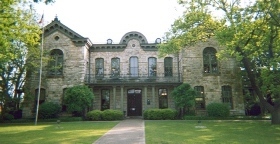
The
Former Gillespie County Courthouse c.1882
On the Public Square near the current courthouse.
Designed by Alfred
Giles, English Architect turned Texas Sheep Rancher
"...with its formal balance, heavy decorative consoles, and Classical
roof slopes, [it possesses] the dignity characteristic of Renaissance
Revival buildings." - Williard B. Robinson, Texas Public Buildings
of the Nineteenth Century |
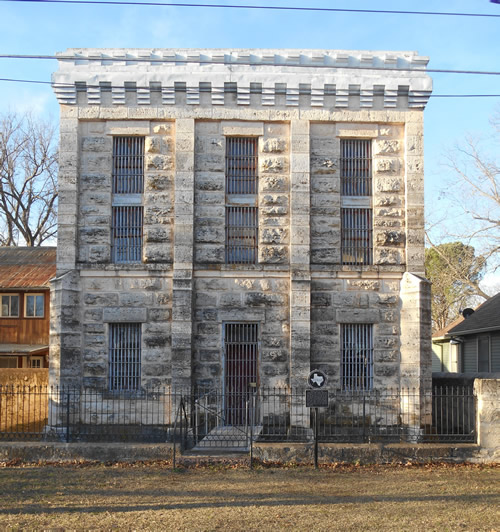
The 1885 Gillespie
County Jail in Fredericksburg
Photo courtesy Michael
Barr, January 2021 |
The Jail Wall
Photo Courtesy Shannon Yarbrough, May 2005 |
|
|
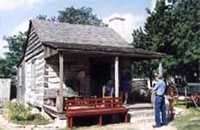
Authentic
cabin relocated to Pioneer Museum Complex on Main Street
Courtesy
of Sandy Fiedler |
From
"Blending
German Colonization with Modern Tourism " by Sandy Fiedler:
"Today Main Street shows off dozens of marvelous shops for collectibles,
antiques, crafts, etc. There are German restaurants, beer gartens,
and bakeries (with shortbread, baked meringue, kolaches). The pleasing
scents of candles fill the nostrils. Unobtrusive doorways lead to
mysterious courtyards. Many of the ubiquitous historical markers are
noticeable only if you are on foot in this understated, rich historical
district. Churches stand all over the town like watchtowers of strength." |
|
|
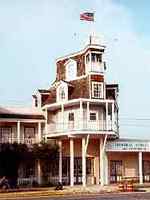
Admiral
Nimitz State Historic Site - National Museum of the Pacific War
P O Box 777
Fredericksburg TX 78624
830/997-4379
Courtesy
of Sandy Fiedler |
"On Main Street is the Admiral Chester Nimitz Museum and Historical
Center. Fredericksburg is proud to be the birthplace of Nimitz, Fleet
Admiral of the Pacific Forces in World
War II. This museum is part of the National Museum of the Pacific
War with the new George Bush Gallery.
"There are many bed and breakfast establishments and motels-there
are no bad places to stay in Fredericksburg," voiced one resident.
"Everything is clean and safe."
...You can regain a sense of what it used to be if you start with
a tour of the Pioneer Museum Complex on Main Street in Fredericksburg.
A Founders' Day Festival is held there every May."
© Sandy Fiedler |
| Photo
courtesy Texas Transportation Museum in San Antonio |
| Photo
courtesy courtesy Gillespie County Historical Society |
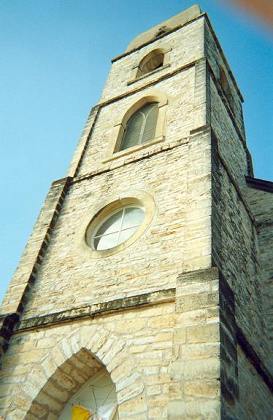
Marienkirche
(Old St. Mary's Church)
Photo
Courtesy Shannon Yarbrough |
Marienkirche
(Old St. Mary's Church) c. 1848
Built under the direction of Benedictine priest Peter Baunach, the
church was built by its members.
According to architectural historian Williard B. Robinson, "the aisles
were paved by soapstone flagging, but the floor under the pews was
covered with sand." |
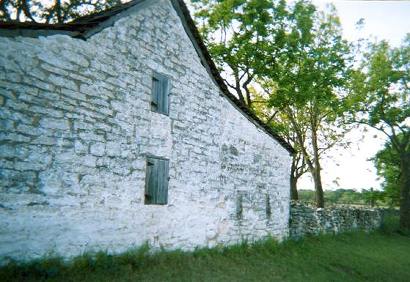
Hohenberger Homestead
Another example of German masonry.
Photo Courtesy Shannon Yarbrough, May 2005 |
|
|
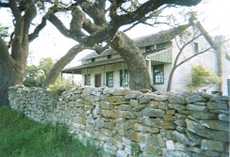
Stone
walls remain as noteable landmarks for Fredericksburg.
Photo Courtesy Shannon Yarbrough, May 2005 |
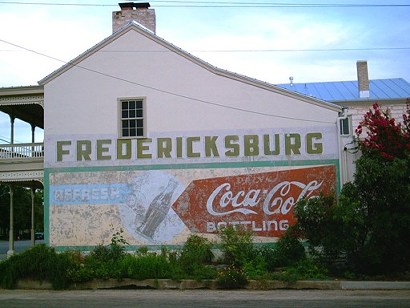
A Coca Cola sign
in Fredericksburg
Photo courtesy Shannon Yarbrough |
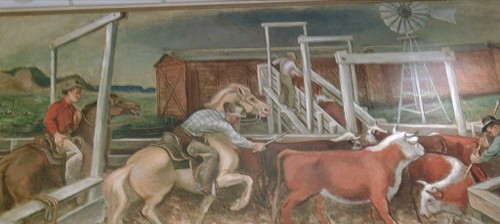
Fredericksburg's
Post Office Mural "Loading Cattle" by Otis Dozier, 1939
Photo
Courtesy Shannon Yarbrough, 5-2005
More Post Office
Murals |
Fredericksburg
Chronicles:
|
Magic
Moments with Satchel Paige by Michael Barr
The legendary pitcher Leroy "Satchel" Paige 10-1-23
Lady
Bird's Gift to St. Barnabas Church by Michael Barr 8-5-23
The
Girl Scout Cabin by Michael Barr 7-15-23
Cool
Times at the Ice House by Michael Barr 6-15-23
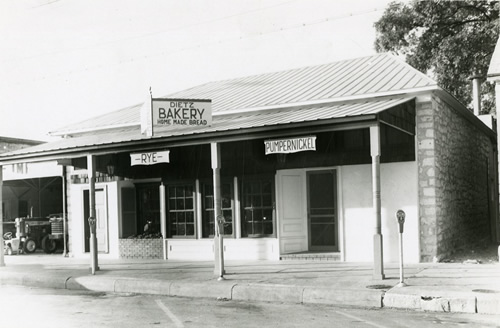
Bakeries
Rise to the Occasion by Michael Barr 6-1-23
Towns
and Parking Meters: A Complicated Relationship by Michael Barr
5-1-23
Early
Aviation was Exciting and Dangerous by Michael Barr 4-1-23
Sober
Thoughts on Prohibition by Michael Barr 3-15-23
On
the Road with Basse Express by Michae Barr 2-14-23
By 1960, Basse Express diesel trucks made the 70 mile one-way trip
from San Antonio to Fredericksburg in a couple of hours hauling
everything from thumb tacks to toilet paper.
German
Christmas Past by Michael Barr 12-20-22
Runaway
Horse is Page 1 Story by Michae Barr 11-22-22
A
Pine Forest in the Hill Country by Michae Barr 11-15-22
If you've ever wondered about the quiet stand of lanky pine trees
behind Fischer and Wieser's Das Peach Haus and Dietz Distillery
on US Highway 87 South, you're not alone. It's another strange and
wonderful oddity that makes the Texas Hill Country such a fascinating
place.
Walter
Cronkite in Fredericksburg by Michael Barr 11-8-22
Beer
Wars by Michael Barr
Early
Radio - Window to the World by Michael Barr
Robert
Penniger: Early Editor of the Fredericksburg Standard by Michael
Barr
Checking
In With John Ostrow by Michael Barr
Fredericksburg's
Tourist Park by Michael Barr
Strolling
Through the Gillespie County Fair by Michael Barr
Christmas
in Fredericksburg - a Community Celebration by Michael Barr
Football
Comes to Fredericksburg by Michael Barr
July
4 in Fredericksburg by Michael Barr
A
Hidden Message in Fredericksburg Street Names by Michael Barr
In
and Out of the Old Gillespie County Jail by Michael Barr
Spanish
Flu Didn't Play Fair by Michael Barr
Making
Out at the 87 Drive-In by Michael Barr
The
Tower Drive-In by Michael Barr
The
Domino Parlor by Michael Barr
Sunny
Side Hut by Michael Barr
The
Location of Fredericksburg a Twist of Fate by Michael Barr
Vereins
Kirche: The Symbol of Fredericksburg by Michael Barr
Celebrating
the Vereins Kirche by Michael Barr
Crazy
Local Politics by Michael Barr
Fredericksburg, Texas in the early 20th century was believed to
be the largest unincorporated village in the country...
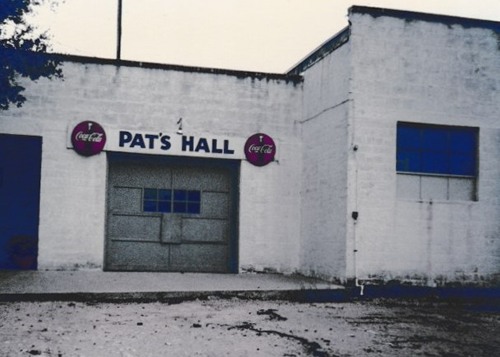
Peter's
Hall by Michael Barr
Krauskopf's
Gun Cap Factory by Michael Barr
Making
Leather at Itz Tannery by Michael Barr
Post
Office Mural by Michael Barr
Superior
Hospital Care Didn't Happen Overnight by Michael Barr
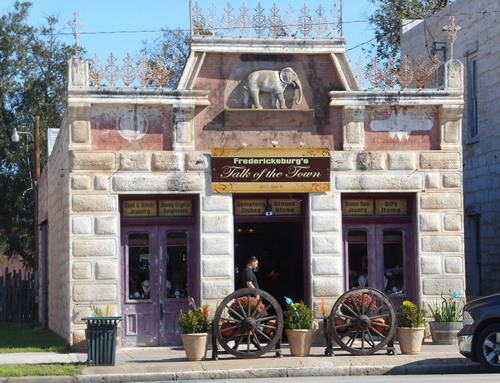
The
White Elephant Saloon by Michael Barr
The White Elephant Saloon at 242 East Main Street in Fredericksburg
may have been the classiest joint of any saloon in Texas that carried
the name. John Kleck built it in 1888...
Balanced
Rock by Michael Barr
Broccoli
Sign Stops Bush Motorcade by Michael Barr
Legends
and Giants by Michael Barr
The Germans who settled the Texas Hill Country took to baseball.
By the 1920's, small towns all over Gillespie and surrounding counties
had adult baseball teams. There were once 23 different adult baseball
teams in Gillespie County alone.
Female
Athletes Confound Experts by Michael Barr
Fredericksburg High School Girls Basketball Team
The
Turn Verein by Micharl Barr
"The Germans believed a balance of hard work, fun and healthy
living produced good citizens, and they didn't leave such things
to chance. They organized clubs, like the Turn Verein, to develop
skills for a robust and patriotic society.
Friedrich Ludwig Jahn, a Prussian educator, patriot and gym junkie,
encouraged schools to teach classes in physical education. He even
devised new exercises and gym equipment (parallel bars, side horse,
balance beam) while teaching school in Berlin...."
The
Fredericksburg Railroad by Michael Barr
Fredericksburg waited 30 years for the railroad, but when the train
arrived it was a day late and a dollar short...
Banker
Smith by Michael Barr
Fredericksburg believed in Banker Smith. His word was gospel. He
got things done. Banker Smith is best remembered as the driving
force behind the Fredericksburg Railroad. He spent years of his
life and a considerable part of his wealth, bringing the railroad
to town.
Marking
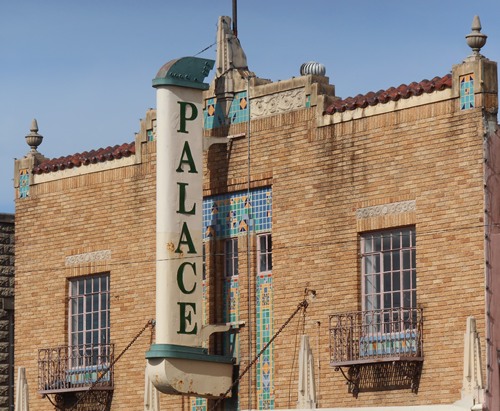
Time at the Palace Theatre by Michael Barr
The Palace Theatre marked time in Fredericksburg for most of the
20th Century. The grand old movie house was a part of the fabric
of the community.
Vaudeville
- Not Just a Naughty French Word by Michael Barr
The
Popularity of Polo by Michael Barr
Fredericksburg was the smallest town in the country with a polo
club sanctioned by the American Polo Association.
Fredericksburg
in the Roaring Twenties by Mike Cox
Fredericksburg was just a small county seat town barely three generations
removed from its founding by German immigrants when civic leaders
first began to understand the importance of tourism...
Street
Name Trivia by Joe Foster
The first letters of streets intersecting Main Street heading southeast
from the center of town spell "ALL WELCOME"...
The first letters of streets intersecting Main Street heading northwest
from the center of town spell "COME BACK". more
Bats
by Clay Coppedge
As it is and has been, about 100 million bats, mostly Mexican free
tail bats, make their summer homes in Texas.
The bats love Texas for the same reason a lot of people do: geography
and climate. Bats love caves and the state has some 3,000 caves
and sinkholes though most of the bat colonies are concentrated in
about two dozen of those caves. Bracken Cave near Fredericksburg
has a thriving metropolis of 20 million bats, the largest known
bat colony in the world. Those 20 million bats can eat 200 tons
of insects in a single night, including mosquitoes and agricultural
pests that plague cotton and
corn crops.
more
Nine
Pin Bowling by Michael Barr
Skat
by Michael Barr
Pioneer
Mills by Michael Barr
Guenther bought land along the banks of Live Oak Creek where he
built an earthen dam and a millhouse. The site of Guenther's mill
is just north of the Live Oak Creek bridge on Highway 16, between
the bridge and Lady Bird Johnson Park.
Walking
by Wanda Orton
The
Luckenbach World's Fair by Michael Barr
The 1973 World's Fair began as a hair-brained idea in the minds
of Luckenbach's owners, Hondo Crouch and Guich Koock.
They staged the second semi-annual Luckenbach World's Fair at the
old Fair Grounds in Fredericksburg. more
Hoodwinked
by Hollywood by Michael Barr
The filming of Strawberries Need Rain in Fredericksburg &
Gillespie County.
Robbing
the Fredericksburg Stage by Michael Barr
A Jail Without Walls by Michael Barr
Those
Crazy Flying Machines by Michael Barr
Basse
Block by Michael Barr
Anyone who has walked Fredericksburg's historic district has noticed
a number of homes and commercial buildings constructed of an unusual
building material that looks like cut stone but is really a prefabricated
concrete block known as Basse block.
The
Nimitz: Hotel with a History by Michael Barr
Priceless
Memories of Bob Hope by Michael Barr
Gillespie
County Goat Becomes Navy Mascot by Michael Barr
Alter
Stolz Solves an Image Problem at FHS by Michael Barr
The
Magic of Radio by Michael Barr
The
Hypnotic Power of Television by Michael Barr
A
Disturbance on Creek Street by Michael Barr
Arrested for carrying a pistol unlawfully
|
People
The
Priest and the President by Michael Barr 1-1-24
Sheepherder
Ciano Val Verde Marschall by Michael Barr 12-15-23
Some
Smokey Klaerner Stories by Michael Barr 12-1-23
"Legends don't come along very often, but Gillespie County
Sheriff Alfred 'Smokey' Klaerner certainly qualifies."
Coach
Chester Klaerner by Michael Barr 10-15-23
Col.
Otto Wahrmund - Beer Business Icon by Michael Barr
German
Artists Draw First Hill Country Images by Michael Barr
Had artists Hermann Lungkwitz and Richard Petri stayed in their
native Germany, their names may have been buried under an avalanche
of other artists with similar training and talent. Instead they
came to Fredericksburg, where their drawings and paintings became
some of the first pictorial records of the Texas Hill Country.
Making
House Calls with Dr. Keidel by Michael Barr
August
Seimering and the Forty-Eighters by Michael Barr
Max
Hirsch - Wizard of the Race Track by Michael Barr
Max Hirsch, the dean of American horse trainers, sat in the clubhouse
at Belmont Park on Long Island, New York and reminisced about his
first race as a jockey. It was a Sunday afternoon match race down
Main Street in Fredericksburg, Texas
Colorful
Judge Cooley by Michael Barr
Emil
Sauer - Diplomat and Adventurer by Michael Barr
Emil Sauer, a gracious and scholarly American diplomat, was also
a world traveler and adventurer who explored exotic places. He was
part Henry Kissinger and part Indiana Jones.
Sheriff
Klaerner, Dan Hoerster's Hat and the Blind Horse
A
German Love Story by Michael Barr
Friedrich and Emma Schnerr of Fredericksburg, and a tombstone by
Elisabet Ney
O.
Henry in Fredericksburg by Michael Barr
Peter
Berg Hermit of the Hills by Michael Barr
The story of Peter Berg and his sweetheart ranks right up there
with Romeo and Juliet, Antony and Cleopatra and Brad and Jenn on
the list of the most timeless and tragic love stories ever told.
Freedom
for Millie Tinker by Michael Barr
Amelia "Millie" Tinker was born a slave around 1813.
Who
was Dr. Schubbert? by Michael Barr
Although he led the colony during its most vulnerable time, there
is little about him in the history books. He's like the crazy old
uncle nobody talks about.
|
Fredericksburg,
Texas Related Stories
Hardin
Ranch Rodeo - Early Rodeos Were Thrilling and Dangerous by Michael
Barr
The best known Hill Country rodeo in the early years was the Wild
West Rodeo and Roundup held at the Hardin PL Ranch 21 miles northwest
of Fredericksburg near Willow City.
Willie
Molter: An Eye for Horses by Michael Barr
The
Meusebach-Comanche Treaty by Jeffrey Robenalt
In early spring of 1847, a remarkable treaty between German settlers
and Native Americans was negotiated on the banks of the San Saba
River in the hill country north of Fredericksburg, Texas.
Meusebach's
Nursery in Loyal Valley by Michael Barr
The Little Engine That Couldn't by C. F. Eckhardt
The Fredericksburg & Northern Railroad
"... Even after the War, with much improved roads and a much
lessened Indian problem, it still took freight wagons the better
part of a week to travel from San Antonio to Fredericksburg... The
people north and west of San Antonio wanted and needed a railroad...
more"
70
Miles of Bad Road by Michael Barr
A trip by car from Fredericksburg to San Antonio in the early 20th
century was not undertaken on a whim. In fact trip was too simple
a word to describe the experience. It was a journey filled with
surprises around every turn, attempted only by eccentric adventurers
who enjoyed living dangerously.
|
Fredericksburg
Area Natural Attractions
|
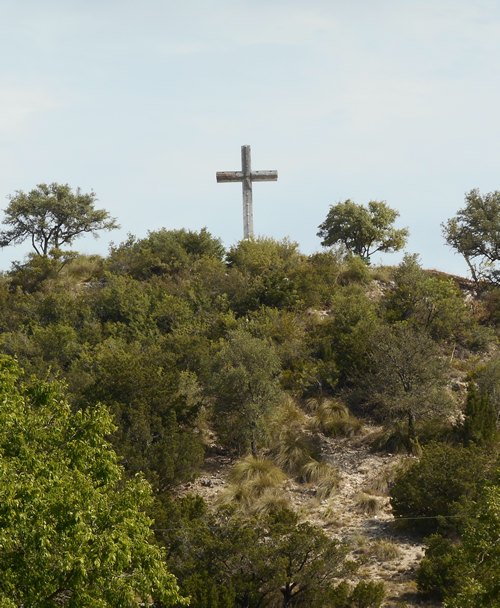
| Photo
by Michael Barr, August 2018 |
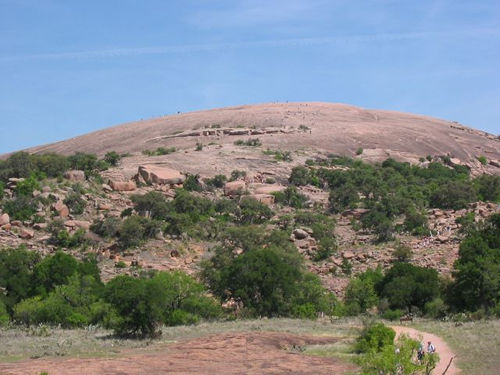
Claygate,
April 14, 2006
Wikimedia Commons |
| Texas
Escapes, in its purpose to preserve historic, endangered and vanishing
Texas, asks that anyone wishing to share their local history, stories,
landmarks and recent or vintage photos, please contact
us. |
|
|
 HOME
HOME