|
|
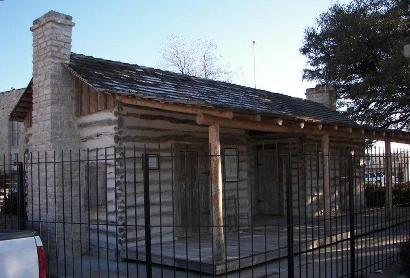
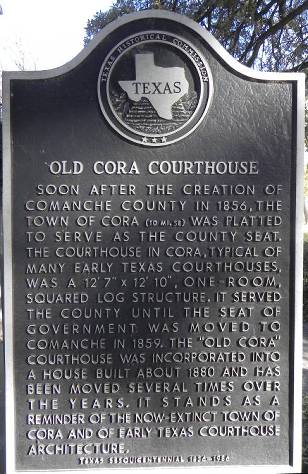
"Old Cora"
on Comanche courthouse square
Photo
courtey Terry
Jeanson, 2007 |
The
1936 Texas Centennial Marker near the city of Comanche
says the county was thus named for those raiding warriors of the Plains
because of their "superb horseman[ship]" and courage, as well as being
"the terror of Texas frontier settlers who dispossessed them of their
hunting grounds." With that in mind, we went to the county's 1856
courthouse as we looked in awe at a structure that has withstood time
and the elements, as well as the best intentions of man.
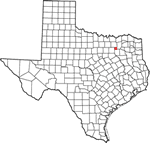
Although the citizens of Comanche County, created on January 25, 1856,
had chosen the name of Troy for their county seat, they were
affronted since there already was such a town in Texas. Local land
agent Thomas Frost submitted several other names to the Postal Department,
with the name "Cora"
winning out. Cora was the name of the eldest daughter of Major Alonzo
Beeman of Moffatt, Bell County, who must have been a good friend of
Frost's at the time. Thus the county seat became Cora.
The 1856 split-log, one-roomed courthouse served as a post office
(Frost was its postmaster) as well as district court. One of its early
trials concerned three men, Asa Reed, Jesse Reed, and John Taylor,
who were accused of murder. Folks from all around attended the trial
wherein it was found that Asa was innocent because Jesse had done
it. Justice could not be served, however, because Jesse skipped town
and was never seen again. (Or maybe justice was served.) |
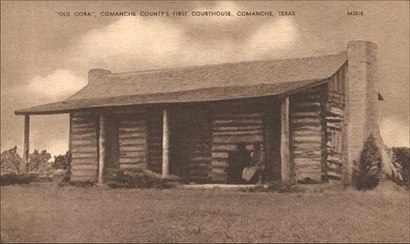 |
"Old Cora"
Postcard courtesy www.rootsweb.com/ %7Etxpstcrd/ |
 |
Right
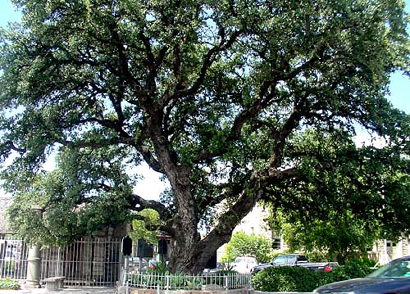
about this time in 1858, Martin Fleming, then a boy, enjoyed camping
in a grove under the branches of a particular live oak tree. Fleming
had previously befriended several young Comanches, but on this occasion,
hundreds others, who had had it with encroaching settlers, were on
the warpath. As the angry warriors sped in on horseback, Fleming hid
behind this old oak, ultimately saving his life. In 1912, the grove
was being destroyed as the city of Comanche
took shape, but a much older Fleming put up a fight to save "his tree."
His haven was spared and now stands as a place of honor on the courthouse
square.
When the county seat was moved to Comanche
in 1859, the Cora courthouse was developed into a two-roomed residence.
Because of its historic significance, it was later bought and moved
bit by bit to the municipal park at Lake Eanes where the Statue of
Justice from the county's 1890 Victorian courthouse was also removed.
Eventually, Old Cora was moved to its present location on the southwest
corner of the courthouse square right next to Fleming
Oak. |
 |
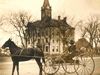
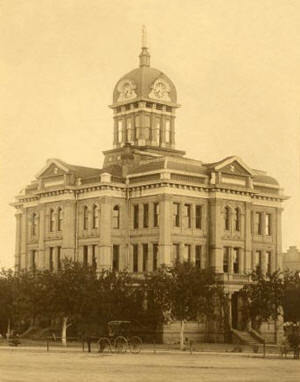
The 1890 Comanche
County Courthouse, razed
Photo courtesy texasoldphotos.com |
| The outstanding
1890 courthouse, designed by Jacob Larmour, followed two other
courthouses erected between 1859-1890. This palatial structure was
three stories high. Atop its clock tower was the aforementioned Statue
of Justice. |
|
|
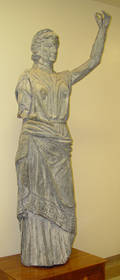
The
one-armed 1890 Statue of Justice.
Photo
courtesy Lou Ann Herda |
This
Statue of Justice met with many unfortunate injustices. Once,
in 1897, a proprietor of a local Comanche store demonstrated to onlookers
the sharp shooting capabilities of his new shipment of rifles. He
"stepped outside into the daylight for the benefit of his patrons"
and was dared to " shoot the arm off the lady of Justice." Although
the right arm of the law was made of 3-32"-thick lead alloy sheet
metal, his shot was accurate. In 1908, her scale of Justice flew off
during a storm. In later years, as the courthouse was being razed
and she was taken down, workers noticed two bullet holes in her neck.
That was not long before they discovered a colony of bees inside.
The one-armed, scale-less lady can now be seen in the foyer of the
1940 courthouse.
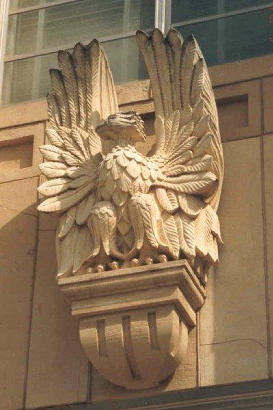
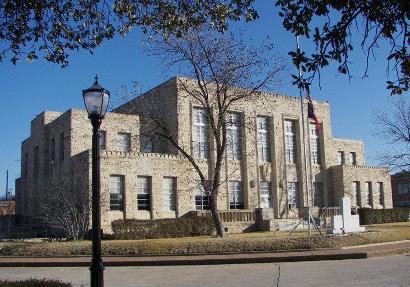
The 1940 courthouse, designed by Wyatt C. Hedrick, was built
during the Works Progress Adminstration (WPA). This courthouse is
built of native stone quarried out of Logan's Gap. A pair of the most
beautiful eagles adorns the entrances. |
 |
|
March 2003,
© Lou Ann Herda, Ed. D
Special thanks goes to one of our most favorite people, Margaret
Waring, Comanche librarian and historian extraordinaire, for gracing
us with her time and wisdom while we were there. She stands taller
than any we've encountered.
All quotes, as well as most information, were taken from the 1969
Comanche County Courthouses by Frances B. Lockwood. (Ms. Lockwood
incidentally dedicated her book to Mrs. Waring for her "interest
in the history of Comanche County, her perseverance in digging out
the facts of that history, and preservation of historical material
in the library's files.")
Book Hotel Here > Comanche
Hotels
|
|
|
 HOME
HOME