|
| Dillon's
entry in the Handbook of Texas contains only the most basic
facts. Less than 40 words. "Settled around 1900" a post office was
"secured" in 1903 and discontinued three years later. By the 30s it
was gone from maps. That's it. Hardly worth a mention. We were fortunate
to receive an email from Robert Cowser, a former Texan living in Tennessee
who saw firsthand the evidence of Mr. Dillon's unfulfilled dreams.
No one can remember a place like someone who grew up there so it's
altogether fitting that Mr. Cowser's remembrance provides our page
for Dillon, Texas. |
Dillon, Texas
by Robert
Cowser
A few years ago I drove from my home in Tennessee to visit the farm
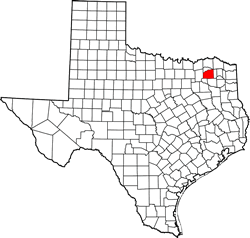
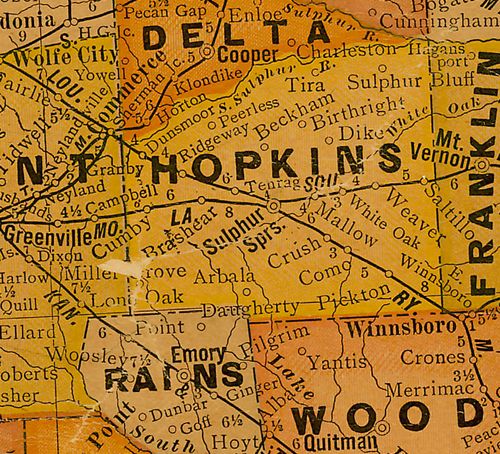
in Hopkins County
where I spent the first eighteen years of my life. The farm is the
site of what once was community called Dillon. In the 1890s Frank
Dillon, an emigrant from Indiana, worked hard to found a town on his
property. He built a blacksmith shop, a store, and a kiln. A grassy
mound still exists where the kiln once stood. With his neighbor, O.
P. Wardrup, as a partner, Dillon operated a cotton gin.
For five or six years at the beginning of the twentieth century Dillon
operated a post office out of his store. A courier in a horse-drawn
buggy brought the mail from the Saltillo
depot five miles to the north. As one might expect, the post office
was named Dillon. As automobiles became more and more common, Dillon
talked of converting his blacksmith shop to a garage. He sent one
of his sons to a school in Dallas
for training in auto mechanics.
Primarily because neither the St. Louis Southwestern nor the Louisiana
and Arkansas railroads came near the site of the store and shop, Dillon's
efforts to build a town failed. That morning, as I looked at the peaceful
site, I felt strangely pleased that the town never developed. Even
if he had been able to convince a builder to put up a row of buildings,
the town probably would not have survived the Great Depression. Locust
trees and Bermuda grass now grow over the site where Dillon's house,
store, blacksmith shop, cotton gin, and kiln once stood.
See Columns by Robert
Cowser |
 |
| Texas
Escapes, in its purpose to preserve historic, endangered and vanishing
Texas, asks that anyone wishing to share their local history, stories,
landmarks and recent or vintage photos, please contact
us. |
|
|
 HOME
HOME

 Texas
Gulf Coast
Texas
Gulf Coast East
Texas
East
Texas Central
Texas North
Central
Texas North Central
Texas South
Central
Texas South Texas
Panhandle
Texas
Panhandle South
Texas
South
Texas Texas
Hill Country
Texas
Hill Country West
Texas
West
Texas Texas
Ghost Towns
Texas
Ghost Towns Texas
Counties
Texas
Counties