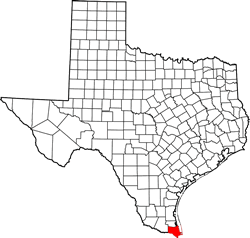
|
Battle Of Palmito
Ranch Historical Marker
Route 4 (Boca Ricia Road)
about 12 miles east of Brownsville
Photo courtesy Ken
Rudine, February 2007 |
Historical Marker:
BATTLE OF PALMITO
RANCH
The last land engagement
of the Civil War was fought near this site on May 12-13, 1865, thirty-four
days after Robert E. Lee surrendered at Appomattox.
Col. Theodore H. Barrett commanded Federal troops on Brazos Island
12 miles to the east. The Confederates occupied Fort Brown 12 miles
to the west, commanded by Gen. James E. Slaughter and Col. John S.
(Rip) Ford, whose troops had captured Fort Brown from the Federals
in 1864.
Ordered to recapture the fort, Lt. Col. David Branson and 300 men
advanced from Brazos Island. They won a skirmish with Confederate
pickets on May 12. Barrett reinforced Branson's troops with 200 men
on May 13 and renewed the march to Fort Brown. Confederate cavalry
held the Federals in check until Ford arrived with reinforcements
that afternoon. Ford's artillery advanced and fired on the northern
end of the Federal line while the cavalry charged. The Confederate
right charged the southern end of the Federal line and captured part
of the Union infantry. Barrett ordered a retreat toward the U.S. position
on Brazos Island. While the Confederates reported no fatalities in
the Battle of Palmito Ranch, the Union forces reported four officers
and 111 men killed, wounded or missing.
1963 |
BATTLE OF PALMITO
RANCH
On May 13, 1865,
the last land action of the Civil War took place here, more than a
month after Lee's surrender at Appomattox. The Confederates forces
knew of the surrender since May 1, when a New Orleans newspaper was
tossed from a boat on its way to Brownsville
to soldiers at Palmito Ranch. On May 9, 1865, Confederate Lt. Gen.
Edmund Kirby Smith, stated that he proposed to continue fighting.
On May 11th, under the cover of darkness at Boca Chica Pass, 300 Union
troops crossed to the mainland in an attempt to occupy Brownsville.
After a forced march, they reached White's Ranch at dawn and attempted
(unsuccessfully) to conceal themselves to rest. With the element of
surprise gone, the troops openly marched toward Brownsville
but didn't get far.
At Palmito Ranch they were confronted by a Confederate force of 190
members of Lt. Col. George H. Giddings's Texas Cavalry which resulted
in a brief skirmish. Both forces disengaged with the Union force camping
for the night. The Confederates attacked at 3 a.m., forcing the Union
troops to return to White's Ranch.
Early on May 13, 200 reinforcements arrived, bringing the Union strength
up to 500. This larger force moved on Palmito Ranch where the major
battle took place. The outnumbered Confederate received succor late
that afternoon, from Colonel "RIP" Ford's Second Texas Cavalry, and
a six-gun battery of field artillery.
The flat, open land gave the advantage to the Confederate mounted
cavalry and the Union troops were routed. A seven-mile running fight
to Brazos Island ensued - and there the Federal troops were met by
reinforcements, now causing the Confederates to retreat.
Since everyone knew the war was officially over, this may have seemed
to Ford to be a good note to go out on. He addressed his troops, saying,
"Boys, we have done finely. We will let well enough alone, and retire."
The four hour battle left a score of Southerners wounded, but the
Union fared much worse. Thirty men were killed or wounded and over
a hundred were taken prisoner. A few days later a truce was signed.
This seemingly minor see-saw confrontation may have been small by
comparison with the Civil War's major battles, but it won a footnote
in history by being the last land fight of the war - one that was
won by the losers. |
| Texas
Escapes, in its purpose to preserve historic, endangered and vanishing
Texas, asks that anyone wishing to share their local history, stories,
landmarks and recent or vintage photos, please contact
us. |
|
|
 HOME
HOME