|
|
THE KILLOUGH
MASSACRE
Page 4
Text & photos
by Janet Gregg |
‹
Page 3.
Some of the women screamed as the Indian ran toward them. The Indian,
who spoke no English, tried to get them to take a path less traveled,
the path to the left. They balked at first but he would not let them
pass and they eventually gave in, believing they were going to die
either way. A short way down the path they came into a clearing where
about 200 Indians were camped. They were put in a hut and the Indian
who found them sat in front of the door holding his gun.
The encampment was about four miles West of where Rusk
now stands. They had traveled roughly 20 miles.
A negro woman came in and fed them, but refused to answer their questions.
It was the first food they had eaten in two days. Eventually an interpreter
was brought to them and he explained that they had been found by friendly
Indians and were safe. They also learned that had they gone a half
mile down the path to the right, they would have been killed, as a
band of unfriendly Indians on the warpath, including some of the same
group who had attacked them, were camped there. The interpreter also
told the women that the friendly Indians had placed guards all over
the county trying to find them before the renegades did.
They were given blankets and slept in the hut that night, with the
Indian who found them rolled up in a blanket across the door. The
next morning they were given horses and continued on their way to
Fort Lacy.
When they reached the fort it was night. The exhausted women were
hailed three times and were about to be shot when they finally identified
themselves as “women from Saline”. They stayed in the fort for a month
then went to old Douglas. |
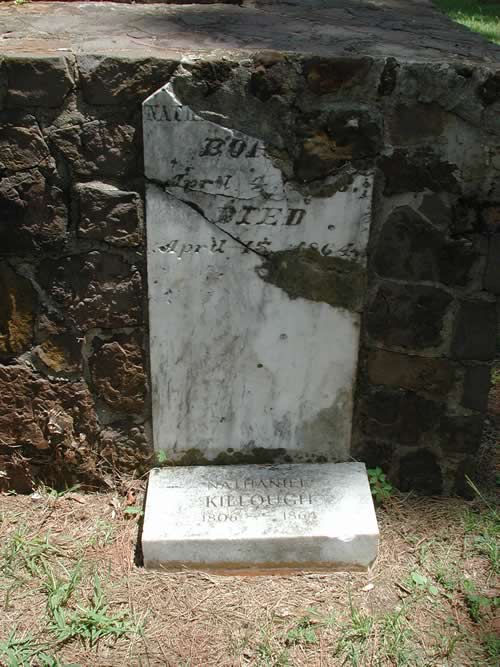 |
The Killough
Massacre - One of the family tombstonesr
Photo courtesy Janet Gregg, 2005 |
Narcissus
always maintained there was one white man with the renegade Indians.
She said when the Indians tried to make her little group go to Chief
Sam Bengs, one rode up to her and tried to assure her the women and
baby would not be harmed. Narcissus said through the paint and Indian
clothing, she could tell he was a white man, and when he realized
she saw that, he turned and rode away.
She recognized him as a man named Hawkins, who was from their old
hometown in Alabama. He had migrated to East
Texas earlier, had joined the tribes and gained a position of
prominence among them. The survivors believe he spurred the Indians
to attack. He was reportedly the first of the settlers who had migrated
to East Texas, to return
to Alabama to report the tragedy. Narcissus returned there later with
her baby boy and that’s how the settlers learned Hawkins had reported
the news first.
Hawkins involvement though, was never confirmed by General Thomas
J. Rusk, who, five weeks later, guided by Nathaniel, led a detachment
of soldiers to the site of the attack to bury the victims. The four
bodies they found were buried in wooden boxes under a large oak tree,
which no longer exists, a few hundred yards east of where Samuel’s
home stood. The graves were given rough stone markers. |
|
The
soldiers found the settlement’s homes ransacked with beds ripped up
and belongings turned upside down or thrown into the yards. Samuel’s
home had been torched, but it only partly burned because it had been
built with green wood. next
page › |
Text and photos
© Janet Gregg
November
8, 2005
Writer’s Note: As with many stories handed down
verbally from generation to generation, there are some discrepancies
between the various versions that have been put into writing. I have
taken all available information into account and tried to clarify
and resolve those discrepancies, choosing the most likely scenarios
for this article when a concrete resolution to a specific detail could
not be found. - JG
Resources ›
Getting There
› |
| Texas
Escapes, in its purpose to preserve historic, endangered and vanishing
Texas, asks that anyone wishing to share their local history, stories,
landmarks and recent or vintage photos, please contact
us. |
|
|
 HOME
HOME