|
|
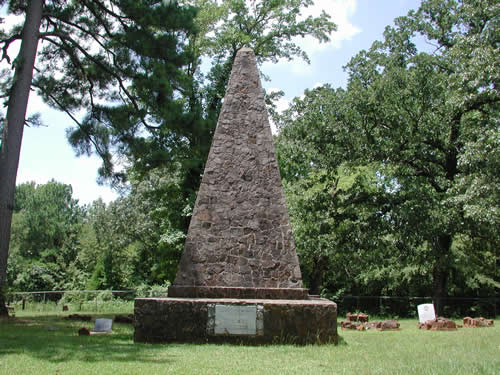
The stone Killough
Massacre Mounument
on CR-3431, Larissa,
TX
Photo courtesy Janet Gregg, 2005 |
Traveling
with a newborn is hard work, whether you’re going by plane, car or
bus. Imagine doing it without any of our modern transportation or
other conveniences.
Imagine if you can a trip that normally takes one to two days today,
taking nearly three months. Imagine walking or at best riding horse
back or in a covered wagon during the fall rainy season, with no heat
or air conditioning and few, if any, roads to follow.
Imagine having to gather firewood to cook and killing your own dinner.
Imagine having no respite from bugs, wildlife or the weather. Imagine
the men in your party having to literally at times carve a path through
the wilderness in order to proceed further.
This is what it was like for the Killough, Williams and Wood families
migrating a distance of more than 600 miles from Talledega County,
Alabama to Texas in the fall of 1837. There were approximately 30
people in the party, including Isaac Killough, Sr. and his wife Urcey,
who was 60 years old at the time; their four married sons Isaac, Jr.,
Samuel, Nathaniel and Allen; their two married daughters Mary “Polly”
and Jane and their youngest child, a single young woman named Elizabeth.
In addition, all of the married Killough children had spouses and
children of their own, including two newborns. Mary “Polly” also had
two single brothers-in-law join the group. Isaac, Jr.’s brother-in-law
also joined the party.
That year, they gave themselves the ultimate Christmas present, a
new home. On Christmas Eve 1837 their journey to a new life ended.
They settled on land they had paid for with gold. |
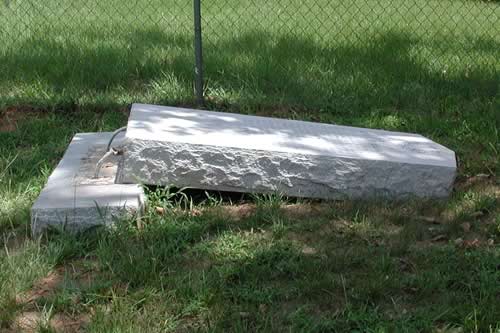 |
The state historical
marker vandalized
Photo courtesy Janet Gregg, 2005 |
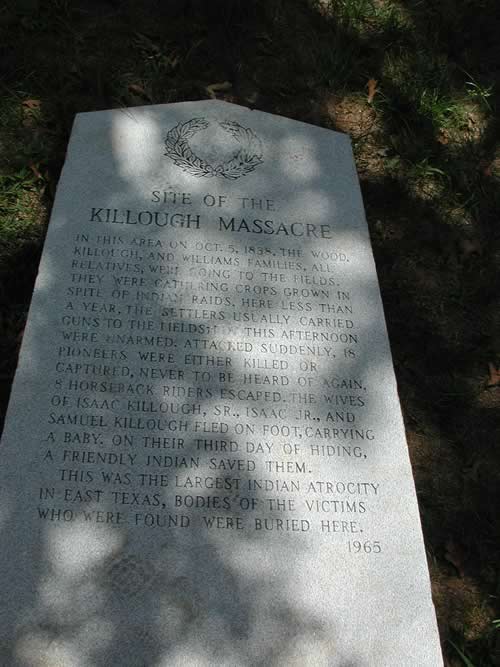
Site of The
Killough Massacre historical marker
Photo courtesy Janet Gregg, 2005 |
At
that time, under a law passed by the Congress of the Republic
of Texas, each head of a family could purchase 640 acres of land
and single men could purchase 320 acres, at 50 cents per acre. The
only catch was all immigrants had to live in Texas three years in
order to receive clear titles. It was good deal compared to the cost
of land in the United States, which was selling, on average, for $1.25
per acre.
The
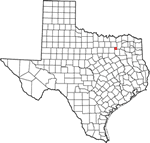
tiny settlement was located near the Neches River, seven miles northwest
of Jacksonville,
which didn’t exist at the time, in what was then Nacogdoches
County in the Republic of Texas.
Their closest neighbor was 40 miles away. Martin Lacy was a former
Indian agent for the Mexican government. Lacy had built a fortified
home and trading station on the Old
San Antonio Road, located just off what is now State Highway 21,
two miles southwest of Alto
in Eastern Cherokee
County. Lacy’s home was known to the settlers as “Fort Lacy”.
At the time, Texas had less than 57,000 people and fewer than two
dozen municipalities. Residents included Anglo-Americans, Mexicans,
slaves, a few free blacks and Indians; more than half of which belonged
to civilized tribes. Sam
Houston was President and the capitol was temporarily located
in a new town called Houston,
located on the Buffalo Bayou.
Throughout the winter, the Killough, Wood and Williams families built
their homes and cleared their land. In the spring they planted crops
including a large corn crop.
In August 1838, just as the corn was ready to harvest, rumors of an
Indian uprising forced them to flee to Nacogdoches
nearly 60 miles away. next
page › |
Text and photos
© Janet Gregg
November
8, 2005
Writer’s Note: As with many stories handed down
verbally from generation to generation, there are some discrepancies
between the various versions that have been put into writing. I have
taken all available information into account and tried to clarify
and resolve those discrepancies, choosing the most likely scenarios
for this article when a concrete resolution to a specific detail could
not be found. - JG
Resources ›
Getting There
› |
| Texas
Escapes, in its purpose to preserve historic, endangered and vanishing
Texas, asks that anyone wishing to share their local history, stories,
landmarks and recent or vintage photos, please contact
us. |
|
|
 HOME
HOME