|
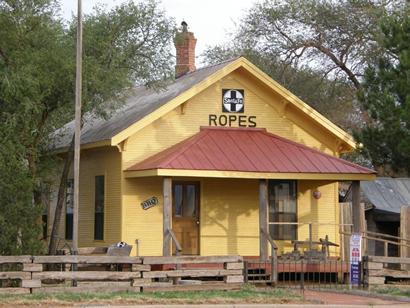
The former depot
in Lubbock's Ranching Heritage
Center
TE Photo, September 2009
More Texas Depots |
History in
a Pecan Shell
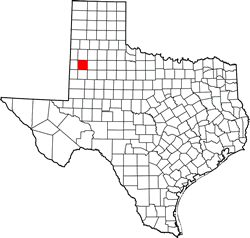
Ropesville
was Hockley County's
first community, formed when the Spade Ranch opened for development.
Settlers shepherded by one Jim Jarrott began arriving in 1901. When
the South Plains and Santa Fe Railroad Company laid tracks from Lubbock
to Seagraves,
Isaac Ellwood donated land for a railroad depot.
Ropesville was platted in 1917 and when the time came (1920) to name
a post office, the ranch cowboys suggested the name Ropes for the
rope corrals they had built to pen outgoing cattle.
That names was submitted, however, postal authorities thought mail
might be misdirected to Ropers, Texas, so the application was rejected.
They trotted out the old standby "ville" - tacked it on and resubmitted.
The rest is history. Ropes, Texas lives on. The former depot was moved
to Lubbock and is now part
of the Ranching Heritage Center.
The town blossomed with most of the businesses essential for a town.
Soon the town had a cotton gin, hotel, bank, cafe, and even a theater.
The town's first school also served as a church and in 1925 a high
school was built. Four churches were built in short order. In 1926
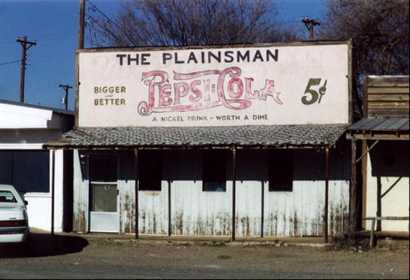
the town got its first newspaper - The Ropesville Hustler.
It later became the Ropes Plainsman and finally it became the
Lubbock Plainsman when it was bought in the 1960s.
Ropesville had a population of 500 when the Great Depression began.
As it worsened, the Ropesville Resettlement Project began with federal
funding. Thousands of acres of Hockley
County were parceled into farms of 140 to 160 acres. During WWII,
the funds went to the war effort and farmers were able to buy the
land.
In 1965 Ropesville reached its zenith with nearly a thousand citizens.
By the late 1980s it had declined by half and the figure for 2010
was 434. |
Ropesville
Chronicles
Who
killed J.W? by Clay Coppedge
The first recorded murder on the South Plains of Texas happened when
Lubbock lawyer J.W. Jarrott was shot and killed while watering his
team of horses near the present-day community of Ropesville on Aug.
27, 1902... more
|
| Texas
Escapes, in its purpose to preserve historic, endangered and vanishing
Texas, asks that anyone wishing to share their local history, stories,
landmarks and recent or vintage photos, please contact
us. |
|
|
 HOME
HOME