|
Texas | Architecture
| Water Towers
Forty Years
in the Water Tower Business
or
Does the Ladder of Success Have to be this High?
Clyde Burns
of Huntsville, Texas
by Edward Aquifer
Photos courtesy Clyde Burns |
|
|
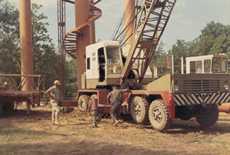
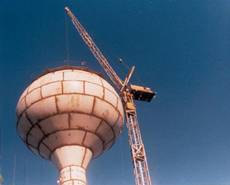
Water
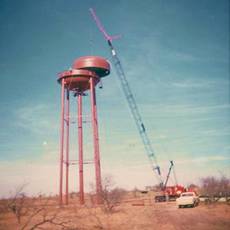
tower and crane
"This is one of the first tanks we erected with a crane, close
to Bridgeport, Texas in 1973."
Bridgeport,
Texas |
You
may not have met Clyde Burns in person - but if you've lived in Texas
longer than two weeks - you've almost certainly driven by one or more
of his projects. You may also have driven by (or under) some of his
work in Kansas, Oklahoma, Illinois, Indiana or a dozen other states.
Born a stone's throw from the Red River, in Collinsville, Grayson
County, Clyde's Texas roots go back to before the Civil War. His great-grandfather
was one of Gainesville's first three merchants.
In 1957 having just graduated from high school, Clyde took a job working
in the oil fields. It promised good pay, adventure and a high risk
of traumatic amputation - what young man could resist? His duties
included climbing the rigs and derricks and it was here that he discovered
he had no fear of heights - a definite asset in his next job - the
one that turned out to be his lifelong career. |
|
|
Construction
using a "Basket Pole" crane. |
|
|
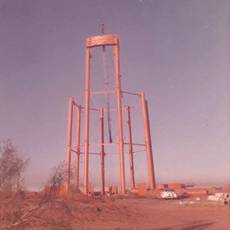
Construction
using a Guyless Derrick crane. |
|
|
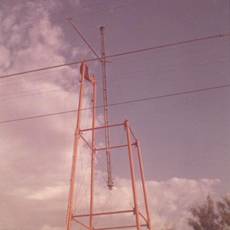
Another
basket pole crane job. The crane is suspended by cables from the uprights
as they rise. |
Jumping
Ship
On one particular job, down near Port
Lavaca, a water tower crew was erecting a tank not far from the
rig where Clyde was working. The drilling crew watched with interest
as the water tower took shape - but what really got their attention
was Saturday morning when they showed up for work as usual and the
water tower men were gone - not to reappear until Monday morning.
This was 1958 during the "Eisenhower Recession" and if someone was
considering a job change - they had better be sure they were making
the right move. A lunch hour conversation with the water tower workers
revealed that there wasn't that much difference in pay - so Clyde
bid adieu to his oily comrades and never looked back. |
|
|
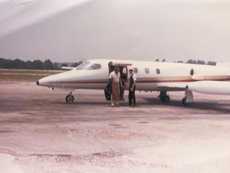
Clyde
Burns deplaning near the latest job site.
(Later in his career) |
Starting at the
bottom (both literally and figuratively) Clyde joined the bull gang
and spent his days doing the grunt work similar to that of an oil
field roustabout. After a stint as a "scaffold jumper" - grinding
burrs on the welded seams and operating a chipping gun, he then started
welding and by the Spring of 1963, he had been promoted to assistant
foreman.
He worked for one company for 20 years - until the owner started pursuing
businesses unrelated to water towers and had to declare bankruptcy.
Clyde then joined a company in Kentucky who found a lucrative business
in salvaging older tanks all across the United States and then re-erecting
them at other locations. |
|
|
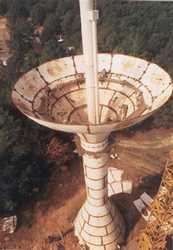
Aerial View
(from crane) of the Wamba, Texas water tower.
Wamba, Texas
|
|
|
Close
up view of the above photo. Inner rim is wooden scaffolding with welder
appearing as a gray dot just to the right of the inner pole. |
When asked about
the inherent dangers of working so far above the ground, Clyde stated
that fatalities were rare. His company once went eight years without
a one - and when it did inevitably happen, ironically it occurred
on one of the shortest tanks the company built - a stubby fifty foot
"washwater" tank - the type frequently used by municipal utility districts
and water treatment plants.
Even then - the fall from the tank didn't kill the man - the cause
of death was an infection from his hospital stay. |
The "Space
Age" Tower of Giant City
When you look past
the three rings of any specialized business, there's always something
interesting on the midway. We learned from Mr. Burns that the American
Water Tank Association recognizes achievement within its industry
with an annual award of excellence. In 1972, Clyde won the award for
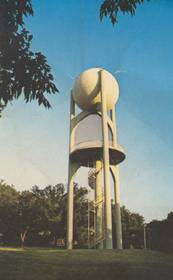
his tank in the Giant City State Park in southern Illinois. The 82-foot
three-legged tank holds 100,000 gallons - and its most unusual features
(besides it's over-all Jetsonesque appearance) is a spiral staircase
leading up to a 50-foot observation deck* - allowing park visitors
a panoramic view of the Shawnee Mountains. |
|
|
"Giant
City" State Park Crane at tower base. Note spiral staircase.
|
Artifacts
When asked about tower evolution, Clyde said that the typical municipal
water tower was the natural offshoot of the railroad water towers.
These went from wood construction to steel tanks sometime around the
time of the Civil War.
While doing a salvage job in Gouda Springs, Georgia, Clyde says that
he once removed a tower that had a plaque installed in 1954 for the
tower's centennial - making it a genuine ante-bellum artifact. The
manufacturer was Brown Steel of Noonan, Georgia - one of the
oldest companies tank companies in the southern United States. |
|
|
Wamba's
water tower nearing completion. |
|
The
Pittsburg Connection
As one looks back on a career that has spanned so many years - the
occasional coincidence becomes inevitable.
Municipalities buy tanks according to their needs. They have scores
of options such as catwalks, staircases, ladders, lights, etc. and
it's entirely possible to have erected over 200 tanks (as Mr. Burns
has done) and to never have had two with exactly the same complement
of accessories. Out of these 200 tanks - the option of a spiral
staircase had only been requested three times. One was the aforementioned
tower at Giant City State Park, but the other two tanks went to
towns with the same name. Pittsburg,
Texas and Pittsburg, Kansas both requested spiral staircases.
What does this mean? Probably nothing. We just like to mention coincidences.
|
|
|
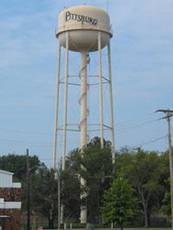
Pittsburg,
Texas water tower showing the spiral staircase.
Pittsburg, Texas
Photo courtesy Kazu |
|
|
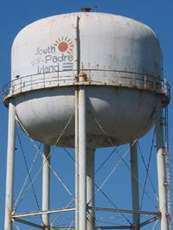
South
Padre Island water tower showing some salt spray weathering.
Photo courtesy Kazu |
| The
photos included within this article are towers that Clyde has erected
in Texas over the years. He mentions that his crews were often en
route to their next job long before the painting crew ever showed
up. Most of these photos were taken well after the fact - as the South
Padre Island tank (above) demonstrates. |
|
|
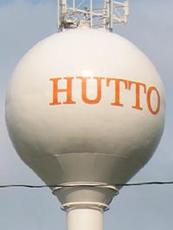
"The result
of poor workmanship at the fabricating plant.."
Note line under "HU"
Photo courtesy Kazu
|
| Mr.
Burns also mentioned that "heat buckles" and other irregularities
that disturb the symmetry of the tanks were the result of poor workmanship
at the fabricating plant and should not reflect on the skill of the
erection crew. |
|
On some occasions - salvage is not an option. Removal needs to be
swift - as it was for this WWII-era
airfield tank in Conroe,
Texas. Clyde's expertise brought the tower down in less time than
it takes to write this paragraph - although the cutting of the steel
took considerably longer. |
The next time
you're on a roadtrip and turn on the shower or flush the toilet -
give some thought to the water pressure and think of those huge tanks
hidden in the clouds. There's a good chance the pressure is coming
to you from a Clyde Burns tank.
© John Troesser |
Related Article:
An
Illustrated Water Tank Glossary ›
by Edward Aquifer
Photos courtesy Clyde Burns
A Salute to Standpipes, "Tin Men", Waterspheres, Torosphericals,
Spheroids and Hydro-pillars. |
|
|
 HOME
HOME