|
|
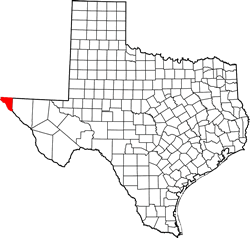
SAN ELIZARIO,
TEXAS
Former El Paso
County Seat
El
Paso County,
West Texas
31°34'58"N 106°15'57"W (31.582873, -106.265703)
FM 258 and FM 1110
15 Miles SE of Downtown El Paso
Population: 14,215 (2017)
13,603 (2010) 11,046 (2000)
San Elizario, Texas Area Hotels › El
Paso Hotels |
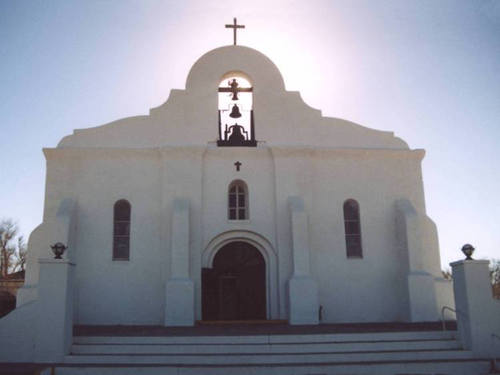
San Elizario
Chapel
Recorded Texas Historic Landmark
Photo courtesy Barclay
Gibson, December 2003 |
History
in a Pecan Shell
The town dates from 1598 when Juan de Oņate arrived near the site.
Oņate claimed the region (including present-day New Mexico) for the
Spanish crown. The original settlement went by the name Hacienda
de los Tiburcios and later moved to the south side of the Rio
Grande. In 1775 the community had a population of 157. The Spanish
built their presidio directly across the river from Fort
Hancock in the Valle de San Elizario and when the presidio later
relocated to the Hacienda de los Tiburcios, the presidio retained
the name - changing the name of the settlement to San Elizario.
San Elizario was second only to El
Paso for most of the nineteenth century. After Mexico won its
independence from Spain in 1821, San Elizario became part of the state
of Chihuahua. In 1841 the population was just over 1,000. A change
in the course of the Rio Grande left San Elizario in between the old
and new channels of the river. It became part of Texas in 1848 with
the signing of the Treaty of Guadalupe Hidalgo.
The community was on the Corpus
Christi to California road and during the 1849 gold rush, many
fortune-seekers passed through on the way to Sutter's Mill.
When El Paso County
was organized in 1850, San Elizario was made the county seat and except
for two short spans (1854 and 1866) it was El
Paso County's seat of government until 1873. During the Civil
War Union troops occupied the presidio, but it was abandoned after
the war.
San Elizario's decline began in the early 1870s and during the "Salt
War" of 1877, the town lost population to the Mexican side. Finally,
the town was bypassed by the railroad in 1881 and as El
Paso grew, San Elizario shrank. The population was still a healthy
1,500 in 1890 but by 1914 it had declined to just over 800. It reached
rock-bottom in 1931 with a population of 300 but grew slowly over
the years to climb back to 1914 levels by the 1970s. |
Historical Marker:
San Elizario
San
Elizario was established in 1789 on the former site of Hacienda de
Los Tiburcios as a Spanish colonial fort known as the Presidio de
San Elceario. The Presidio was moved from its original location (approx.
37 mi. s) in response to requests from settlers for military protection
from Indian raids. It operated as a Spanish post until 1814, when
troops withdrew during the Mexican War for Independence (1810-1821).
During its years as a part of Mexico, the Presidio de San Elceario
(now San Elizario) was occupied periodically by Mexican troops. A
reduced military presence resulted in the fort's decline. American
control of the area began in 1848, with the Treaty of Guadalupe Hidalgo,
which established the Rio Grande as the border between the United
States and Mexico. When the county
of El Paso was organized in 1850, the town of San Elizario was
chosen first county seat and served as such until 1873. In 1877 it
was the scene of a crisis known as the Salt War, in which local businessmen
attempted to control the salt market that had operated since colonial
times. Although San Elizario was bypassed by the railroad and has
become a rural farming community, it remains an important element
in the region's rich heritage. (1985) |
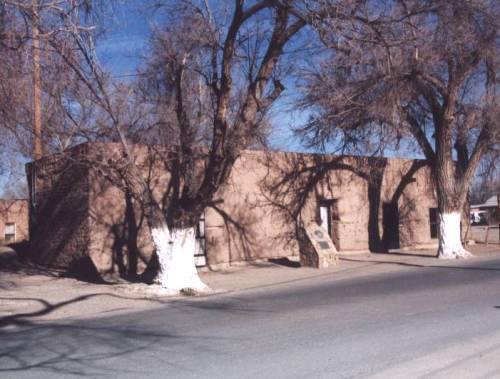 |
Former
El Paso County courthouse & jail
Photo courtesy Barclay
Gibson, December 2003 |
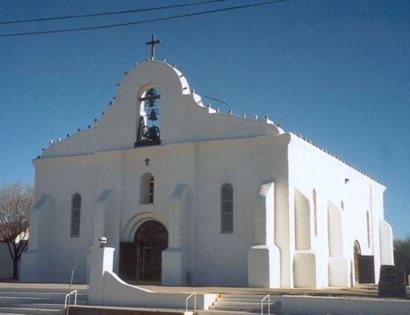
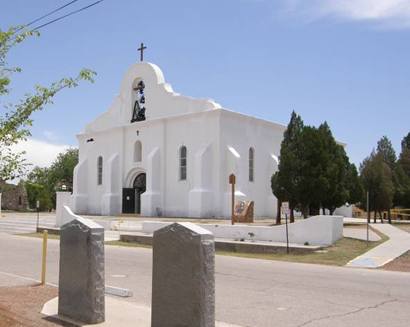
San Elizario
Chapel
1556 San Elizario Rd.
Photo courtesy Terry
Jeanson, December 2005 |
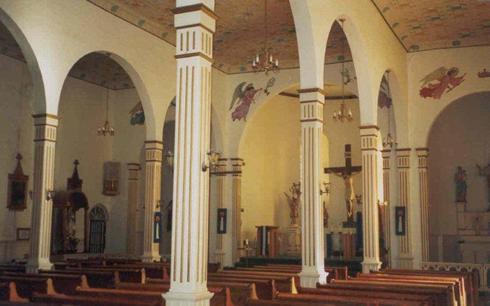
San Elizario
Chapel interior
Photo courtesy Terry
Jeanson, December 2005 |
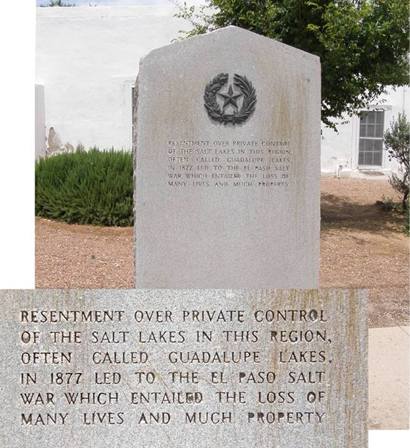
San Elizario
Chapel Historical Marker
Photo courtesy Terry
Jeanson, December 2005 |
San Elizario
Chapel
(Capilla de San
Elzeario)
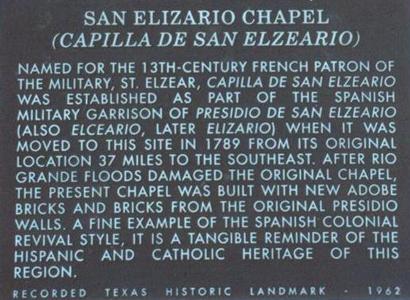
Named for the 13th-century French patron of the military,
St. Elzear, Capilla de San Elzeario was established as part of the
Spanish military garrison of Presidio de San Elzeario (also Elceario,
later Elizario) when it was moved to this site in 1789 from its original
location 37 miles to the southeast. After Rio Grande floods damaged
the original chapel, the present chapel was built with new adobe bricks
and bricks from the original presidio walls. A fine example of the
Spanish Colonial Revival style, it is a tangible reminder of the Hispanic
and Catholic heritage of this region.
Recorded Texas Historic Landmark - 1962 |
San Elizario
Chapel with Centennial Markers
Photo courtesy Barclay
Gibson, May 2009 |
|
An award-winning
history of the El Paso Salt War |
|
San Elizario
Chronicles:
From "Billy
the Kid's Texas vacation"
by Clay
Coppedge
"... He once broke into a jail in San Elizario. This comes
originally from an 1880 manuscript by a member of Garrett's
posse, Charles Frederick Rudolph, who recounted how Billy rode from
Las Cruces to San Elizario (just outside of El
Paso) after learning that his friend, Melquiades Segura, was in
jail there for murder. Billy arrived in San Elizario around 3 a.m.
and knocked on the jail door to wake up the Mexican guards. He told
the guard who answered the door that he was a Texas Ranger and he
had two American prisoners with him. The unsuspecting guard opened
the door only to find himself staring at Billy's .44 revolver. Billy
relieved the guards of their guns, replaced Segura with the guards
and threw away the key. Then he and Segura hightailed it a few miles
to Mexico.
That's the kind of story that made Billy the Kid into something more
than a horse thief and murderer in the popular imagination. San Elizario
celebrates the escapade every summer with the Billy the Kid Festival....
more" |
|
Texas
Escapes,
in its purpose to preserve historic, endangered and vanishing Texas,
asks that anyone wishing to share their local history and new or
vintage/historic photos, please contact
us.
|
|
|
 HOME
HOME

 Texas
Gulf Coast
Texas
Gulf Coast East
Texas
East
Texas Central
Texas North
Central
Texas North Central
Texas South
Central
Texas South Texas
Panhandle
Texas
Panhandle South
Texas
South
Texas Texas
Hill Country
Texas
Hill Country West
Texas
West
Texas Texas
Ghost Towns
Texas
Ghost Towns Texas
Counties
Texas
Counties