|
|
Katherine
Anne Porter
in East Texas
by Bob Bowman |
|
In
her writings American essayist and Pulitzer Prize winner Katherine
Anne Porter often wrote of the rural South, describing places that
sounded remarkably like East Texas.
There was a good reason. She spent several years of her youth at Lufkin
and was married there in 1906.
But the time spent by Porter in East Texas has been overlooked by
most biographers. They simply mention that she “grew up in Texas and
Louisiana.” |
|
|
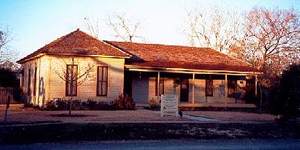
The
Katherine Ann Porter Museum in Kyle
Photo by John Troesser, 12-00 |
Porter,
who once claimed to be a descendant of Daniel Boone, was born Callie
Russell Porter on May 15, 1890, at Indian Creek, in southern Brown
County, to a poverty-stricken Texas family. When her mother died two
years later, Callie and her siblings lived with a grandmother at Kyle,
near San Marcos.
Between 1901, when her grandmother died, and 1906, Callie was shuttled
around Texas and Louisiana, living with her father, Harrison, a brother
and two sisters. They wandered among relatives and rented houses.
Poverty remained with the family, and Callie began to hone her senses
as an observer of people, customs and traditions.
Despite the family’s nomadic life, her father valued education and
placed his children in free schools when they were available. In 1904
he gathered enough money to enroll Callie in a church school in San
Antonio. Her single year was the only formal education she received
beyond grammar school.
At the age of sixteen, while living at Lufkin, she ran away from home,
took her grandmother’s name, Katherine, and married John Henry Koontze,
a railroad employee and the first of three husbands. Her marriage
license, filed in Angelina County on June 20, 1906, is one of the
few reminders of her residence in Lufkin.
At the time, Ira Bryce, minister of Lufkin’s First United Methodist
Church, married Porter and Koontze, as well as her sister, Gay Porter
and T.H. Holloway, in a double-ring ceremony.
Nine years later Katherine left Koontze to work as an actress, contracted
tuberculosis and decided during her recovery that she was best suited
to be a writer. She soon began working as a journalist in Chicago
and Denver.
Porter
apparently never forgot her life in East Texas. Many of her short
stories reflect the geography, rural traditions and language of the
pineywoods. In “Noon Wine” she wrote: “And did I not tell you about
standing at the edge of a field and listening to an old man, leaning
on a plow, a childhood friend of my father’s talking, and how I said
to myself, Why, that is my own speech...”
In another story,“He,” Porter wrote: “In the early fall, Mrs. Whipple
got a letter from her brother saying he and his wife and two children
were coming over for a visit next Sunday week. Put the big pot into
the little one, he wrote at the end.”
Porter was best known for her short stories and she finished only
one novel, “The Ship of Fools,” a disillusioned story set in a little
purgatory on the sea. She spent twenty years with the book before
it was finished, but it made her rich and famous with a movie at age
72. A Pulitizer Prize came in l966 for a collection of her best short
stories.
Sometimes called Texas’ greatest woman writer, Porter died September
18, 1980, in a nursing home at College Park, Maryland, after a series
of strokes. She was buried beside her mother’s grave in the Indian
Creek Cemetery near Brownwood.
The home she occupied as a child in Kyle with her grandmother is now
the Katherine
Anne Porter Museum. |
All
Things Historical November 15, 2004 Column
Published with permission
(Distributed as a public service by the East Texas Historical Association.
Bob Bowman is a member of the Texas Historical Commission and author
of 30 books about East Texas.) |
Katherine
Anne Porter
BOOKS |
|
|
|
|
|
 HOME
HOME