|
LUFKIN, TEXAS
"Crossroads of the Piney Woods"
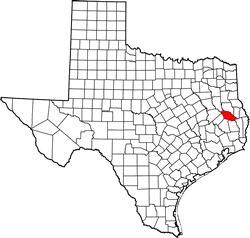
Angelina
County Seat, East Texas
31°20'13"N 94°43'49"W (31.336874, -94.730374)
Intersection of Hwy 59 and 69
115 miles NE of Houston
Hwy 59 North 20 miles to Nacogdoches
ZIP code 75901, 75902, 75903, 75904, 75915
Area code 936
Population: 34,143 (2020)
35,067 (2010) 32,709 (2000) 30,206 (1990)
Book Hotel Here › Lufkin
Hotels
|
One
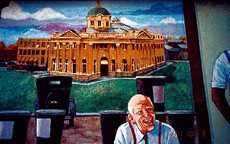
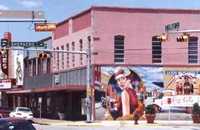
of the many murals by Lance Hunter in Lufkin
Photo courtesy Barclay
Gibson, April 2006 |
History in
a Pecan Shell
Lufkin is named after Railroad Engineer E.P. Lufkin
and Angelina County
is named after an Indian girl who became an enthusiastic convert of
the Franciscan missionaries. A bronze statue across from the Museum
of East Texas honors her.
If you've ever been behind an 18 wheeler on the Interstate and have
seen the word LUFKIN on the back of the trailer, it is from our featured
town. In a convoluted evolution, the carriages that ran logs through
the saw, became carriages that extracted logs from the forest. During
WWII, the
same company manufactured carriages to support howitzers, then school
buses and finally they made the trailers that we see today.
Lufkin Industries also builds the pumping
units you see all around oil fields. The Lufkin Industries historical
relics room has one of these pumping units that was struck by a Japanese
torpedo off the coast of California in 1942. It was damaged, but was
not destroyed. How's that for proof of durability?
W.C. Trout, one of Lufkin Industries pioneers, bought the town
it's first horse-drawn fire engine shortly after his gasoline stove
exploded and burned his house to cinders. The Trout name is also seen
at the Zoo. Walter Trout (one of W.C. Trout's sons) named the zoo
after his mother Ellen. The zoo started in 1965 when a friend sent
Walter Trout a 500 lb. baby hippopotamus as a combination gag gift/
zoo starter kit.
Lufkin's influence on the timber and oil industries
in Texas cannot be overstated. Lufkin along with nearby Nacogdoches
provide excellent bases for further exploration of East
Texas.
(Source:
The above information on Lufkin Industries and the Trout family was
taken from Lufkin: From Sawdust to Oil by Elaine Jackson, Gulf
Publishing, 1982)
In the early teens, Lufkin's water source was a standpipe in Cotton
Square. The standpipe was drained in 1913 in the hope of finding the
body of one Frank Parsons who disappeared after a violent explosion
that destroyed a good portion of the railroad station. The blast must've
been stronger than they thought. Frank's body turned up in California
three years later, with Frank in it. |
Lufkin, Texas
Landmarks and Attractions
|
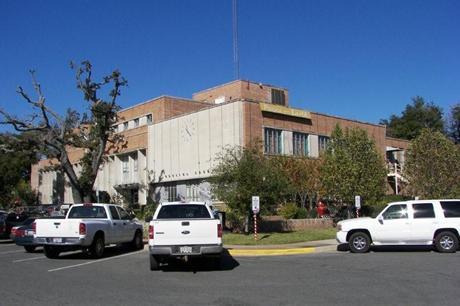 |
Angelina
County Courthouse
Texas
Forestry Museum - 1905 Atkinson Dr. 936-632-9535
"Built in 1976 to preserve the history and heritage of the
forests and forest products industry, recently underwent an extensive
renovation at Lufkin. As a result, the museum offers visitors new
perspectives of Texas’ earliest industry, sawmilling, and one of
its newest, the manufacture of paper." - Bob
Bowman
Medford
Collection of Western Art - 300 E. Shepherd St.
Museum of
East Texas - In historic 1905 Episcopal Church. Second and Paul
Streets. 936-639-4434
Ellen Trout
Zoo and Park - 402 Zoo Circle off Loop 287 North. Admissions.
936-633-0399
Cry Baby
Creek
Jack Creek, a stream west of Lufkin, has for years been known as
Cry Baby Creek, supposedly because a women and a baby died when
their auto veered off a wooden bridge and fell into the steep creek.
Annette Sawyer of Lufkin, who directed us to the bridge, said visitors
who come to the site at night claim they have heard sounds resembling
a baby crying. One visitor supposedly found the imprint of a baby’s
hand on her auto window after returning from the bridge. (From Reply
to Readers by Bob Bowman )
|
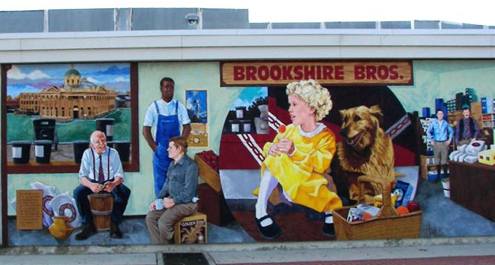 |
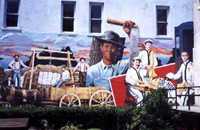
Another mural
by Lance Hunter
Photo courtesy Barclay
Gibson, April 2006 |
Southern
Hushpuppy Cookoffs by Bob Bowman
Held annually in September as a part of the Texas Forest Festival.
The only hushpuppy cooking contest in the U.S.
Rudolph
the red-nosed pumping unit by Bob Bowman
If you drive through Lufkin during the holidays, be sure to take
notice of one of East Texas’ most unusual Christmas decorations.
For decades, “Rudolph the Red Nosed Pumping Unit,” the creation
of Lufkin Industries, Inc., the inventor of the balance-type oilfield
pumping unit, has helped East Texas celebrate the season...
|
|
|
Lufkin
Street scene
Mural by Lance Hunter
TE photo |
|
|
Mural
at Cotton Square and starting point of Downtown Walking Tour
Mural by Lance Hunter
TE photo |
|
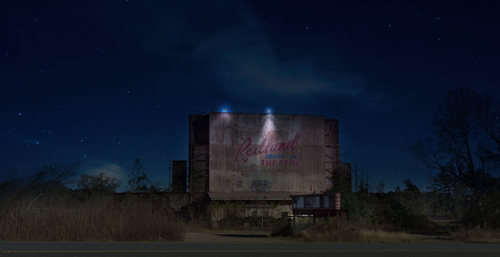
Redland Drive-In-Theater
More
images
Photos
courtesy Shawn Stephens, December 2017
|
|
The Old Redland
Drive-in
"When I first moved to Lufkin in the early seventies, there
were several drive-in theaters including the Panther Drive-In which
was demolished long ago. The Redland is still standing intact, although
dilapidated, and I understand it might be torn down soon. It sits
on Highway 59 on the outskirts of town on the way to Nacogdoches.
Included a
couple of pictures. Thanks." - Shawn Stephens, December
10, 2017
|
Lufkin Chronicles
-
History, Stories & People
|
How
a town was born by Bob Bowman
"...shed some light on the old story of how Lufkin became the
county seat. "
Nazis
in East Texas by Bob Bowman
Slightly more than sixty years ago, a German prisoner of war, known
only as “Rothammer,” carved his name on the gates of a POW camp
beside U.S. Highway 69 north of Lufkin. In doing so, he left an
almost indiscernible link between World War II and East Texas.
Remembering
a Courthouse by Bob Bowman
"[I]n the l950s, many Texas counties threw aside history, tradition
and elegance and replaced some of our finest courthouses with modern
buildings -- many of them with little character or appeal. That
happened in my home town of Lufkin." ...
A
Railroad Centennial by Bob Bowman
A
Soldier's Story by Bob Bowman
Milton -- an ancestor of Jack Irish of Lufkin -- found himself involved
in the Siege of Bexar, the battle that preceded the fall of the
Alamo, and barely escaped with his life during the massacre of Texas
prisoners at Goliad.
A classic story of a simple soldier involved in the momentous events
that gave birth to Texas.
Ted
Daffan, an East Texas songwriter by Bob Bowman
Katherine
Anne Porter in East Texas by Bob Bowman
"In her writings American essayist and Pulitzer Prize winner
Katherine Anne Porter often wrote of the rural South, describing
places that sounded remarkably like East Texas. There was a good
reason. She spent several years of her youth at Lufkin and was married
there in 1906...."
Remembering
two doctors by Bob Bowman
When doctors W.D. Thames of Lufkin and Joe Dickerson of Jasper died
recently, East Texas lost two unique physicians--men who made house
calls, kept up with the babies they delivered, and cared for whole
families....
Courtroom
Storytellers by Bob Bowman
Because they've seen the best and worst of humanity, lawyers are
among our best storytellers. Courtroom stories of Lufkin's Joe Tonahill
and Jasper's J.J. Collins.
Angelina
and Neches River Railroad
The
Bravest Man by Bob Bowman
Those who lived in Lufkin during the Depression years knew Homer
Garrison, Sr., as a kindly, genteel man who gave away pennies to
children and felt he had cheated them “because I always got a two-bit
smile.” Somehow, it wasn’t the image you expected for the bravest
man in the world, which is the way his son, Homer Garrison, Jr.,
a man once considered as J. Edgar Hoover’s replacement, felt about
his father.
Making
history by Bob Bowman
In August of 1945, when the United States dropped the first atomic
bombs on Hiroshima and Nagasaki, Charlie Kimble of Lufkin was part
of the American landing party that toured Japan’s shambles and helped
free 4,500 Korean prisoners of war...
The
mayor and the lion by Bob Bowman
Years ago, when Pitser Garrison was the mayor of Lufkin, a young
African lion was born at Ellen Trout Zoo.
Inventing
the oilfield pumping unit by Bob Bowman
Not
a happy camper in Angelina County by Wanda Orton
|
Lufkin Nearby
Destinations
|
Angelina
National Forest - 14 miles SE on US 69 to the nearest entrance
Davy Crockett
National Forest - Hwy 94 West 11 miles
Sam Rayburn
Lake - Ask Lufkin/Angelina County Chamber of Commerce 409-634-6644
for maps
Jonesville
- Second county seat of Angelina County
Depression
Era Roadside Park
A roadside park beside U.S. 287 a few miles before entering Woodville.
See Depression
Parks by Bob Bowman ("All Things Historical" column)
Lufkin
Tourist Information
Lufkin/Angelina County Chamber of Commerce
On the Loop (287) at Chestnut St.
409-634-6644. Website: www.lufkintexas.org
|
| Texas
Escapes, in its purpose to preserve historic, endangered and vanishing
Texas, asks that anyone wishing to share their local history, stories,
landmarks and recent or vintage photos, please contact
us. |
|
|
 HOME
HOME