|
Who
was the first—and possibly the greatest—hero of the Texas Revolution?
He’s a man you may have heard of, but not very often. Try Ben Milam.
Surprised? You really shouldn’t be, but Ben’s been ignored and short-changed
by both academic historians and writers like me for so long that he’s
been all but forgotten. Ben, though, really started it all. |
 |
Oh, sure—there
were fits and starts as early as 1832. It was in 1835, though that
things were set to pop. Martin Perfecto de Cos, Santa Anna’s brother-in-law,
was arguably the best home-grown field general the Mexican Army had.
Vicente Filisola and Adrian Woll were probably more competent overall,
but they were European imports—soldiers-of-fortune with European training
and experience who took their talents to Mexico in search of a market
and found one. Filisola was Italian, Woll German. Cos was a native
of Mexico who’d been a successful officer in the Revolution and—while
he did have the patronage of Santa Anna—he was good at what he did
in spite of it. He held the largest population and trade center in
Texas, San Antonio de Bejár, with a force not of peon levies and convict
soldiers, but hardbitten, well-trained veteran regulars.
Against this the Texicans could muster only untrained volunteers.
Man-for-man they were among the best fighters in North America, but
their style of fighting—one-on-one, hit and run, honed against Lipans,
Tonkawas, and Comanches—wasn’t exactly suited to the task ahead. They
had to take a town, not necessarily well fortified but certainly strengthened,
held by well-trained, well-disciplined veteran combat troops. That
meant house-to-house fighting from behind walls and fences against
disciplined firepower and possibly even artillery. It was not an inviting
prospect.
The Texican leaders, Bowie, Milam, and others, did try to instill
some discipline into the men, drilling them in advancing and retreating
in good order, exhorting them to discipline their fire and concentrate
their firepower with volleys rather than picking targets. It takes
more than a few weeks, though, to overcome the habits of a lifetime
and build soldiers that fight effectively as a team. The Texicans
had only weeks to do what they could, and the Mexican troops had been
trained in their tactics for years.
The Texicans were, in that wonderful Biblical phrase, ‘sore afraid’—which
means, in plain Texan, those folks were flat skeered. The Indians
they were used to fighting were, for the most part, poor shots. Their
fighting was unpredictable. Sometimes they’d fight, sometimes they’d
run—and there was no predicting which they’d do or when or why they’d
do it. In addition, Indians fought ‘every man for himself,’ totally
without command discipline.
The Mexican troops in Bejár
would fight. There was no doubt about that. Under Martin Perfecto
de Cos they’d fight well and be skillfully deployed and maneuvered.
Individually they might be no better shots than the average Indian—the
average Mexican musketeer, shooting at a mark, was lucky to hit in
the same county as the target. Disciplined fire was another story.
In ranks of 100 or more, firing volleys on command, they’d put a curtain
of large chunks of lead in the air and some of it would definitely
get on somebody. “Catching the blue plum”—an euphemism for getting
hit by a .75 caliber ball from the Napoleonic War surplus English-made
Brown Bess muskets most Mexican infantry carried—meant a lifetime
of debility if not a very painful death.
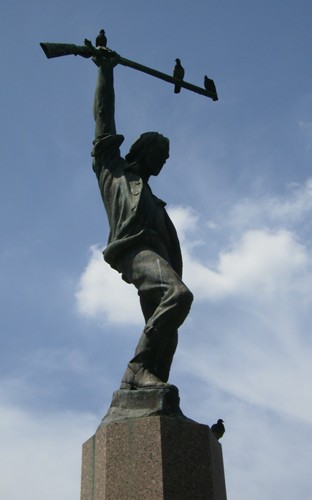
Somebody had to lead the Texicans into Bejár.
The odds were that somebody would die very quickly. Nobody wanted
the job, not even the redoubtable Jim Bowie. One man stepped forward—and,
according to the story of one who was there, he drew a line in the
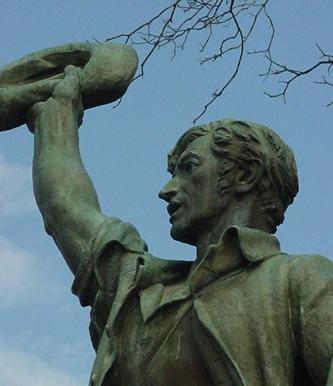
dirt with a stick he had in his hand and said “Who’ll follow old Ben
Milam into Bejár?” |
 |
Benjamin
Rush Milam was a native of Kentucky, born about 1789. He was one of
the earliest US immigrants into Texas,
and one of the few who wasn’t a ‘Muldoon Catholic.’ Before emigrating
to Texas, Ben converted to Catholicism
and was baptized a Roman Catholic in Kentucky, where records of his
conversion and baptism are preserved yet. For the record, there are
a great many Catholics in Kentucky, and at least three proto-cathedrals
grace surprisingly small rural towns there.
How deeply he felt his conversion may be open to question. He may
not have been a Muldoon Catholic in fact, but he seems to have been
one at heart. Ben was a high-ranking Freemason when he converted,
but he doesn’t seem to have told the bishop about it. At the time,
Freemasonry was proscribed by the Catholic Church and it’s still frowned
on. The Knights of Columbus, the Catholic men’s brotherhood, was specifically
established in the US to give Catholic men an alternative to the Freemasons.
That didn’t mean Catholics—some of them very important Catholics—weren’t
Freemasons. Antonio Lopez de Santa Anna y
Perez de LeBron, who held the title—among others—of ‘Defender
of the Faith,’ was a practicing Freemason. His display of the Masonic
‘brother in distress’ sign to Sam
Houston, another Freemason, after his capture, probably saved
him from almost immediate hanging and certainly contributed to the,
in effect, VIP treatment he got from Houston and the other Texas officials,
most of whom were Masons.
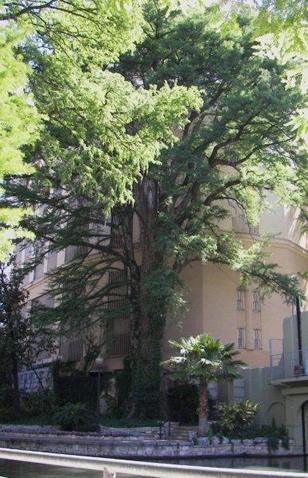
Ben Milam helped plan and personally led the assault on Bejár—and
almost lived through it. The battle was mostly over when he stopped
next to a tree in the back yard of the de Veramendi house. Oral history,
passed down through the generations from those who were there to their
descendants, says Ben had a reason for stopping by the tree. He hadda
pee! While he was engaged in this most intimate act, a Mexican sniper
shot him through the head. |
 |
Whether the Mexican
rifleman chose that particularly intimate moment to shoot Ben down
or not we don‘t know for sure, but the story’s been around for about
170 years now. Trouble is, it couldn’t have been a ‘Mexican sniper,’
because the Mexican army had no snipers. What they had were special
rifle battalions of highly-trained, well-treated troops who were armed
with British-made .64 caliber Baker rifles. In fact, the whole Mexican
Army was copied—weapons, organization, and tactics—from the British
Army of the Napoleonic Wars. Santa Anna may have called himself ‘The
Napoleon of the West,’ but he certainly appreciated the organization
and tactics of Arthur Wellesley, the Duke of Wellington, who was primarily
responsible for the downfall of Bonaparte. As in the British Army,
the Mexican Army’s rifle battalions were well-trained in the use of
their weapons on individual targets. The worst of the rifle troops
were pretty fair shots, while the best were certainly equal to anything
on the Texican side.
Ben
was buried where he fell, in the back yard of the de Veramendi house.
There his bones lay for many years. Eventually he was disinterred
and his remains removed, with appropriate Masonic ritual, to a corner
of a Protestant cemetery on the site of what is now San
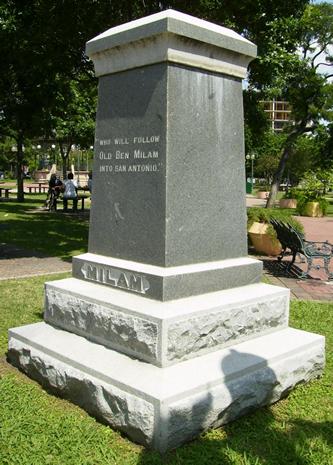
Antonio’s Milam Park. The gravesite was marked with a limestone
monument inscribed, simply, MILAM. It was assumed that no further
identification would ever be needed. |
 |
|
When the cemetery
was dedicated as Milam Park, it was decided that, instead of being
relegated to a corner, Ben should rest in the middle of the park.
He was again disinterred — once more with appropriate Masonic ritual
— and re-interred precisely in the center of the park that bore
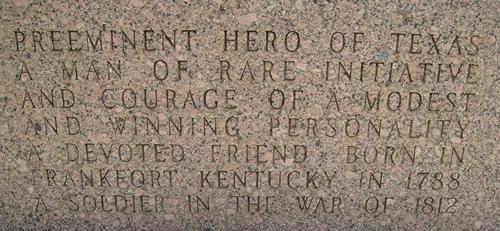
his name. In 1936 the by-then-badly-weathered limestone marker was
replaced with the granite monument you’ve seen if you’ve ever visited
Milam Park.
Over the years Milam Park’s neighborhood changed to one you wouldn’t
care to enter after dark. San
Antonio has been trying to revive the area and arrest its decay
for a long time, and just a few years ago San
Antonio’s Mexican sister city, Cuernavaca, offered to donate
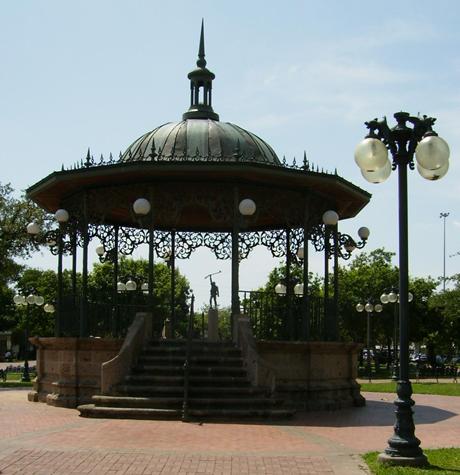
a gazebo-like bandshell to be erected in the middle of Milam Park
as part of the rejuvenation.
Immediately objections were voiced—“You can’t put a bandshell there—it’ll
be right on top of Ben Milam’s grave!” We seem to treat our Texas
heroes, even our nearly-forgotten ones, with greater respect than
some Europeans treat theirs. The grave of the founder of the Scottish
Presbyterian Church is rumored—though no one knows for sure—to be
under the blacktop of a Glasgow parking lot.
In fact, old Ben had been so thoroughly ignored or forgotten in
San Antonio that,
officially, San Antonio
had no idea where his bones lay. The late Dr. I. Waynne Cox, together
with Dr. Anne Fox, both of the UTSA anthropology/archaeology department,
began researching Ben’s posthumous perambulations. Sure enough,
they found long-forgotten newspaper accounts of the removal and
second reburial of the forgotten hero “in the middle of Milam Park.”
Those who objected to the bandshell said “See—we told you so! Ben’s
right under the monument.”
Still, nobody knew for sure. Even if there was a grave there, nobody
really knew if it was Ben Milam’s. A dig was organized to discover
if there really was a grave under the monument, and if there was,
to determine—if possible—whose grave it was. Nobody really expected
much success in the latter.
There was a grave, exactly where the objectors said it would be.
In the ground the archaeologists found the outline of an old wooden
’toe-pincher’ coffin, by then so deteriorated that the only trace
of it was a discoloration in the soil. Inside the outline were the
considerably deteriorated remains of a Caucasian male between the
ages of 45 and 50, who stood about 5’7” in life.
Could this be Ben? All descriptions of Ben put him “six feet tall
or a little better.” In fact most such descriptions were exaggerations.
We have ‘eyewitness’ accounts describing Daniel Boone as ‘over six
feet’ when he stood only about 5’6”, David Crockett as ‘a giant
of a man’ when he stood only about 5’7”, and Sam Houston as ‘six
feet six’ when he actually stood 6’2”. Other evidence was needed
to say yea or nay.
The skull was badly shattered and much of the facial structure was
gone, but enough remained for the cranium to be reconstructed. In
the left rear aspect of the skull was a large hole, which a forensic
anatomist identified as an exit wound caused by a bullet of approximately
.65 caliber. According to eyewitness accounts, Ben was shot in the
front of the head from the right, with a Mexican rifle-—which, remember,
was .64 caliber—and “the ball went plumb through his head.” There
is little doubt that the remains found in the middle of Milam Park
are those of Texas’ great—but almost-forgotten—hero, Ben Milam.
Now let’s back up a mite, to that fateful evening in 1835 when Ben
Milam cried “Who’ll follow old Ben Milam into Bejár?” Abraham Zuber—whose
father was there when it happened—said his daddy told him Ben drew
a line in the dirt with a stick he had in his hand for those who’d
follow him to cross. A lot of historians have speculated since—based
on the total lack of any known, surviving eyewitness testimony to
the contrary, and on the fact that the one eyewitness to survive
and testify to the goings-on inside the Alamo
didn’t mention it until years after the fact—that Ben’s line in
the dirt, drawn with a stick, has been transmogrified, over the
years, to a line in the dust in the courtyard of the Alamo
drawn by Buck Travis with his sword.
Well, Buck’s line in the dust certainly makes a better story, and
from what we know of Travis’ personality that’s exactly what he
would have done if he’d thought of it. Then there’s the question—why
would Ben have a stick in his hand just before a battle? A rifle
or musket, sure. A knife, a tomahawk, a sword, even a chopping ax—all
of those would be reasonable. But a simple stick? Why?
Maybe it wasn’t a ‘simple stick.’ The leg bones of the skeleton
unearthed in Milam Park were well preserved. On examination by competent
physicians, they were determined to show evidence of a debilitating
arthritic condition. From forensic evidence the man buried under
Ben Milam’s monument in Milam Park probably couldn’t have bent his
right knee at all, and bending his left knee would have been painful
at best. Ben Milam—for there’s little question now of the identity
of the original possessor of that skeleton—was crippled by arthritis.
He could barely get around. He certainly walked with a cane if not
a crutch. Without one or the other he probably couldn’t have walked
at all.
The ‘line-in-the-dust’ controversy is not now settled nor is it
ever likely to be. Travis’ line is such a part of the Alamo
story that it will never die. We do have, however, an explanation
for the stick with which Ben drew his line. It was a walking stick—and
he always carried it, because he couldn’t walk without it.
Milam’s bones were at UTSA for several months, under study to determine
the many things bones can tell about the people who once possessed
them—diet, disease, habits, and abilities. Once UTSA completed its
study, the Smithsonian requested a short-term loan of the bones
for study. Ben did what no other hero of the Texas Revolution has
ever done—he boarded a jetliner and flew to Washington and back.
Of course he—or his bones—did it in a specially-designed suitcase,
but it was still a first.
|
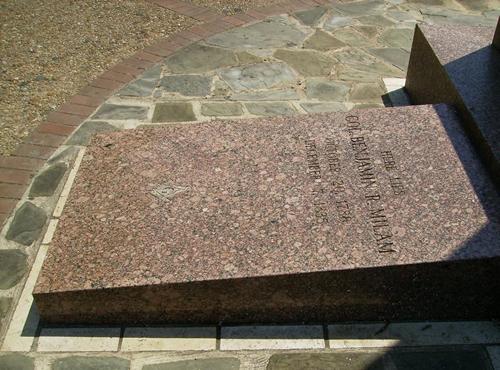 |
Milam Park has
been renovated. Ben has been re-interred—hopefully for the final time—with
full Masonic ritual and honors, together with an honor guard from
those Texans who owe much of their history to him. But—how thoroughly
has Ben Milam been forgotten? There’s a county
named for him, a street in Seguin bears his name, there are schools
called ‘Milam,’ and then of course there’s Milam Park in San
Antonio. In the most comprehensive if not the most monumental
novel ever written about Texas, James Michener’s TEXAS, Ben Milam
is the only major participant in the Texas Revolution who is never
mentioned at all.
It’s about time we started remembering old Ben. If he hadn’t stepped
up and hollered “Who’ll follow old Ben Milam into Bejár?” we Texans
might not have a state at all.
© C. F.
Eckhardt
April 24, 2008 column |
Photographer's
Note:
Milam & the center of the park
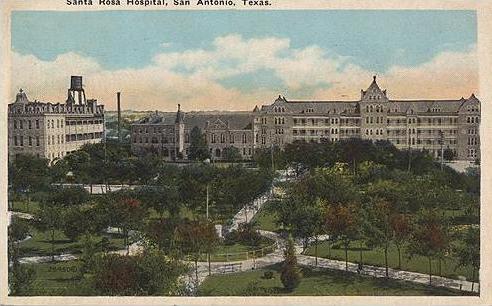
This month's story on Ben Milam gave me fond memories of the evenings
we played in the gardens at Santa Rosa Hospital while Papa visited
his patients, and drew me down to Milam Park to take a look at Ben's
grave and statue. I couldn't figure out how they moved that big statue
to the end of the park. Then it dawned on me....Ben never moved, the
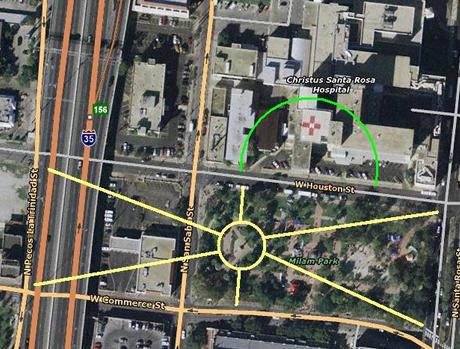
park was chopped off by the freeway! The gazebo is in the new center
of the park. Ben is at the west end of the park, centered, where he
always was.
I have included an old postcard that clearly shows the location of
Ben's grave in the center of the park,
and have done an overlay for you. (See below)
"When the cemetery was dedicated as Milam Park, it was decided that,
instead of being relegated to a corner, Ben should rest in the middle
of the park. He was again disinterred—once more with appropriate Masonic
ritual—and re-interred precisely in the center of the park that bore
his name.
In 1936 the by-then-badly-weathered limestone marker was replaced
with the granite monument you’ve seen if you’ve ever visited Milam
Park." That granite monument is a part of the Centennial Celebration.
- Sarah
Reveley, April 27, 2008 |
 |
|
|
 HOME
HOME