|
This
may be a bitter pill for some Texans to swallow, but the windmill
was not invented in Texas. Neither was
the Colt revolver. Ditto barbed
wire.
All three are Texas icons credited with
taming the wild west, making the land inhabitable and improving the
cattle industry. Texas
would have had a hard time without any of those three items, but none
are Texas natives.
Barbed
wire was invented in Illinois, allegedly by a farmer attempting
to keep chickens out of his wife's garden The Colt revolver and the
windmill were both invented in - gasp! - Connecticut. |
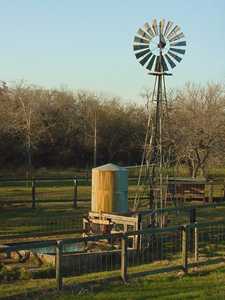
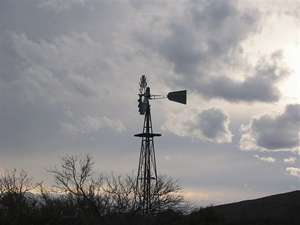
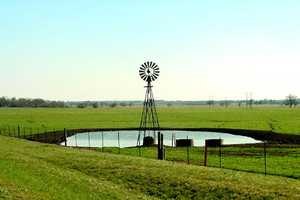
A windmill near
Cuero
TE photo |
Of
the three, windmill is the one that probably gets the least credit
for doing the most work. Here in Central
Texas you still find a few working windmills, but a lot of the
ones that endure here do so more out of sentiment and aesthetics than
need.
In all those old Western movies, the Colt .45 and even barbed
wire often had starring roles but windmills just stood there and
looked iconic. "I do not remember ever seeing John Wayne or any other
cowboy hero pulling sucker rod or pipe from a well," West
Texas writer Elmer Kelton noted in 1992, adding that windmills
served as an introduction to any machinery more complicated than a
coffee grinder for many an old time cowboy. |
 |
While
that's true to some extent in nearly all of Texas,
it was especially true in West
Texas, where much of the land would still be uninhabitable if
Connecticut Yankee Daniel Halladay hadn't figured out a way to turn
a mill into a windmill in 1854. The key turned out to be the addition
of a vane that directed the wheel into the wind.
Some inventions don't change much over time because the inventor gets
it right the first time. Halladay's invention fits that category.
The first wheels were made of wood radiating from a horizontal shaft
and set at angles to the wind. The biggest advancement came when manufacturers
began building galvanized steel wheels in 1888.
Other than that, the windmill still works basically the same way Halladay
designed it. The wind turns the wheel and a gear box moves sucker
rods up and down inside a vertical pipe. Valves open and close in
concert with the movement of the sucker rods, and that draws the water
out of the ground. That's the bumper sticker version, but you get
the idea.
The whole thing was set on a four-legged wooden tower that a good
crew could construct over a well in a day. Of course, an important
part of erecting a windmill was to know where the water was and how
deep the sucker rods had to extend to reach the water table. If windmills
hadn't done the work, especially on the Great
Plains and in the arid West,
the work wouldn't have got done. |
 |
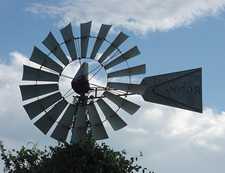
Today,
except in the most arid and isolated areas, the windmill often does
little more than look picturesque, and it's good at doing that. Windmills
remain a favorite subject of painters and photographers and people
who like their scenery spiced with a touch of romance. Windmills represent
a blast from the past, suggesting as they do the primitive and isolated
way of life that settlers lived.
"Texans have always expressed a particular fondness for old windmills,"
E. Dan Klepper wrote in his essay, "Sail Ribs and Tailbones." "Windmills
are the desert's handmaidens and signal the possibility of life in
landscapes seemingly barren of comfort or overwhelmed by isolation.
Their integration into the Texas profile
is so complete that it is difficult to imagine the land having ever
been without them." |
 |
 |
True
enough. A Texas without windmills is
as hard to imagine as open range. The day of open range is long gone,
thanks in large part to barbed wire and the windmill. Windmills made
it possible for ranchers
to fence their land and keep cattle
in different pastures, instead of grazing practices dictated by the
location of surface water. That enabled cattle
raisers to cross breed cattle, which gave us shorthorns, Herefords
and other breeds, which has helped keep ranchers
and butchers busy for all these years.
Non-native Texans like to say they weren't born in Texas
but got here as fast as they could. The same could be said of the
windmill, because here is where it found its most receptive market.
In 1928, manufacturers produced 99,050 units a year and exported 26,000
of them. Half of the remaining windmills were sold in Texas.
The XIT
Ranch in the Texas
Panhandle at one time had 335 functioning windmills.
The world's tallest windmill was located on the XIT,
but the wind giveth and the wind taketh away. The big windmill was
toppled by - what else? - the wind in 1926.
© Clay
Coppedge
"Letters from Central Texas"
October 16, 2005 column |
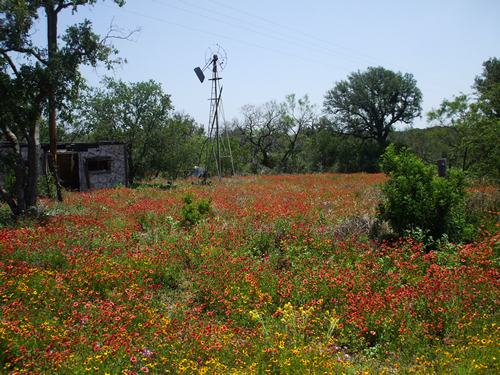 |
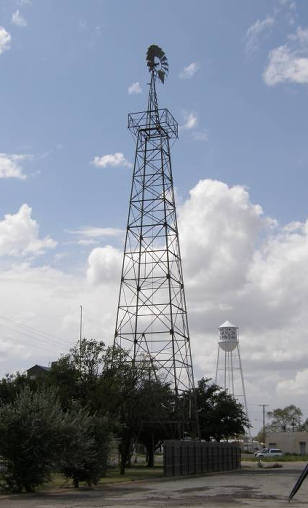
Windmill in Fredonia
Photo courtesy William Cope, June 2014 |
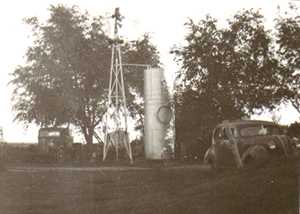
Family windmill in Lubbock
Vintage photo courtesy Bob Walker |
|
It [windmill above]
was on our farm in Lubbock,
Texas in the late 1930s and early 1940s. The tank was a converted
oilfield boiler manufactured by my father. As six and seven year-old
children, we would climb the windmill, scoot across the small pipe,
and swim in the tank. - Bob Walker, A Texan in Florida, December 20,
2005 |
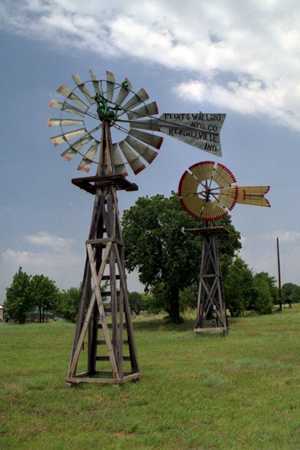
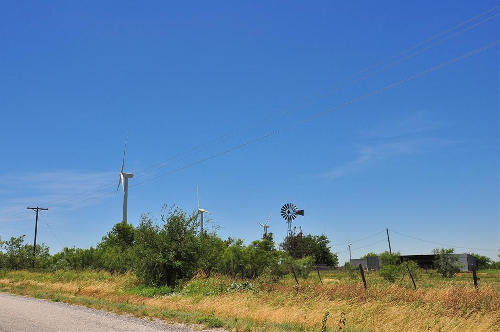
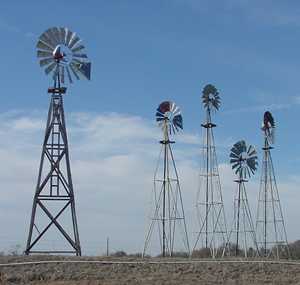
Windmill farm
in Tolar
Photo courtesy Sam Fenstermacher 2004 |
"I took
this photo at an oasis in Big
Bend National Park. It is a functional windmill. There is a plaque
there stating that it was once a watering hole for travelers."
- George Lester, June 13, 2004 |
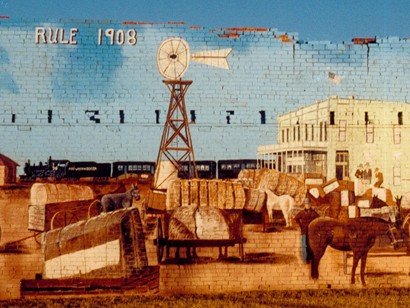
Mural in Rule,
Texas.
Photo courtesy Rule Chamber of Commerce |
See
also:
Cowboy
Life on a Small Spread by
C. F. Eckhardt
Cowboyin' ain't all it's cracked up to be. It's not all horsebackin'
and branding and Saturday night at the dance hall. Herewith a view
of some of the cowboy chores Roy and Gene never did in the Saturday
matinee... Truly the windmill-powered waterpump with its huge fan
atop a spidery wooden or metal tower is one of the great symbols of
the American plains, from Texas to North Dakota and beyond. Unfortunately,
the windmill is a mechanical device. All mechanical devices have to
be, from time to time, oiled or greased... more
|
|
|
 HOME
HOME