|
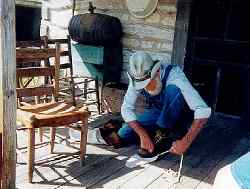
"Bones"
demonstrating the craft of covering chair bottoms with fresh cowhide.
Pioneer Museum in downtown Frederickburg
Founder's Day Festival held every May
Photo courtesy Sandy Fiedler, 2000 |
What
does the assassination of JFK have to do with the development of tourism
in Fredericksburg, Texas? A lot. But first, how did Fredericksburg
come to be in the first place?
In 1846 John O. Meusebach, Commissioner-General of the Society
for the Protection of German Immigrants in Texas, led his group
of 120 into the area between the banks of the Llano and Colorado Rivers.
Naming the colony for Prince Frederick of Prussia, Meusebach oversaw
the division of land. Ten acres of farmland and a town lot 100' by
200' went to each married man, and ten acres to each single man 17
years or older.
It was the best of times and the worst of times, to borrow a phrase-wonderful
because it was a time of new beginnings, and terrifying because there
was no backup plan in case of failure. No buildings, bridges, or streets
were there to reveal the shape of a man's hand at work. No one sold
them a beam, board, or stone.
Every structure, from the humblest cabin to the first church, they
had to make themselves out of the raw land. |
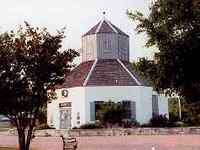 |
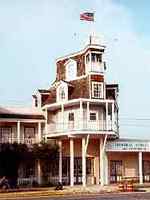
Replica of "Vereins
Kirche" or "Society's Church"
Photo courtesy Sandy Fiedler |
In
the colony were skilled craftsmen, builders, merchants, farmers, and
professionals representing all classes of society, serving to build
a community based on integrity, industriousness, and faith in God.
In 1847 construction began on "society's church," the Vereins Kirche.
It was a small octagonal building, which served as a church for all
denominations and as a schoolhouse, its bell heralding important events.
Although the original building eventually fell into disuse and was
razed, a replica erected in 1935 now stands in the middle of the Marktplatz
on Main Street. |
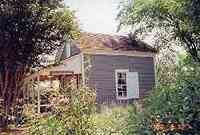
"Sunday
House" on the grounds of Pioneer Museum complex
Photo
courtesy of Sandy Fiedler |
Feelings
of loneliness were eased on weekends when farmers brought families
into town. They stayed with relatives and friends. About 1897 a new
trend began to change the appearance of the town. Because of a rumor
that town folks were tired of their country cousins' spending every
weekend with them, one man decided to build his family a "Sunday
house". Before long, dozens of one-and two-room houses sprang
up, clustered near the churches because attending church was so important.
The farmers and ranchers came to town on Saturdays to trade their
products with local merchants and townspeople, attend church on Sunday,
and return home later that day.
For about fifty years Sunday houses played an important role in the
life of the town. Eventually, however, good roads and automobiles
erased the necessity for a separate place in town. Of the more than
100 Sunday houses built, most remain intact, still used as homes or
shop |
| Today Main
Street shows off dozens of marvelous shops for collectibles, antiques,
crafts, etc. There are German restaurants, beer gartens, and bakeries
(with shortbread, baked meringue, kolaches). The pleasing scents of
candles fill the nostrils. Unobtrusive doorways lead to mysterious
courtyards. Many of the ubiquitous historical markers are noticeable
only if you are on foot in this understated, rich historical district.
Churches stand all over the town like watchtowers of strength. |
|
|
Admiral Nimitz
State Historic Site - National Museum of the Pacific War
P O Box 777
Fredericksburg TX 78624
830/997-4379
Photo courtesy Sandy Fiedler |
| On
Main Street is the Admiral Chester Nimitz Museum and Historical Center.
Fredericksburg is proud to be the birthplace of Nimitz, Fleet Admiral
of the Pacific Forces in World
War II. This museum is part of the National Museum of the Pacific
War with the new George Bush Gallery. |
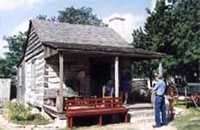
Authentic cabin
relocated to Pioneer Museum Complex
Photo
courtesy Sandy Fiedler |
| "There are many
bed and breakfast establishments and motels — there are no bad
places to stay in Fredericksburg," voiced one resident. "Everything
is clean and safe." |
How did Fredericksburg become the tourist haven it is today?
A talk with Mark Williams of the Pioneer Museum gives insight. "Fredericksburg's
life blood is tourism, but it wasn't planned that way."
He explained that in the early 1930s, Albert Keidel, a descendent
of immigrants, studied architecture. He noticed how the wealthy Dupont
family had invested big money in the restoration of the colonial town
of Williamsburg, Virginia. He tried to interest Fredericksburg citizens
in preserving the treasures they took for granted. The community rejected
his prodding. Eventually, however, he created the well-known "homestead
style" of architecture based on a variety of locally used styles.
His influence along with that of another man, Tyrus Cox, indirectly
caused the restoration and appreciation of the local architecture
whose examples were beginning to decay.
"Then a morbid thing happened that helped put Fredericksburg on the
map," related Mark intriguingly. "It was the JFK assassination."
Mark explained that the home of the new president, Lyndon B. Johnson,
was just a few miles east. There was only one place nearby for the
press to stay-Fredericksburg. After covering the news on the Johnson
Ranch, reporters did the natural thing: they found human interest
stories in Fredericksburg and the German culture. This exposure caused
citizens to speed up restoration in the early 1970s. Money came in
from Houston, Dallas, and Fort Worth, causing property values of old
homes to soar.
"Fredericksburg is slowly being kicked into the twenty-first century,"
Mark observed. "As late as 1979, it was still more nineteenth century.
Because of the influx of people and money from all over the U.S.,
the closed, tightly knit culture is being overwhelmed. There still
is much genuine flavor, but it is becoming commercialized."
He noted that presently there are about two or three thousand descendants
of the first immigrants.
"Technology is pushing the future on them now," Mark added. "Monday
through Thursday it is a sleepy town, but Friday through Sunday, traffic
is bumper to bumper."
The April 1999 issue of National Geographic carries an article
titled, "Texas Hill Country." Author John Graves writes about
the old German settlements. "Boerne,
Comfort,
even Fredericksburg the jewel-all
are now ringed by standard American clutter and filled with tourist
shops, serenity having dwindled away."
But you can regain a sense of what it used to be if you start with
a tour of the Pioneer Museum Complex on Main Street in Fredericksburg.
A Founders' Day Festival is held there every May.
Gillespie County Courthouse |
Enchanted
Rock State Natural Area
325/247-3903
On Big Sandy Creek, near Gillespie and Llano County lines.
18 miles North of Fredericksburg on Ranch Road 965
16710 Ranch Rd 965
Fredericksburg TX 78624
http://www.tpwd.state.tx.us/park/enchantd/
[ See A
Couch Potato's Guide to Climbing Enchanted
Rock by Michael Barr ]
Tourist information
Pioneer Museum
Complex
309 W. Main St. Fredericksburg, TX 78624
Mon - Sat 10-5 Sun 1-5 Closed major holidays
Website: pioneermuseum.com
Gillespie County
Historical Society
830-997-2835
© Sandy Fiedler
October,
2000
|
| Texas
Escapes, in its purpose to preserve historic, endangered and vanishing
Texas, asks that anyone wishing to share their local history, stories,
landmarks and recent or vintage photos, please contact
us. |
|
|
 HOME
HOME