|
I'm
not sure if some citizens of Texas realize just how much they owe
to a handful of ladies who saved from ruin, our most precious historic
structure, the Alamo.
One of those women, Adina De Zavala, has been credited as the one
most responsible for saving the old mission and if it hadn't been
for her efforts, the Alamo
might well have been replaced by a parking lot. It was in her blood
to fight for something she believed in, the lady had an historic legacy
- her grandfather, Lorenzo de Zavala, was the first vice-president
of the Republic of Texas. According to The Handbook of Texas Online,
Miss De Zavala organized a group of women who met for the purpose
of discussion and study of Texas heroes. These ladies became part
of the Daughters of the Republic of Texas in 1893. De Zavala and her
group prevented the destruction of the Alamo chapel, after it had
been purchased from the state by the wholesale grocery firm of Hugo
and Schmeltzer Company |
|
|
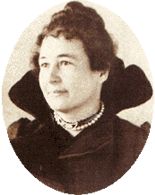
Adina
De Zavala
Photo
courtesy of Murray Montgomery |
Miss De Zavala
obtained a verbal promise from the company that her chapter of the
DRT would be given the first chance to purchase the Alamo
property. In 1903, Clara Driscoll joined the DRT and De Zavala's group
of preservationist women. Driscoll soon purchased the property from
the grocery firm to prevent it from falling into the hands of another
group, referred to as an "eastern syndicate." In 1905, the Texas legislature
authorized the state to purchase the property from Driscoll and custody
was turned over to the DRT.
However, trouble soon began to brew between De Zavala and Driscoll.
The rift was over Driscoll's desires to tear down part of the old
Hugo and Schmeltzer building, as it was her contention that it had
been built long after the famous battle in 1836. Miss Zavala opposed
this action; as she was sure that the building was part of a structure
know as the "long barracks" which was of great historical value. Even
though Driscoll's group won several decisions in state court against
De Zavala, it didn't deter this granddaughter of a patriot from sticking
to her guns and fighting for what she believed to be the truth of
the matter.
At one point, in 1908, Miss De Zavala went so far as to barricade
herself inside the north barrack of the Alamo
for three days to protest its destruction. It was her belief that
this section was of even more historical worth than the Alamo chapel.
De Zavala's efforts were not in vain, and history has proved that
she was right in her belief about the value of the old barracks. It
has been confirmed that that section of the Alamo
grounds is where much of the fighting took place in the legendary
1836 battle. |
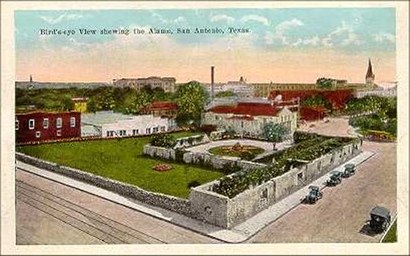 |
Bird's-eye view
showing the Alamo
Postcard courtesy www.rootsweb.com/ %7Etxpstcrd/ |
| Although the
noble lady had saved her beloved mission, she never seemed to venture
far away from the place. In her book, The
History and Mystery of the Menger Hotel, Docia Schultz Williams
writes that Adina De Zavala was a resident of the
old hotel, located on Alamo Plaza, from 1926 to 1932. According
to Williams, "She must have lived at the
hotel in order to be close to the shrine which meant so much to
her." |
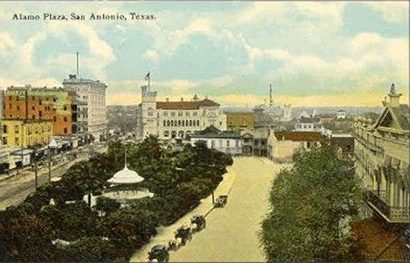
Alamo Plaza showing
Menger Hotel
on the right
1915 Postcard courtesy www.rootsweb.com/%7Etxpstcrd/ |
Adina De Zavala went on to be instrumental in saving the Spanish Governors'
Palace in San Antonio.
She organized, in 1912, the Texas Historical and Landmarks Association.
She also wrote several books about San
Antonio and the Alamo.
She was a member of the Texas Folklore Society, the Philosophical
Society of Texas, and the United Daughters of the Confederacy, the
Texas Women's Press Association, and many other organizations.
This great lady of Texas died on March 1, 1955, and is buried at St.
Mary's Cemetery in San
Antonio.
© Murray Montgomery
Lone
Star Diary
April 20, 2004 column |
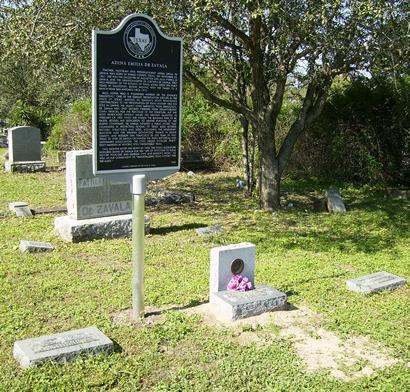
Adina Emilia
De Zavala
Grave and Historical Marker
|
Adina Emilia
De Zavala grave and historical marker
Photo courtesy Sarah
Reveley, 2009 |
Adina Emilia
De Zavala historical marker
Photo courtesy Sarah
Reveley, 2009 |
Historical
Marker Text:
Adina Emilia
De Zavala
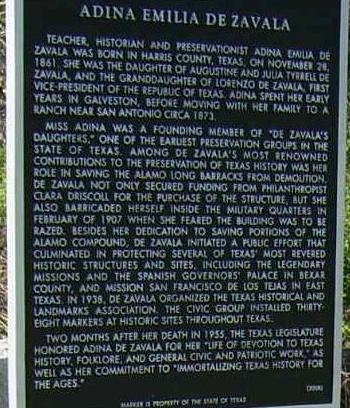
Teacher, historian
and preservationist Adina Emilia De Zavala was born in Harris County,
Texas, on November 28, 1861. She was the daughter of Augustine and
Julia Tyrrell De Zavala, and the granddaughter of Lorenzo De Zavala,
first Vice-President of the Republic of Texas. Adina spent her early
years in Galveston,
before moving with her family to a ranch near San
Antonio circa 1873.
Miss Adina was a founding member of "De Zavala's Daughters," one of
the earliest preservation groups in the state of Texas.
Among de Zavala's most renowned contributions to the preservation
of Texas history was her role in saving the Alamo
Long Barracks from demolition. De Zavala not only secured funding
from philanthropist Clara Driscoll for the purchase of the structure,
but she also barricaded herself inside the military quarters in February
of 1907 when she feared the building was to be razed. Besides her
dedication to saving portions of the Alamo
compound, De Zavala initiated a public effort that culminated in protecting
several of Texas' most revered historic
structures and sites, including the legendary missions and Spanish
Governors' Palace in Bexar County, and Mission
San Francisco de los Tejas in east
Texas. In 1938, De Zavala organized the Texas Historical and Landmarks
Association. The civic group installed thirty-eight markers at historic
sites thorughout Texas.
Two months after her death in 1955, the Texas Legislature honored
Adina De Zavala for her "life of devotion to Texas history, folklore,
and general civic and patriotic work," as well as her commitment to
"immortalizing Texas history for the ages." |
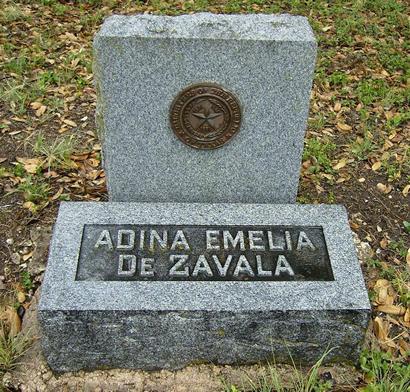 |
Adina Emilia
De Zavala granite marker
Photo courtesy Sarah
Reveley, 2009 |
|
|
 HOME
HOME

 Gulf
Coast
Gulf
Coast East
Texas
East
Texas Central
North
Central
North Central
South
Central
South Panhandle
 South
Texas
South
Texas Hill
Country
Hill
Country West
Texas
West
Texas Ghost
Towns
Ghost
Towns COUNTIES