|
 |
History in
a Pecan Shell
Once called Roughtown,
the name was changed after residents formed a vigilance committee,
closed saloons and prohibited the selling of liquor within a two-mile
radius of the town. The current name is said to be Spanish for "alligator"
and it is presumed that the area was once rife with the reptiles.
An earlier Mexican village was reported in the mid-1830s but as ranchers
moved in, the population faded away.
A town was platted by John W. Ramey in the 1850s and by 1866 it was
a thriving town with a population of 500. A post office was granted
in 1874 with the slightly different spelling of Lagarta and
Lagarto College opened in
1884. The population dropped to 350 by 1875 but the town had since
added a newspaper, gristmill and hotel. In 1906 Lagarto had two schools
with a combined enrollment of 29 students taught by 2 teachers.
The town was later (1888) bypassed by the San Antonio and Aransas
Pass Railway and within two years Lagarto was in decline.
First the college closed and from a population of 200 in 1892 it shrank
to just 75 by 1914. By 1936 Lagarto had 100 residents, two schools,
a church, a business, and scattered dwellings. Local schools merged
with schools in George West after
WWII. In 1959 with the construction of Lake Corpus Christi,
Lagarto was given a reprieve, although the population was estimated
at only 80 residents from 1974 to 1990.
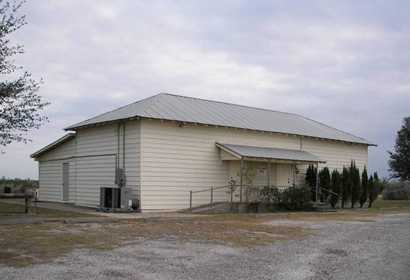
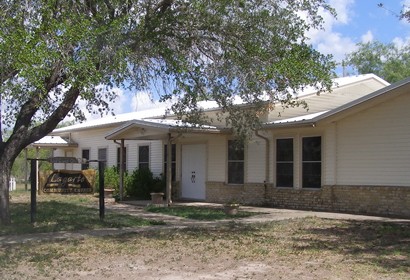
The 1925 school is still in use as a community center (look for the
signs on the W side of FM 534). |
A Visit to
Lagarto, Texas
Photographer's
Note:
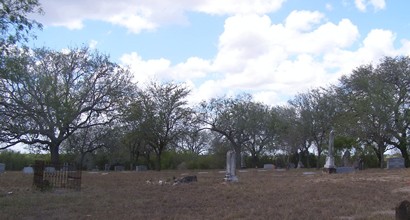
Traveling down 534 you can find the old School & Cemetery
(off the road-no signs). But to see where the town realy is today
you need to go east on FM-3162 about 2 miles to where it dead ends
at Lake Corpus Christi. There you can find a store, community center
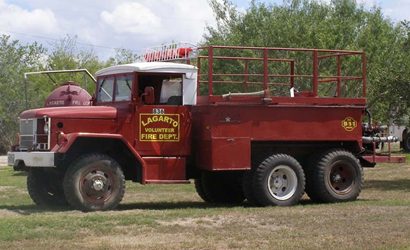
and fire station. There are many homes in the hills by the lake here.
A massive brush fire earlier this year destroyed many residences and
made big news. Many people were displaced and fundraisers are trying
to get this group back on it's feet. - William
Beauchamp, August 11, 2009
Lagarto Cemetery & Historical
Marker › |
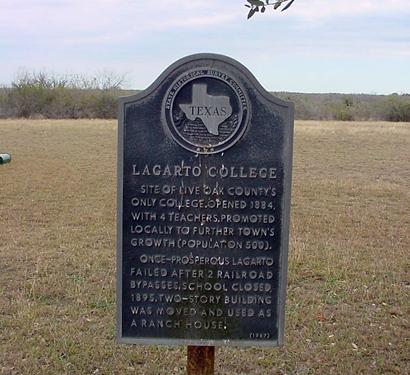
Historical Marker:
Lagarto College
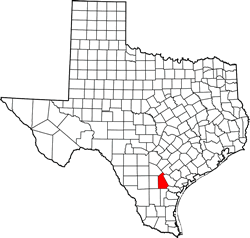
Site of Live Oak
County's only college. Opened 1884, with 4 teachers. Promoted locally
to further town's growth (population 500). Once-prosperous Lagarto
failed after 2 railroad bypasses. School closed, 1895. Two story building
was moved and used as a ranch house. |
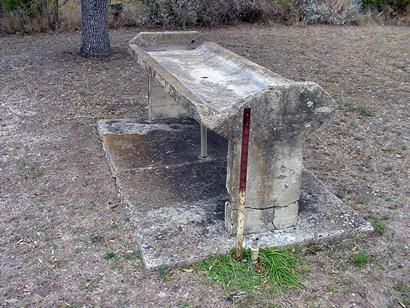
The drinking
fountain of the old school
TE Photo, February 2006 |
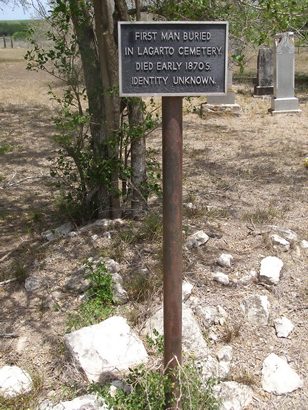
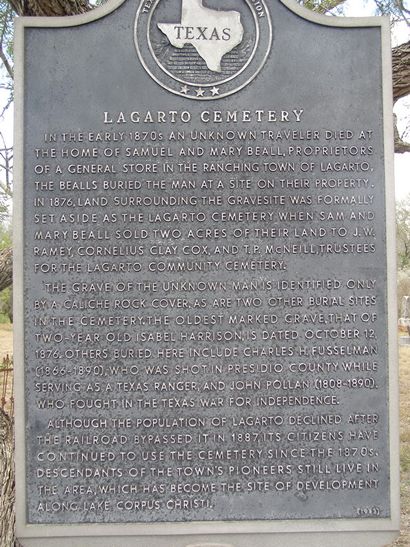
Historical Marker:
Lagarto Cemetery
In the early 1870's
an unknown traveler died at the home of Samuel and Mary Beall, proprietors
of a general store in the ranching town of Lagarto. The Bealls buried
the man at a site on their property. In 1876, land surrounding the
gravesite was formally set aside as the Lagarto Cemetery when Sam
and Mary Beall sold two acres of their land to J.W. Ramey, Cornelius
Clay Cox, and T.P. McNeill, trustees for the Lagarto Community Cemetery.
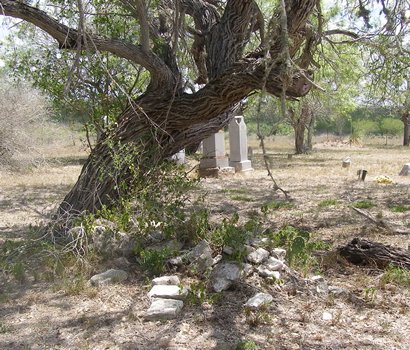
The grave of the unknown man is identified only by a caliche rock
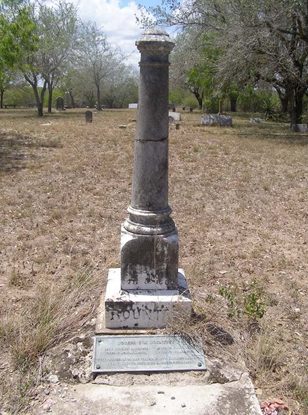
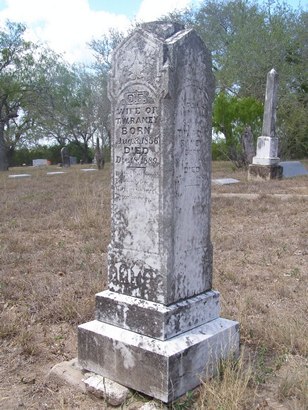
cover, as are two other burial sites in the cemetery. The oldest marked
grave, that of two year old Isabel Harrison, is dated October 12,
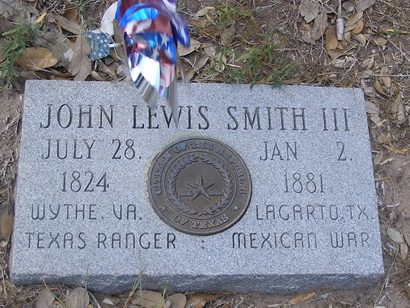
1876. Others buried here include Charles H. Fusselman (1866-1890),
who was shot in Presidio county while serving as a Texas ranger, and
John Pollan (1808-1890), who fought in the Texas war for Independence.
Although the population of Lagarto declined after the railroad bypassed
it in 1887, its citizens have continued to use the cemetery since
the 1870's. Descendants of the town's pioneers still live in the area,
which has become the site of development along Lake Corpus Christi. |
 |
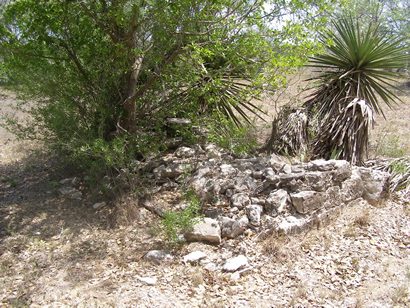
Grave of first
man buried in Lagarto Cemetery
Photo courtesy William
Beauchamp, August 2009 |
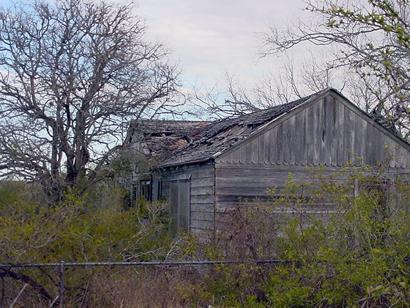
A former residence
TE Photo, February 2006 |
Lagarto,
Texas Forum
Lagarto
Not a Ghost
I would suggest you visit Lagarto, Texas before telling the world
that it is a ghost town. I live within two miles of the Lagarto
highway marker, and I'm not a ghost and neither are the estimated
700 residents of the area. In a way, I'm glad you call it a ghost
town. That way, no one will bother us here. Certainly, and gladly,
it is no longer an incorporated town and no longer has its own post
office, thank goodness! Thank goodness folks like you have no idea
what's here!! - Penny Peavy, Lagarto, Texas, December 08, 2006
Lagarto is included in T. Lindsay Baker's Ghost Towns of Texas
|
| Texas
Escapes, in its purpose to preserve historic, endangered and vanishing
Texas, asks that anyone wishing to share their local history, stories,
landmarks and recent or vintage photos, please contact
us. |
|
|
 HOME
HOME