|
|
THE KILLOUGH
MASSACRE
Page 2
Text & photos
by Janet Gregg |
‹
Page 1
At
that time, Nacogdoches
was the most established town in the East
Texas Piney Woods, having been inhabited by Indians as early as
1250A.D. followed later by French and Spanish explorers and missionaries
and ultimately by settlers migrating from other states. In 1837 Nacogdoches
became an incorporated city and in the late summer of 1838, it was
a seat of political prominence for the Republic. It also had a newspaper,
the Texas Chronicle, which had just started publishing that year.
The Indians were considered a real threat because the land the Killough,
Wood and Williams families settled on had originally been part of
a large tract originally granted to the Cherokees in an 1836 treaty.
But in December 1837 the Senate of the Republic
of Texas nullified the treaty and sold the land to settlers, creating
great resentment among not only the Cherokee, but other Indian tribes
as well.
The three families remained in Nacogdoches
until late September or early October when Isaac Killough, Sr. negotiated
permission from the Indians to harvest what they could of their crop
and collect their stock, reportedly until the “first great white frost”.
On their way back to the settlement, they reportedly encountered a
friendly, old Indian who warned them not to go home because wild Indians
were roaming the area. But they ignored the warning. When they arrived
at the settlement they found their fences had been burned, along with
other evidence Indians had been there.
On
October 5, 1838, the harvest was nearly complete and several of the
women were preparing a wedding dinner for the pending nuptials between
17 year old Elizabeth Killough and Barakias Owen. Owen was one of
Mary “Polly” Owen’s brothers-in-law. Elizabeth was her youngest sibling.
The families had only a small amount of corn left to harvest, about
two wagon loads, just one afternoon’s worth of work. After lunch,
they broke from habit and didn’t take their guns with them to the
field.
While crossing a creek to get to the stand of corn they were ambushed
by a renegade band of painted Indians that included Cherokee, Caddo,
Coushatta and possibly Keechi plus Mexicans and several runaway slaves.
What ensued was chaos. next
page › |
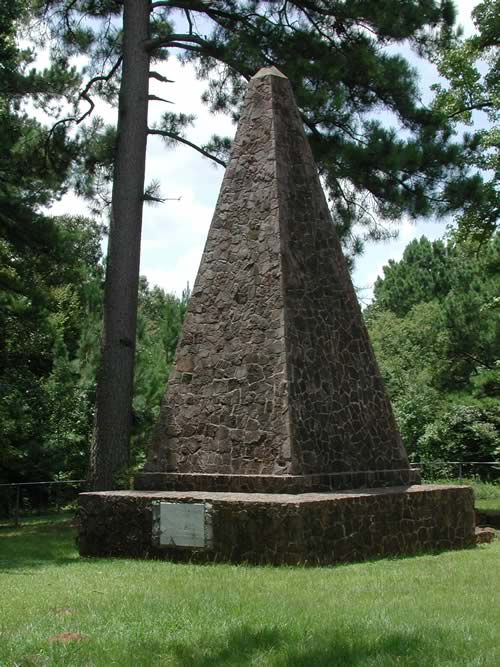 |
The Killough
Massacre Mounument
on CR-3431, Larissa,
TX
Photo courtesy Janet Gregg, 2005 |
Text and photos
© Janet Gregg
November
8, 2005
Writer’s Note: As with many stories handed down
verbally from generation to generation, there are some discrepancies
between the various versions that have been put into writing. I have
taken all available information into account and tried to clarify
and resolve those discrepancies, choosing the most likely scenarios
for this article when a concrete resolution to a specific detail could
not be found. - JG
Resources ›
Getting There
› |
| Texas
Escapes, in its purpose to preserve historic, endangered and vanishing
Texas, asks that anyone wishing to share their local history, stories,
landmarks and recent or vintage photos, please contact
us. |
|
|
 HOME
HOME