|
|
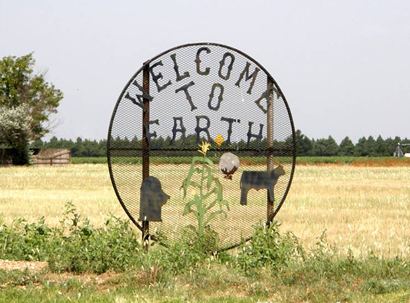 |
History in
a Pecan Shell
Earth had no 19th
Century history. It began in 1924 and was originally called Fairlawn
or Fairleen.
The source of its unusual name is unclear and three stories are given:
1. When the first postmaster was filling out the application for a
name, a sandstorm blew in.
2. The town founder had wanted to call it Good Earth which was shortened
by post office bureaucrats and
3. The postmaster described the storm on his applications and the
reply from Washington (supposedly) stated : "Since the earth seems
to move in that country, the post office shall be named Earth." (Or
words to that effect.)
In 1930 Earth had a respectable population of 350 Earthlings. By 1940
it was 600 and it reached its zenith in 1980 with 1,512 residents.
The population increase (rare in West Texas) is due to irrigation
and Southwestern Public Service's plant outside of town.
Earth Historical Marker › |
 |
by Mike
Cox ("Texas Tales" column)
...Rancher William E. Halsell did not make the heavens above, or the
fishes in the sea, but he created Earth in 1924. He had been in the
area since 1901, when he bought up a huge chunk of the old XIT
ranch for $2 an acre. In August 1924 he had a town site platted
and began selling lots.
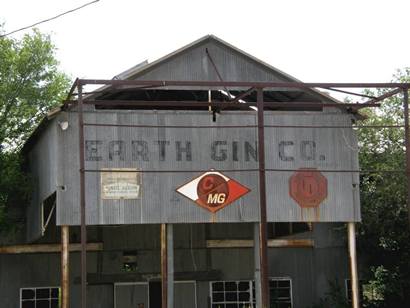
The Halsell Land Co. built a hotel, a cotton gin and the first house.
Within a couple of years Earth could boast of a café, a service station,
a store or two and more residences. And that’s about all the solid
ground there is when it comes to the history of Earth.
Researchers have un-earthed at least four versions of how a point
in a rural High Plains county became Earth:
The first settlers wanted to call the new town Tulsa, but the
U.S. Post Office quickly took them back to Tulsa as a bad choice,
since such a town already existed in Oklahoma.
Halsell supposedly called his town Fairlawn (some say Fairlene),
but the frequent blowing dirt inspired someone to come up with Earth.
Another tale has R.C. “Daddy” Reeves, who operated the new town’s
hotel, declaring: “We’ve got more earth here than anything else, let’s
call it Earth.”
A final version has Halsell, wanting to emphasize the fertile soil
around his town, came up with Good Earth. Washington, this
tale holds, did away with “Good” and made the place plain old Earth.
While accounts vary as to how Earth, Texas got its worldly name, you
can take to the soil bank that Earth is the only place in the United
States called Earth. (There’s Black Earth, Wisc., Blue Earth, Minn.,
White Earth, Minn. and Md., Earth City, Mo and Middle Earth, Md. but
that’s as close as it gets.) Neither does a global search reveal another
Earth anywhere on Earth.
Someone seemingly with all the time on Earth has also discovered that
in addition to Earth, the state of Texas has a small solar system
of other towns named after the planets swirling around our sun. Beyond
Earth, Texas’ extraterrestrial town names include Mercury,
Mars, Saturn
and Pluto.
Several states have Venus, Jupiter and Neptune as town names, though
no state has chosen to honor Uranus.
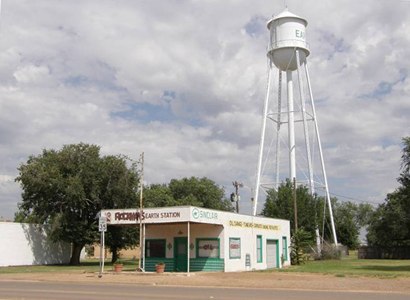
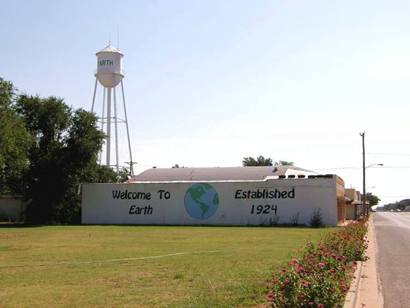
But to get back to Earth, despite its all-encompassing name, it’s
a pretty down-to-Earth community, a rural agricultural center whose
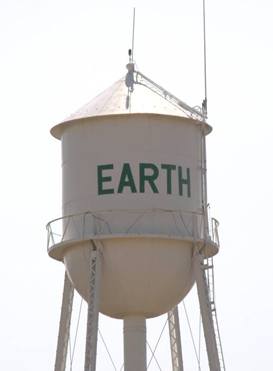
principle landmark is a shiny silver-colored water tower with the
green (as in “God’s green Earth”) letters E-A-R-T-H painted on its
tank.
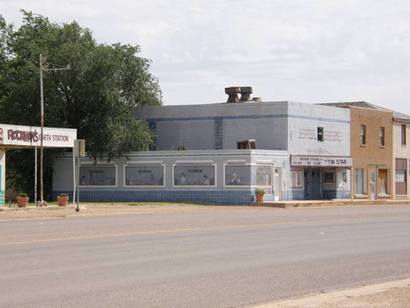
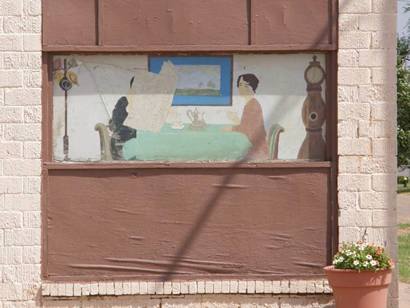
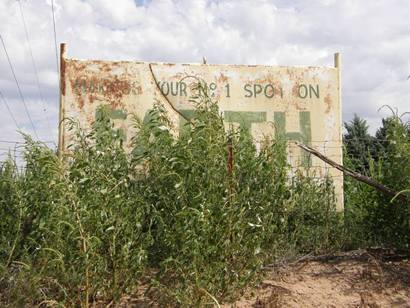
Speaking of paint, several of the buildings along State Highway 70,
the town’s main thoroughfare, have been enhanced by someone handy
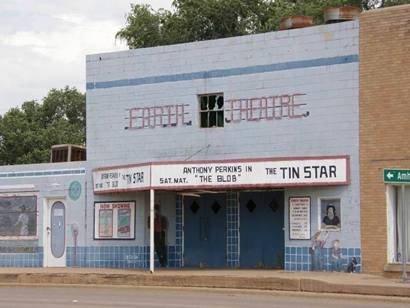
with a brush. The former movie theater, long since closed, has been
dolled up as “The Tin Star,” featuring Anthony Perkins perpetually
playing in “The Blob” with showings at 6 and 10 p.m. daily and matinees
at 2 p.m. on Saturdays.
Down the street at Main and Cedar is the paint-enhanced office of
the Earth News, an imaginary newspaper “Dedicated to the Development
of the World’s Richest Irrigation Area.” On the side of another building,
someone painted a giant green population sign reading “Earth Pop.
1019.”
That population is not big enough to support its own school, so students
go to class in nearby Springlake.
Because of that, the football team is known as the Wolverines, not
Earthmen.
Small but tough, Earth endured the Dust Bowl and the Depression but
stayed in slow decline until the late 1970s. The high point of Earth’s
orbit came in 1980, when the town’s population peaked at 1,512. But
the number of those calling Earth home has dropped by nearly a third
since then.
Even the Dairy Queen stands abandoned these days.
© Mike Cox "Texas
Tales" column |
 |
Photographer's
Note:
These last trips to the Panhandle
have given me a whole new perspective on this part of the state. Most
of the towns were
totally pleasant to visit. They each have their own personalities.
- Barclay
Gibson, September 2009 |
Earth Historical
Marker on US 70
Photo courtesy Barclay
Gibson, August 2009 |
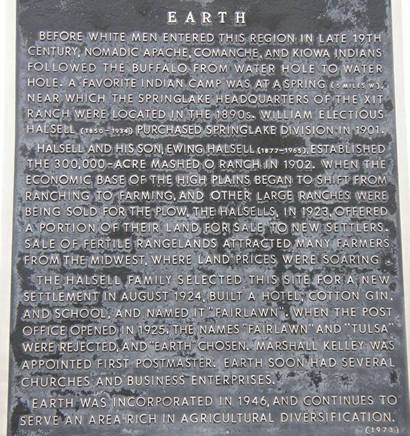
Historical Marker
Earth
Before white men
entered this region in late 19th century, nomadic Apache, Comanche,
and Kiowa Indians followed the buffalo
from water hole to water hole. A favorite Indian camp was at a spring
(5 miles west), near which the Springlake headquarters of the XIT
Ranch were located in the 1890s. William Electious Halsell (1850-1934)
purchased Springlake Division in 1901.
Halsell and his son, Ewing Halsell (1877-1965), established the 300,00-acre
Mashed O Ranch in 1902. When the economic base of the High Plains
began to shift from ranching
to farming, and other large ranches were being sold for the plow,
the Halsells, in 1923, offered a portion of their land for sale to
new settlers. Sale of fertile rangelands attracted many farmers from
the midwest, where land prices were soaring.
The Halsell family selected this site for a new settlement in August
1924, built a hotel, cotton gin, and school, and named it, "Fairlawn".
When the post office opened in 1925, the names "Fairlawn" and "Tulsa"
were rejected, and "Earth" chosen. Marshall Kelley was appointed first
postmaster. Earth soon had several churches and business enterprises.
Earth was incorporated in 1946, and continues to serve an area rich
in agricultural diversification.
(1973) |
 |
| Texas
Escapes, in its purpose to preserve historic, endangered and vanishing
Texas, asks that anyone wishing to share their local history, stories,
landmarks and recent or vintage photos, please contact
us. |
|
|
 HOME
HOME

 Texas
Gulf Coast
Texas
Gulf Coast East
Texas
East
Texas Central
Texas North
Central
Texas North Central
Texas South
Central
Texas South Texas
Panhandle
Texas
Panhandle South
Texas
South
Texas Texas
Hill Country
Texas
Hill Country West
Texas
West
Texas Texas
Ghost Towns
Texas
Ghost Towns Texas
Counties
Texas
Counties