|
 |
 |
Historical Marker
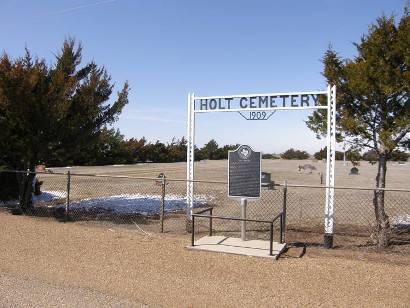
Holt Cemetery
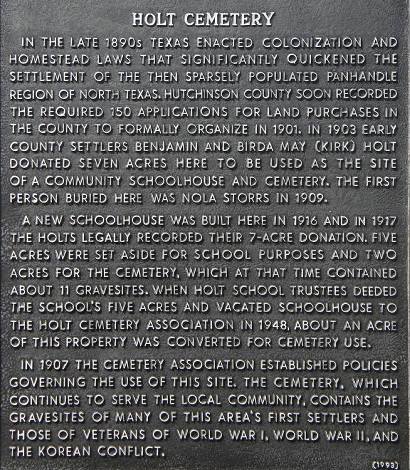
In the late 1890s
Texas enacted colonization and homestead laws that significantly quickened
the settlement of the then sparsely populated Panhandle
region of North Texas. Hutchinson
County soon recorded the required 150 applications for land purchases
in the county to formally organize in 1901. In 1903 early county settlers
Benjamin and Birda May (Kirk) Holt donated seven acres here to be
used as the site of a community schoolhouse and cemetery. The first
person buried here was Nola Storrs in 1909.
A new schoolhouse was built here in 1916 and in 1917 the Holts legally
recorded their 7-acre donation. Five acres were set aside for school
purposes and two acres for the cemetery, which at that time contained
about 11 gravesites. When Holt School trustees deeded the school's
five acres and vacated schoolhouse to the Holt Cemetery Association
in 1948, about an acre of this property was converted for cemetery
use.
In 1907 the cemetery association established policies governing the
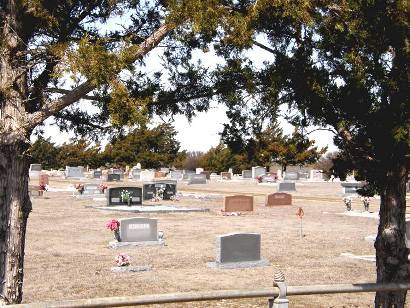
use of this site. The cemetery, which continues to serve the local
community, contains the gravesites of many of this area's first settlers
and those of veterans of World
War I, World
War II, and the Korean conflict.
(1993) |
 |
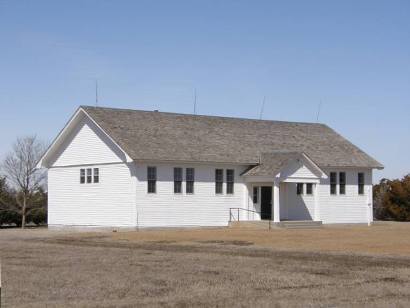
Holt School
Texas Historic Landmark
Photo courtesy Barclay
Gibson , March 2010 |
Historical Marker:
Holt School
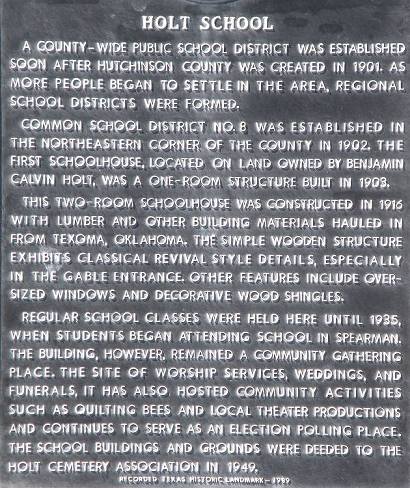
A county-wide public
school district was established soon after Hutchinson
County was created in 1901. As more people began to settle in
the area, regional school districts were formed.
Common School District No. 8 was established in the northeastern corner
of the county in 1902. The first schoolhouse, located on land owned
by Benjamin Calvin Holt, was a one-room structure built in 1903.
This two-room schoolhouse was constructed in 1916 with lumber and
other building materials hauled in from Texoma,
Oklahoma. The simple wooden structure exhibits classical revival
style detailings, especially in the gable entrance. Other features
include oversized windows and decorative wood shingles.
Regular school classes were held here until 1935, when students began
attending school in Spearman.
The building, however, remained a community gathering place. The site
of worship services, weddings and funerals, it has also hosted community
activities such as quilting bees and local theater productions and
continues to serve as an election polling place. The school buildings
and grounds were deeded to the Holt Cemetery Association in 1949.
Recorded Texas Historic Landmark, 1989. |
 |
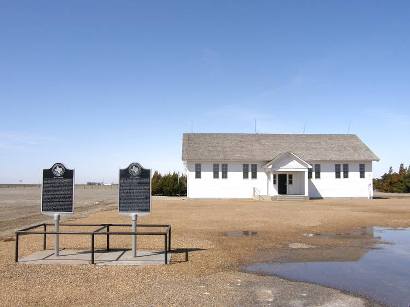
Holt School and
historical markers
On FM 281
Photo courtesy Barclay
Gibson , March 2010 |
Historical Marker
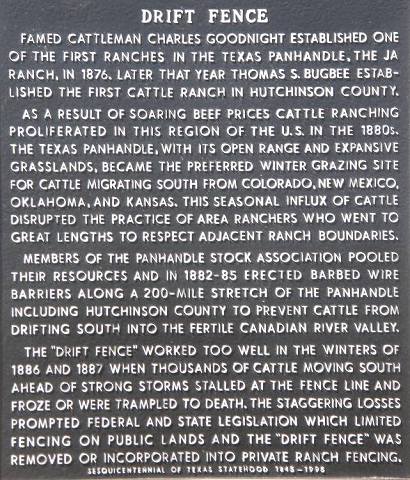
Drift Fence
Famed cattleman
Charles
Goodnight established one of the first ranches in the Texas
Panhandle, the J A Ranch, in 1876. Later that year, Thomas S.
Bugbee established the first cattle ranch in Hutchinson
County.
As a result of soaring beef prices cattle
ranching proliferated in this region of the U.S. in the 1880s.
The Texas Panhandle,
with its open range and expansive grasslands, became the preferred
winter grazing site for cattle migrating south from Colorado, New
Mexico, Oklahoma, and Kansas. This seasonal influx of cattle disrupted
the practice of area ranchers who went to great lengths to respect
adjacent ranch boundaries.
Members of the Panhandle Stock Association pooled their resources
and in 1882-85 erected barbed
wire barriers along a 200-mile stretch of the Panhandle
including Hutchinson
County to prevent cattle
from drifting south into the fertile Canadian River Valley.
The "drift fence" worked too well in the winters of 1886 and 1887
when thousands of cattle moving south ahead of strong storms stalled
at the fence line and froze or were trampled to death. The staggering
losses prompted federal and state legislation which limited fencing
on public lands and the "drift fence" was removed or incorporated
into private ranch fencing.
Sesquicentennial of Texas Statehood 1845-1995. |
 |
| Texas
Escapes, in its purpose to preserve historic, endangered and vanishing
Texas, asks that anyone wishing to share their local history, stories,
landmarks and recent or vintage photos, please contact
us. |
|
|
 HOME
HOME