|
|
|
Research
recently turned up interesting facts about the parallel lives of
two Panhandle men,
one who became famous and the other who became lost in the annals
of history. Strangely, the reason for the difference in the outcome
of their lives was, believe it or not, about 500 feet in altitude.
Now, as Paul Harvey would say, the rest of the story.
Charles Goodnight, the famous man, and Henry W. Cresswell, the forgotten
man, became acquainted when they both arrived in Pueblo, Colo. Goodnight
established a ranching venture and Cresswell started a dairy and
grain farm. As they prospered, they became good friends.
In time, both owned and raised a lot of cattle, grazing them on
open range east of Pueblo. Both became respected customers of the
Thatcher Brothers Bank in Pueblo, which eventually grew into the
largest financial institution in the area.
As the range settled up and became over-grazed, both men sought
new grass for their herds. Goodnight drove a large herd to the Canadian
River in Texas with Cresswell going
along to see and investigate the country. When Goodnight stopped
in the Canadian breaks, Cresswell went on in a great circle to see
the wide open spaces in the northern Texas
Panhandle. He was convinced it would be good cattle country.
Less than a year later, Cresswell brought his herd down the same
trail as Goodnight traveled, settling just down the river from Adobe
Walls and his friend, Goodnight.
Later that year, Goodnight moved on south into Palo
Duro Canyon, eventually grazing over a million acres. Cresswell
grazed his herds from the Canadian
River north to the Oklahoma Strip, which included 1.25 million
acres.
They were neighbors and friends, sold and bought cattle from each
other and were prominent respected citizens. When Goodnight was
elected the first president of the Panhandle Stock Association in
1880, Cresswell served as vice-president.
When the famous drift fence was built across the Texas
Panhandle north of the Canadian
River, Cresswell built east into Oklahoma and Goodnight and
others built west into New Mexico .
Both changed with the times, accepting new barbed
wire fences as inevitable and needed. Each protected their rights
but neither turned vicious with the nester/settler problems.
|
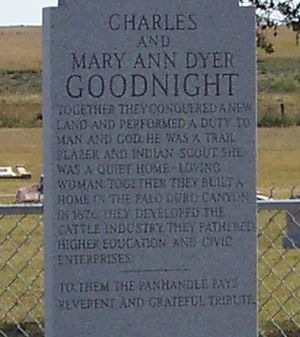 |
Charles and Mary
Ann Dyer Goodnight Marker
Photo courtesy Marlee Goodnight Dickerson |
At
this point, the year 1886-87, the parallels stop. Today, we know almost
every accomplishment and every word Goodnight said or did. Books have
been written and a museum is being developed in his memory.
Almost no one remembers Henry Cresswell. I finally found where he
had died of blood poisoning in January of 1905 and is believed to
be buried at Pueblo. Why was he not remembered better? Because the
winter of 1886-87 brought prolonged blizzards and cold, killing hundreds
of thousands of livestock on the Great Plains.
Those ranchers like Goodnight, living below the caprock, survived
with little loss. Cresswell, grazing the high plains, survived and
continued operating but never recovered financially to the level enjoyed
before the blizzards. The difference was basically about 500 feet
in altitude.
© Delbert Trew
"It's All Trew" August
21, 2007 Column |
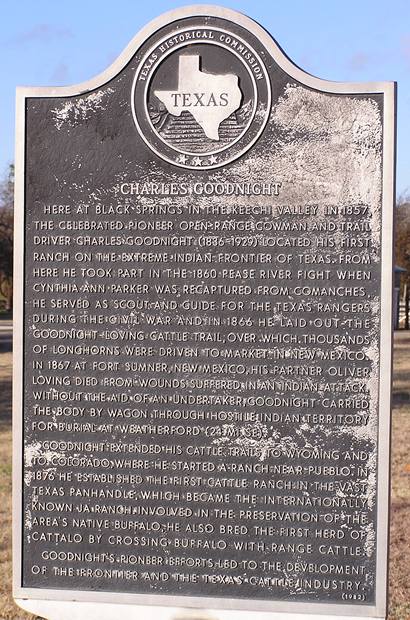
Charles
Goodnight Historical Marker
Photo courtesy Curtis Carter |
Historical Marker
- On FM 52 in Oran
Charles Goodnight
Here at Black
Springs in the Keechi Valley in 1857, the celebrated pioneer open
range cowman and trail driver Charles Goodnight (1836-1929) located
his first ranch on the extreme Indian frontier of Texas. From here
he took part in the 1860
Pease River fight when Cynthia
Ann Parker was recaptured from Comanches, he served as scout and
guide for the Texas Rangers during the Civil War and in 1866 he laid
out the Goodnight-Loving cattle trail, over which thousands of longhorns
were driven to market in New Mexico. In 1867 at Fort Sumner, New Mexico,
his partner Oliver Loving died from wounds suffered in an Indian attack.
Without the aid of an undertaker, Goodnight carried the body by wagon
through hostile Indian territory for burial at Weatherford
(24 miles southeast).
Goodnight extended his cattle trails to Wyoming and to Colorado, where
he started a ranch near Pueblo. In 1876 he established the first cattle
ranch in the vast Texas
panhandle, which became the internationally known JA Ranch. Involved
in the preservation of the area's native buffalo,
he also bred the first herd of cattalo by crossing buffalo with range
cattle.
Goodnight's pioneer efforts led to the development of the frontier
and the Texas cattle industry.
(1982) |
|
|
 HOME
HOME