|
|
RANSOM CANYON,
TEXAS
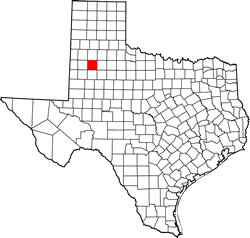
Lubbock
County, Panhandle
/ West Texas
33° 32' 0" N, 101° 40' 47" W (33.533333, -101.679722)
Off of FM 3523
12-18 Miles E of Lubbock
the county seat
Population: 1,135 Est. (2016)
1,096 (2010) 1,011 (2000) 750 (1990)
Ransom Canyon, Texas Area Hotels ›
Lubbock
Hotels |
Near Buffalo
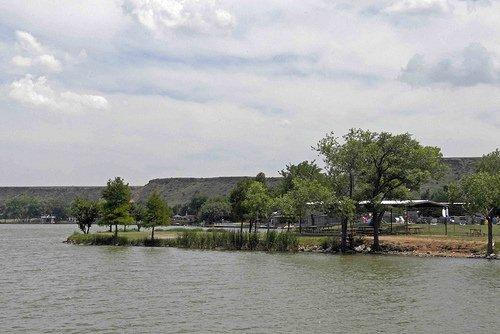
Springs Lake In Yellow House Canyon
On the North Fork of the Double Mountain Fork of the Brazos River
History in
a Pecan Shell
The town was developed
in the second half of the 20th Century.
It incorporated in 1977. The original name of the development had
been Lake Ransom Canyon until 1984 when it dropped the word
“lake.” From a 1980 census count of 561, the development has increased
to just over 1,000 for the 2000 census. |
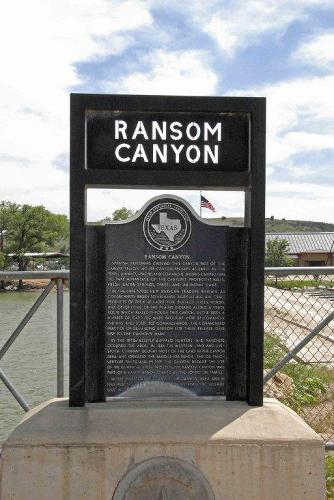 |
Historical Marker:
Ransom Canyon
Spanish explorers
crossed this canyon, part of the larger Yellow House Canyon, perhaps
as early as the 1540s. Jumano, Apache, and Comanche Indians camped
here to take advantage of the canyon's protective walls, fresh water
springs, trees, and abundant game.
In the late 1700s New Mexican traders known as Comancheros began to
exchange agricultural and craft products of their villages for buffalo
hides, horses,
and other items of the Plains Indians along a trade route which passed
through this canyon. In the 1800s a number of captives were brought
here by Comanche Indians and sold to Comancheros. The Comanchero practice
of demanding ransom for their release gave rise to the canyon's name.
By the 1870s mostly buffalo
hunters and ranchers
occupied the area.
In 1884 the Western Land and Livestock Company bought most of the
land in the canyon area and operated the famous IOA Ranch. The IOA
Ranch venture failed and in 1901 the canyon became the site of the
O6 Ranch. From 1915 until 1961 Ransom Canyon was part of a large ranch
owned by the Johnston Family. In 1961 investors purchased the canyon
area and in 1965 platted Lake Ransom Canyon Village. The village was
incorporated in 1978.
1994 |
 |
|
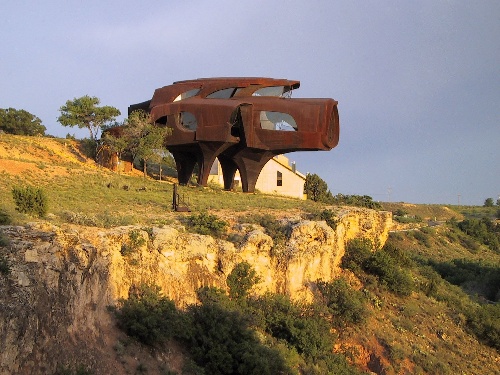
Photo
courtesy www.robertbruno.com
|
Ransome Canyon
Attraction:
Steel
House by Byrone Brown
Sculptor and architect Robert Bruno has bequeathed to us his Steel
House, sometimes referred to as “The Metal Mansion”, just outside
of Lubbock
in Ransom Canyon... |
| Texas
Escapes, in its purpose to preserve historic, endangered and vanishing
Texas, asks that anyone wishing to share their local history, stories,
landmarks and vintage/historic photos, please contact
us. |
|
|
 HOME
HOME

 Texas
Gulf Coast
Texas
Gulf Coast East
Texas
East
Texas Central
Texas North
Central
Texas North Central
Texas South
Central
Texas South Texas
Panhandle
Texas
Panhandle South
Texas
South
Texas Texas
Hill Country
Texas
Hill Country West
Texas
West
Texas Texas
Ghost Towns
Texas
Ghost Towns Texas
Counties
Texas
Counties