|
When
Tyler’s
historic Carnegie Library building celebrated its anniversary, the
event reminded East Texans of the legacy Andrew Carnegie left before
his death in 1919.
Carnegie, a Scottish-born steel magnate, helped create a network of
public libraries across America in the early l900s. Before he launched
his effort, the country had only about 600 fledgling libraries. By
the time he was done, the nation had added nearly 1,700 more.
In Texas,
Carnegie donated $645,000 to 31 Texas communities ranging in population
from Houston,
which had only 44,600 people at the time, to Pecos,
which had only 639. It is little wonder that an early writer called
the old capitalist “the Santa Claus of Texas libraries.”
In
East Texas, the Carnegie
legacy continues in the communities of Tyler,
Jefferson, Marshall,
Palestine and
Franklin.
Some of the towns’ Carnegies have remained libraries while others
serve different community roles. Carnegie buildings, however, have
vanished in Clarksville,
Pittsburg, Sulphur
Springs, and Winnsboro.
|
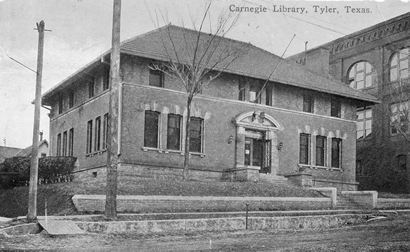 |
Tyler’s
Carnegie is the home to the Smith County Historical Museum and houses
a wonderful collection of materials related to the county’s history.
Tyler is currently raising nearly a half-million dollars to give the
building a centennial facelift. During the Depression, the building
acquired murals entitled “Industry of East Texas,” painted by Dallas
artist Douthett Wilson.
Palestine’s
Carnegie today houses the Chamber of Commerce in a Prairie one-story
and basement building with a series of graceful arched windows across
the facade. The interior is almost original.
At
Franklin, the Carnegie is similar in design. It served as a library
for only a few years after it was built in 1914 and today houses classrooms
and shop classes for the Franklin school district.
Jefferson’s
Carnegie is still maintained as a library six days a week and
Marshall’s Carnegie is
used as an administrative building on the campus of Wiley College. |
|
|
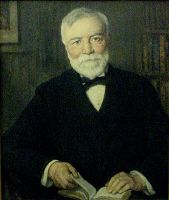
Andrew
Carnegie
Photo
Courtesy The Carnegie Center of Brazos Valley History
|
|
The
public libraries Carnegie built didn’t come cheap. Between 1890
and 1919, he spent $40 million of his own money for library grants.
In Texas he also built one college
library and a lecture hall.
Appropriately, the Pittsburgh-based philanthropist began his Texas
grants at Pittsburg
in East Texas with a
gift of $5,000 in 1898.
Carnegie had a good personal reason for building libraries.
Growing up in Scotland, he had seen his father persuade his fellow
weavers to pool a portion of their salaries and buy books, which
were read aloud as they worked.
When he was twelve, after his family came to America, Carnegie wrote
a letter to the Pittsburg newspaper, seeking public access to a
private library which, to that point, had been reserved for mechanics
and tradesmen. Carnegie never forgot the opportunities libraries
gave him during his career.
But a town didn’t get money for a library because it requested one.
It had to provide a location for the building and annual taxes to
support the library.
If the library proposal had been up to Eugene Debs, an American
socialist leader, no libraries would have been built. Debs believed
Carnegie’s money came from an unfair capitalist system and, as such,
no one should take any of it.
© Bob
Bowman
January 25, 2005 Column, updated February 10, 2012
Bob Bowman's
East Texas ›
A weekly column syndicated in 109 East Texas newspapers
|
|
|
 HOME
HOME