|
|
More
than any other structure, a courthouse is the most endearing symbol
of a county's history in Texas. And they're usually among the most
imposing buildings in the county seat.
But in the l950s, many Texas counties threw aside history, tradition
and elegance and replaced some of our finest courthouses with modern
buildings--many of them with little character or appeal.
That happened in
my home town of Lufkin.
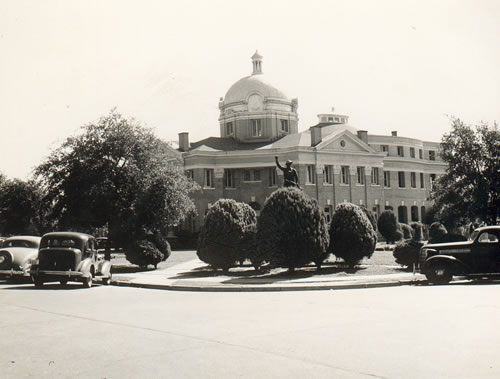
The Angelina County Commissioners Court decided that its fifty-year
old courthouse, resplendent with a dome and a clock, was inadequate
to meet the county's needs. Following a bond election to fund a new
courthouse, the county demolished the old courthouse without ceremony
in 1953. |
|
|
The
demolished Angelina County courthouse as it appears in a downtown
Lufkin mural by Lance Hunter
Photo by John Troesser, 2002 |
Today, to a generation of Angelina County residents who fondly remember
the old courthouse, it was the wrong thing to do.
And the error has now been compounded by the discovery that our old
courthouse was designed by one of the most famous architects in America
-- James Riley Gordon, the man responsible for the designs of eighteen
Texas courthouses during two decades of practice in Texas. |
The Angelina
County courthouse designed by J. Riley Gordon
1939 photo courtesy of TXDoT |
Today,
twelve of the landmark Gordon courthouses are still standing in Bexar,
Comal,
Ellis,
Erath,
Fayette,
Gonzales,
Harrison, Hopkins,
Lee,
McLennan,
Victoria,
and Wise
counties. Ten are still serving their original purpose.
A native of Winchester, Virginia, Gordon moved with his parents to
San Antonio in 1874
and worked with his father, a civil engineer. But he loved architecture
more and began studying with the widely-admired firm of W.C. Dobson
and J.N. Preston. He also worked in the office of the U.S.
Supervising Architect in Washington before embarking on courthouse
designs. In Texas, Gordon progressed from a charming and eclectic
style in the Moorish manner into a highly effective Romanesque style.
His version of this style is seen at its best in the courthouses of
Wise,
Ellis
and several other counties.
During his latter years, Gordon employed a Classical or Beaux-Arts
style and his courthouse designs at Lufkin,
Marshall and Waco
were outstanding examples of this work. In fact, if you visit the
McLennan
County Courthouse
at Waco,
you can see some of the same features that made Lufkin's
courthouse admired.
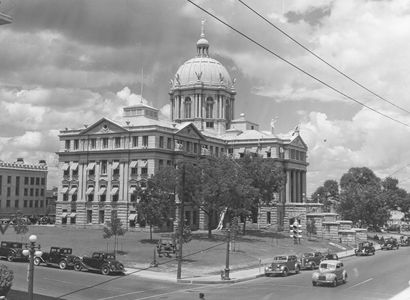
The Waco
courthouse was completed in 1901. At the time Gordon was working
on the plans for Lufkin's
county edifice, which was completed two years later. |
0
 |
|
Visiting the
Waco
courthouse, the similarities with Lufkin
were apparent. Both had soaring domes, topped with small cupolas.
Both had classical arches over each wing and the window designs
of each building were similar.
Borrowing another Waco feature, Gordon's design at Lufkin
included a clock in the dome structure. But when Angelina County's
new, box-like courthouse was dedicated in 1955, it lacked an outside
clock.
Bowing to public
pressure, the commissioners court had the builder place a $1,400
modernistic, numberless clock on the front of the boxy, new courthouse,
but it was hidden by a large oak tree--which the county proposed
to cut down.
But, again, the public spoke out and in a newspaper poll, a 693-194
majority decided to keep the tree. So the new clock remained shrouded
by the tree until a ladies' beautification group decided to trim
the trees in 1966. When the limbs came down, the courthouse clock
was visible for the first time in years. But its belated victory
was a hollow one. The clock hadn't worked at all in ten years.
Today, in a touch of irony, the tree is dying -- and the clock is
working.
All
Things Historical
August 17 , 2004
Published with permission
Distributed by the East Texas Historical Association. Bob Bowman
is a former president of the Association and the author of 30 books
about East Texas.
|
|
|