|
|
It
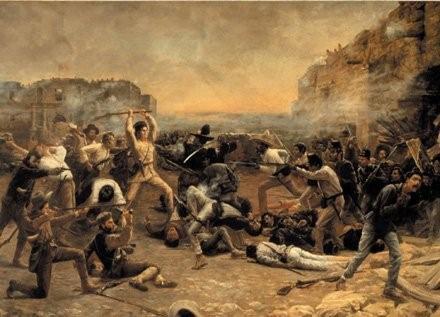
might come as a surprise to many Texans that there were two ‘battles
of the Alamo.’ There was the one in February and March of 1836, and
then there was one that lasted for nine years—from 1903 to 1912.
I really don’t like to write about the Alamo.
Not that I don’t appreciate what its significance for Texas
is--I can’t read Travis’s last letter on the wall there without tears
coming to my eyes, and I know what a first-water (expletive deleted)
he was in his personal life. Still, everybody’s written about the
Battle of the
Alamo—the first one, that is. Not many folks have written about
the second one. |
 |
| I’ve read the
best histories of the first battle—Steve Hardin’s A TEXIAN ILIAD is
about the best, though it covers the entire war for independence.
Walter Lord’s A TIME TO STAND is up there, as is John Myers Myers’
THE ALAMO. I’ve read the best novel ever written about the Alamo—Lon
Tinkle’s THIRTEEN DAYS TO GLORY, which was the basis for the John
Wayne film The Alamo. I’ve also read the two worst Alamo novels. One,
THE BLAZING DAWN, was written by a native Texan, James Wakefield Burke.
The other, W. O. Stoddard’s THE GOLD OF THE MONTEZUMAS—A TALE OF THE
ALAMO, was written in the early part of the last century and seems
to be the basis for the idea that there is a great hoard of gold hidden
somewhere around the Alamo.
|
| But
what about the Alamo
itself? Not the symbol or the fight, but the physical structure that
stands in downtown San
Antonio today. What’s happened to the physical basis of the Shrine
of Texas Liberty since March of 1836? This is the story of the other
battle of the Alamo—how Texas almost lost it forever, who saved it
for Texas and how, why we still have it, and who we have to thank
for that. |
| What’s
in downtown San Antonio
today is not the Mission San Antonio de Valero, but merely the mission’s
chapel and a portion of an old convento or apartment known today as
‘the long barracks.’ Everything else on Alamo Plaza postdates the
Texas Revolution. The original mission’s compound took in most of
the land around the site. The west wall of the compound was about
where the back walls of the buildings across the street are today.
James Bowie died in a small room built into the south wall, near where
the gazebo in Alamo Plaza stands today. Travis apparently died somewhere
near where the Cenotaph
stands. The ground in front of the chapel—the building we call
‘the Alamo’ today—is
soaked with the blood of the men who died in that battle, both Texicans
and Mexicans. |
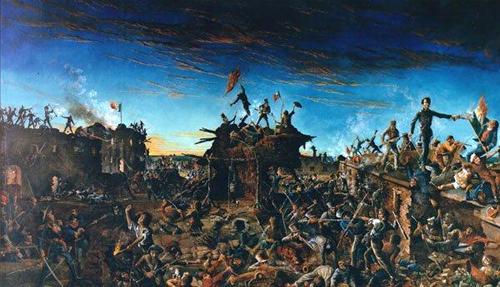
Dawn at the Alamo
Photo courtesy Texas State Library and Archives |
On
the morning of March 7, 1836, the Alamo mission’s chapel and compound
were a gutted, smoking ruin. The chapel was roofless, its bell-towers
gone, its walls with gaping holes from Mexican artillery fire. Santa
Anna, not wishing a shrine to the 240-odd defenders who died there,
order the ruin razed. Not one stone was to be left standing upon another.
The ruin was not razed. In spite of direct orders from Santa Anna,
the walls of the Alamo chapel were left standing. Not that there was
much there—the façade was badly damaged and crumbling, the walls in
many places were no more than head-high on a tall man. Still, Santa
Anna gave a direct order—‘Knock down the walls!’—but it wasn’t done.
Why not?
Nowhere in the records, Texian or Mexican, will you find that Santa
Anna rescinded that order. Nowhere will you find an explanation of
why the order wasn’t carried out. Still, when Santa Anna’s troops
marched out of San Antonio
in pursuit of the ragtag-and-bobtail Sam
Houston was trying to turn into something like an army, the walls
were still standing.
Where there are no records there are stories. The stories—from Mexico
as well as from San Antonio—say
Santa Anna’s engineers and sappers went to the building to carry out
the order—then turned tail and ran. According to the stories they
saw something—several somethings—standing guard over the ruin. What
they saw they described as ‘glowing men with flaming swords.’
Maybe that’s just an old ghost story. Maybe the guys who were sent
to tear the place down went to a cantina instead. After too much mescal
and what was left of the powerful gringo whiskey, they couldn’t
tear the place down and made up a story to cover their failure. Maybe—but
look at the description of what they said they saw. “Glowing men with
flaming swords.” Where have you seen that before? It’s pretty close
to the description of guardian or avenging angels in both Christian
and Jewish lore. Maybe they weren’t seeing things, after all. |
Guardian
angels may have protected the Alamo ruin from Santa Anna’s sappers,
but they seem to have been sent on other assignments shortly afterwards—or
perhaps they felt the Alamo’s walls wouldn’t need protection from
the physical and spiritual heirs of the men who died defending them.
During the ten years of the Republic, the Shrine of Texas Liberty
was not treated with reverence. The mission was built with cut limestone—already
cut, just lying around, nobody was using it. Much of that stone was
cannibalized to build other buildings in San
Antonio. The outer walls of the compound were carried off, as
were the gateposts. Jim Bowie’s death room was torn down piece by
piece, and no one, today, can say where the stones that took his blood
are sited. Eventually the two mostly-intact buildings, the chapel
and the ‘long barracks,’ began to disappear piece by piece.
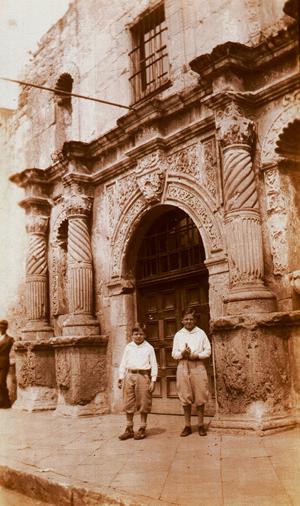
By the time Texas joined the United States the façade of the chapel
was a shambles and the rest of the walls were, in places, no more
than waist high on a tall man. The US Army came to Texas
and made San Antonio
its departmental headquarters. Uncle Sam needed a storehouse—a warehouse—to
store grain and supplies, and there simply wasn’t one available. There
was, however, just north of the main part of town, that old ruin which,
with work, could be rendered usable. The Army took over the ruin of
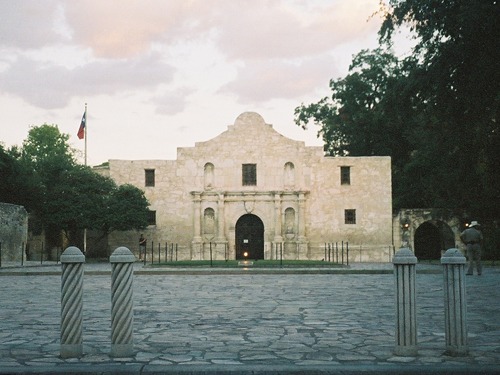
the chapel and rebuilt the walls, then re-roofed it. The present façade
of the Alamo—the step-and-arch
profile that’s known the world over—isn’t what was there in 1836.
At that time the chapel had a flat roof with bell towers at the two
west-side corners. What we recognize as the Alamo’s façade today was
built by the US Army’s Corps of Engineers in the 1840s. |
 |
By
the 1870s the Army had pretty much outgrown its downtown headquarters
and was moving operations to the newly-established Fort Sam Houston,
far to the north of town along the New Braunfels road. It no longer
needed the storehouse with the peculiar façade. At that point controversy
enters the story, because nobody knew, for sure, who actually owned
the chapel, which continued in use as a warehouse by a local merchant
firm. By the 1890s it was becoming somewhat of a tourist attraction—“Yeah,
folks, that battle took place right there in my warehouse”—but tourism
wasn’t yet big business. A frame retail store adjoined the stone building,
and there certainly was no reverential treatment of what some called
‘that old eyesore of a pile of rocks.’
Both the City of San Antonio
and the Roman Catholic Archdiocese of Texas claimed the building.
There was considerable litigation over the title to the chapel and
eventually courts decided in favor of the Archdiocese. The state bought
the chapel itself and the ground it stood on—but no more—from the
Catholic Church. All the rest of the land surrounding the chapel—the
land where the battle was actually fought—passed into private hands. |
 |
1930s photo of
the Alamo
TE Archives |
Texas
didn’t do much with the building. There was no restoration, no effort
even to preserve the crumbling walls. The state owned it, it was there,
that was it. Title to much of the land to the north of the chapel,
where the old convento stood, was held, in the 1890s, by Hugo
& Schmeltzer, a firm of wholesale merchants. They had a huge frame
warehouse and salesroom built adjacent to the chapel and at least
some of their offices were in the convento.
In 1903 Hugo & Schmeltzer was closing its doors for good and selling
off its assets—one of which was the land to the north of the chapel.
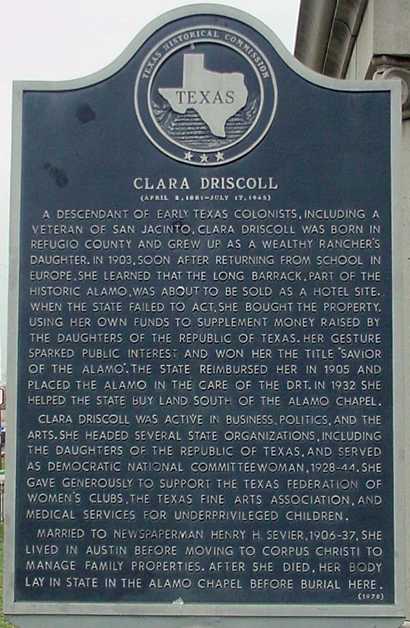
About three years earlier a young woman named Clara
Driscoll, whose grandfather, Daniel Driscoll, was a San
Jacinto veteran, returned to Texas
after spending seven years in school in Europe. Clara was impressed
with the way Europeans preserved and protected their historical sites.
When she saw the condition of the Alamo chapel and the land where
the battle was fought, she was furious. She began a letter-writing
campaign to newspapers around the state. The objective was the preservation
of the Alamo chapel and as much of its grounds as possible. She joined
the DeZavala Chapter of the Daughters of the Republic of Texas and
immediately began campaigning to acquire the Hugo & Schmeltzer property
to add to the Alamo chapel, in order to begin proper preservation
of the Shrine of Texas Liberty.
Now,
Clara was a salty ol’ gal, and there’s more than rumor that she liked
her nip—several of ‘em in succession. She lived much of her later
life in Corpus
Christi, and at one time—now demolished—there was a luxurious
hotel called the White Plaza ‘on the bluff’ in Corpus
Christi, overlooking the bay. Clara and several cohorts tried
to check into the White Plaza one night and were refused registration
because, quite frankly, they were stewed to the gills and the management
thought they’d disturb the other guests.
“By God,” said Clara, “I’ll build a hotel right next to your damn’
hotel, an’ it’ll be bigger an’ finer’n your damn’ hotel, an’ when
I get it finished I’ll spit on your damn’ hotel.” (For the record,
she didn’t say ‘spit,’ but that’s what the tour-guides have to say
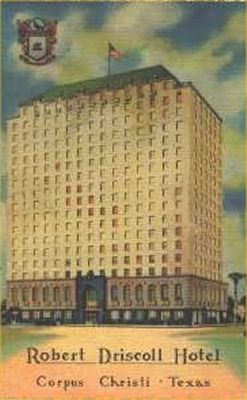
she said.) She built the hotel—the Driscoll, which still stands as
an office building in downtown Corpus
Christi. It was right next door to the White Plaza. Atop the Driscoll,
attached to the penthouse, is a projection that overhung the roof
of the White Plaza. It was from that projection, so they say, that
Clara did what she said she’d do on the White Plaza—and she didn’t
say ‘spit.’ |
 |
The Robert Driscoll
Hotel in Corpus
Christi
Postcard courtesy rootsweb.com/ %7Etxpstcrd/ |
That
was a long time later—in 1903 Clara was simply a wide-eyed young lady
crusading for the preservation of what has become the single most
widely-visited historical site in Texas and one of the most widely-visited
in the US. She and members of the DeZavala Chapter, DRT, approached
Hugo & Schmeltzer about selling the property adjacent to and directly
north of the chapel.
“Sure,” said Hugo & Schmeltzer. “You got seventy-five thousand bucks?”
The DeZavala Chapter of the DRT didn’t have $75,000. Hugo & Schmeltzer
was demanding $5,000 for a one-year option, with an additional $20,000
to be paid when the option expired and five annual installments of
$10,000 at 6% interest to be paid over the next five years. The DeZavala
Chapter—and the DRT as an organization—started trying to raise the
money.
Almost immediately a new player entered the game. An eastern syndicate
wanted to buy the Hugo & Schmeltzer property for a hotel, and it was
offering better than $5,000 for a year’s option. Clara, together with
Judge James B. Wells of Brownsville
and Floyd McGown of San
Antonio, went directly to Charles Hugo, the surviving partner
of Hugo & Schmeltzer, to try to preserve the property for Texas. Hugo
agreed to give a 30-day option on the property for $500, cash on the
barrel, and an additional $4,500 to be paid in 30 days. Clara reached
into her purse, pulled out her checkbook, and wrote the $500 check
that ultimately preserved the grounds of the Alamo
as they are today.
The DeZavala Chapter DRT immediately called for a statewide appeal
to raise the needed $4,500 by April 17, 1903—the day the option expired.
Though the legislature was in session, it declined to appropriate
the money to pick up the option. The DRT sent a delegation to the
legislature—Clara headed it—and an amendment was placed on an appropriations
bill to provide the $5,000 to pick up the option and reimburse Clara
her $500.
Before the appropriations bill could pass the time ran out on the
30-day option. Rather than lose the property, Clara pulled out her
trusty checkbook and put up the remaining $4,500. The property was
safe for a year. The ladies waited for the legislature to act. The
bill passed—but Governor S. W. T. Lanham vetoed it. Clara was out
$5,000 and there was no guarantee the DRT could raise the $20,000
that would be due in a year, much less the $10,000 per year for the
next five years—plus interest—to complete the purchase.
By
February 10, 1904, the DRT had raised $5,666.23. The option was expiring
and the eastern syndicate was sitting in the wings with money to buy
the property for cash. Out came Clara’s checkbook again, and she wrote
a check for $14,333.77 to clinch the sale. She also signed, in her
own name, five notes for $10,000 each at 6% per annum to complete
the payment. She was now obligated for another $50,000 plus interest,
in addition to taxes and insurance on the property—all for ‘an unsightly
old pile of rocks.’ The deed of transfer included the words “This
property is purchased by Clara Driscoll for the use and benefit of
the Daughters of the Republic of Texas, to be used by them for the
purpose of making a park about the Alamo,
and for no other purpose.”
There’s
something peculiar about Texans—we
love a fighter. Our history—and our legends—are full of one-man—and
one-woman—fights for what the fighter though was right. Clara’s fight
to preserve the land around the Alamo
brought an immediate outpouring from around the state. Money rolled
in—and so did sympathy. By August, 1904, the Democratic State Convention
made purchase of the Alamo property a plank in the party’s platform.
On January 26, 1905, the 29th Legislature appropriated $65,000 to
complete the purchase of the Alamo property. Governor Lanham signed
the bill. The bill provided that the Daughters of the Republic of
Texas should be custodians of the property. Clara formally transferred
the property to the State of Texas and Governor Lanham conveyed custody
of the property to the DRT. Just in case you think the funds don’t
quite add up, the DRT raised $10,000 on its own—and yes, Clara got
her $19,333.77 back—but without interest. |
 |
The
purchases that would ultimately expand the Alamo
property into the park we know today had been made, but at terrific
cost. The DRT, as an organization, was nearly flat broke. Clara’s
magic checkbook had taken a tremendous beating. The very last thing
the DRT needed in connection with the Alamo
was an internal squabble-—the sort of thing that would cause the doomsayers
of Texas, of which we have never had a dearth, to say things like
“See, those derned ol’ women can’t even get ‘long amongst themselves.
How’re they gonna run the Alamo!”
Unfortunately, that’s just what they got.
Probably the single most tireless worker for the preservation of the
convento, today’s Long Barracks—outside of Clara and her magic
checkbook—was Adina
de Zavala of San
Antonio. Adina
was president of the DeZavala Chapter of the DRT, one of the earliest
DRT chapters organized. It was named for her direct ancestor Lorenzo
de Zavala, the first Vice President of the Republic of Texas and the
man who could, without much exaggeration, be called the father of
public education in Texas. She worked at least as hard if not harder
than Clara Driscoll, persuading and lobbying, to get the Alamo’s grounds
and surviving structures preserved, but she simply didn’t have the
one thing the DRT desperately needed—and Clara did. In spite of all
other efforts, if Clara hadn’t come up with the money when it was
needed there would be no Alamo
park today.
Adina’ contribution to saving the Alamo grounds should never be belittled,
for she did much. She also assumed much. Somehow she became obsessed
with the idea that the Alamo park and its management were the prerogative
of the DeZavala Chapter, DRT, and not of the organization as a whole,
and in particular that Adina
de Zavala possessed—in her own words—the “divine right” to manage
the Alamo. The result
was a comedy that, like all great comedies, held within it the elements
of tragedy.
On
October 4, 1905, Governor Lanham, by official letter, formally transferred
possession of the Alamo
and the grounds to the Daughters of the Republic of Texas, “To be
maintained by them in good order and repair, without charge to the
state, as a sacred memorial to the heroes who immolated themselves
upon that hallowed ground; and by the Daughters of the Republic of
Texas to be remodeled upon plans adopted by the Daughters of the Republic
of Texas, approved by the Governor of Texas; provided that no changes
or alterations shall be made in the Alamo Church property as it now
stands, except such as are necessary for its preservation….” Upon
receipt of this letter the President General of the DRT, Mrs. Anson
Jones, widow of the Republic’s last President and the chairwoman of
the DRT’s executive committee, appointed Clara Driscoll temporary
local custodian of the Alamo church and surrounding property. Adina
de Zavala promptly went ballistic.
She went immediately to the mayor of San Antonio and represented herself
as the duly-appointed custodian of the property. The mayor, not knowing
she wasn’t, gave her the keys to the Alamo chapel—which she promptly
locked to keep Clara and her associates out. During the fight to preserve
the property a lot of relics surfaced across Texas—and the US—that
were supposed to have some association with Alamo defenders. Most
were sent to the DRT in care of the DeZavala Chapter because, at the
time, it was the unofficial but only practical custodian for them.
Adina stripped the Alamo of almost all the donated or loaned relics,
claiming they were the property of the DeZavala Chapter and not the
DRT as a whole.
Clara was appointed custodian but Adina had the keys—and the relics.
The state conveyed the property to the DRT as of October 4, 1905,
but it wasn’t until the DRT filed a civil action against Adina that
she surrendered the keys to Clara on November 13. Now Clara had the
chapel but Hugo & Schmeltzer still occupied the old convento
and would continue to do so until all its property was sold. Over
the next two years Adina made life miserable for everyone concerned
with the Alamo project, so thoroughly disrupting the 1907 general
convention of the DRT that it was forced to adjourn sine die without
accomplishing anything at all. Clara, herself a member of the DeZavala
Chapter, resigned from the entire organization in disgust.
In the meantime factions formed, as they will in any dispute, and
accusations began to fly. One of the charges leveled by Adina’s faction
was that the DRT as a whole planned not on tearing down the frame
Hugo & Schmeltzer building at all, but on operating it as a saloon
and vaudeville house, with—horror of horrors—women dancing in short
skirts with their legs bare! This, the rumor-mill insisted, would
never happen if the ‘rightful custodians’ of the Alamo, Adina de Zavala
and the DeZavala Chapter, DRT, were in charge. The thing finally reached
such an absurd level that, on April 20, 1907, the Attorney General
of Texas, R. V. Davidson, was compelled to issue a three-paragraph
opinion stating that the duly-elected executive committee of the DRT—not
Adina’s rump-convention executive committee—was the only body authorized
by the Legislature to "…demand and receive rents and profits of the
[Alamo] property.” The opinion went on to state that the Legislative
act “…places the care, control, and custody of this property in the
hands of the Daughters of the Republic of Texas, as a State organization,
and not in the care, control, and custody of any one of the chapters
of the organization.” Even the Attorney General’s opinion didn’t stop
Adina’s monomaniac attempts to seize control of the Alamo. Finally,
on July 20, the main body of the DRT managed to get an injunction
to expel her and get the relics back.
Adina
wasn’t quite finished. In February, 1908, the Hugo & Schmeltzer building
was at last being vacated. Without the knowledge of Hugo & Schmeltzer
Adina
de Zavala managed to get into the building. With help from someone—still
unidentified—she changed all the locks and literally barricaded herself
in the building. At midnight, February 10/11, possession legally passed
to the DRT. Miss Emma K. Burleson, the DRT’s appointed representative,
two other DRT members, Judge J. E. Webb, the DRT’s attorney, and the
Bexar County Sheriff
all went to the old frame structure to take legal possession. The
doors were locked and barred from the inside and a man inside refused
to open them.
Apparently Judge Webb was expecting something like this, for he came
prepared—with an ax. In the presence of the three ladies and the Sheriff
he applied it to the door. The party entered just in time to see the
man disappear up the stairs. They caught him on the second floor.
He was asked who was in the building with him. He said “No one.”
A lot of people saw Adina go in the building but nobody saw her leave.
Sheriff Tobin had a look around. He found her hiding under a desk,
on her hands and knees. He took out a copy of the injunction to read
aloud in her presence, at which point Miss Burleson’s report says
“…she put her fingers in her ears and refused to listen.” Adina also
refused to leave, and the sheriff declared he had to have a court
order to eject her forcibly.
As soon as the standoff became public knowledge the newspapers, of
course, had a field day. In a masterful demonstration of the sensationalism
of early 20th Century journalism, one Texas paper reported that Adina
had barricaded herself “in the very room where James Bowie died”—which
had been torn down and lost nearly a half-century earlier. Newspaper
reports—fueled by Adina and her cohorts—told of her ‘parched lips’
and ‘starving countenance,’ and alleged that she was only allowed
to sip coffee through an aperture in the door, the cup being held
outside by whatever the early 20th Century newspaper epithet for ‘member
of a good squad’ happened to be.
The ‘goon squad’ was made up of two Bexar
County Sheriff’s Deputies, W. T. Ingle and Nat Harlan. Those two
unfortunates were the target for every calumny a headline-writer could
pile on them, and all they were trying to do was maintain an official
presence in the building and see to it nobody went nuts and torched
the place. They guarded the Hugo & Schmeltzer Building—not “the Alamo”
as the news reports claimed—from midnight Monday, February 10/11,
until the final disposition of the situation on Thursday, February
15. In a letter to Miss Burleson, who was somewhat concerned that
there might be some truth in the newspaper reports—Bexar
County’s deputy sheriffs were not known for gentle and understanding
natures—they recounted the situation somewhat differently. “(W)e treated
her with every possible consideration and respect, and during that
time she had plenty to eat, and as far as we know, was as comfortable
as she desired to be.
“She did not drink coffee through an aperture in the door, as stated
by the papers; in fact she stated that she did not drink coffee, and
on one occasion refused coffee offered to her. She was not a prisoner
in the building, but was at liberty to go at any time she chose. She
had the use of a telephone and electric light. “The newspaper reports
regarding Miss de Zavala’s ‘parched lips’ and suffering, from our
observation, have no foundation in fact. The building is filthy and
unfit for occupancy, and was full of rubbish and trash. During the
daytime we brought her all the water she wanted, made fires for her,
and were in every way respectful. We also answered phone calls for
her, and would answer calls at the door and notify her parties desired
to speak to her at the door. Respectfully, W. T. Engle/Nat Harlan.”
Adina was finally ejected from the old building on February 15, the
necessary court order having arrived. She—and the DeZavala Chapter,
DRT—promptly filed a civil suit to try and recover control of the
property. Control of the property was placed directly in the hands
of the Governor of Texas, to be held by him until the litigation was
settled. On March 10, 1910, all appeals on the part of Adina de Zavala
and the DeZavala Chapter having been exhausted, the Alamo property
was formally released to the DRT as a whole. The court decided that
Adina de Zavala and the twelve members of the DeZavala Chapter who
had pursued the suit no longer had any claim to membership in the
DRT, nor could they use the DRT’s name or symbols in connection with
their activities. This effectively dissolved the DeZavala Chapter.
Former members of that chapter who had long before resigned in disgust
at Adina’s actions formed a new Chapter in San Antonio for the express
purpose, under the auspices of the DRT’s state organization, of managing
the affairs of the Alamo.
That Chapter, still in existence, is called The Alamo Mission Chapter,
DRT. |
 |
Well,
the daughters had the Alamo
and what we today call the Long Barracks, but they also had an unsightly
monstrosity of a frame building built over and around the Long Barracks—and
they were very nearly broke from all the litigation. There wasn’t
much they could do until they raised some more money. First on the
list of improvements, though, was the demolition of that frame structure.
This raised yet another controversy. The original convento
had been two story, but how much of the original second story remained
was questionable. In addition, the Hugo & Schmeltzer building had
been around a while and there were people who actually believed it
was part of the historic structure. One of those seems to have been
Governor Colquitt, who insisted that he, and he alone, could control
what was demolished or built on the Alamo grounds. The DRT had to
go back to court again. Finally, in 1912, the Legislature settled
the issue once and for all with an act that gave the DRT control of
the grounds and structures. Controversy has raged ever since as to
whether or not there was enough of the second story of the convento
to salvage, and both sides insist they are right to this day. The
winners, at least, insisted there wasn’t, and what there was—which
wasn’t salvageable—should be removed so the view of the chapel from
the northwest wouldn’t be obstructed.
During 1920, ’21, and ’22 the old 1849 roof on the chapel began to
collapse. Working entirely from donations and organizational fundraising
projects, together with a gift from the San Antonio Chamber of Commerce,
which had belatedly come to realize that ‘the old pile of rocks’ was
a great civic asset, the DRT reroofed the Alamo.
Not one cent of taxpayer money was involved.
In 1925 the DRT and the City of San Antonio came
to an agreement whereby the property to the immediate north of the
chapel—including a large stone building which served as a city fire
station—was transferred to the Alamo park. That old San Antonio firehouse
today is the Alamo Hall—the souvenir shop for the chapel. That fulfilled
a long DRT dream of getting all commercial activity out of the Alamo
chapel and making it a true shrine.
During all this time the floor of the chapel was the original—dirt.
A steady influx of tourists, plus dampness, often churned this into
mud. In 1935-’36—again working entirely with DRT-raised and privately-donated
funds—the stone floor still in the chapel was laid. At the same time
the State, private donations, and the DRT’s fundraising efforts commissioned
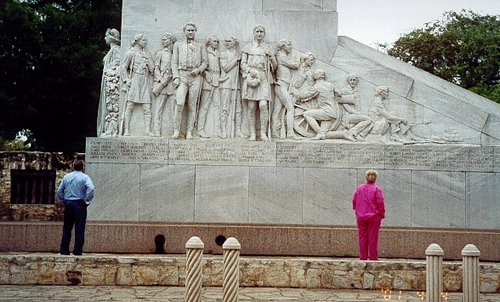
the ‘art deco’ cenotaph
to commemorate the Alamo dead that stands in Alamo Plaza today. At
least four previous efforts to raise funds for an ‘Alamo monument’
had failed. |
 |
|
For
nearly a century now the Alamo
and its grounds have been in the charge of the Daughters of the
Republic of Texas. During that time not one cent of state money
has been spent in the reconstruction, renovation, and preservation
of the Shrine of Texas Liberty. With the exception of the money
that went into the purchase of the actual ground, not a cent of
taxpayer money has been spent on the Alamo.
All operating expenses for the Alamo
shrine and park, including the salaries of the management personnel,
grounds people, and security personnel, have been paid for through
that little donation box inside the chapel, or through the sale
of souvenirs at the Alamo Hall.
At the same time, no one—neither Texan nor tourist—has ever been
charged a single cent to walk through the most sanctified structure
in Texas. Nowhere else in the United States—and quite possibly in
the world—is that true. Every other park or shrine, whether state-run,
federally operated in the US, nationally-operated outside the US,
or privately maintained and operated, operates on admission fees.
At the Alamo, though,
any schoolchild can walk where Jim Bowie and David Crockett walked—and
it won’t cost a cent.
The Alamo is unique—not
just in being the Shrine of Texas Liberty, but in being the only
major tourist attraction in the United States and perhaps in the
world that has been efficiently managed for nearly a century without
becoming—even during the Great Depression of the 1930s—a burden
to taxpayers. In the meantime, what’s happened to the rest of the
parks and shrines
in Texas?
If you’ve tried to enter most state
parks, you’ve found there’s an admission fee of some sort. You’ve
also found that they’re pretty much in a state of dilapidation.
The San
Jacinto Monument had to be closed a few years back because its
maintenance had been so sorely neglected for so long that the monument
itself was unsafe. It cost you, the taxpayers of Texas,
a bundle to fix it. The forts of a later era on what was once the
Texas frontier are, for the most part, preserved in a state of ‘arrested
decay.’ That means they were falling apart, so the state went in
and put some cement in strategic places so they won’t fall apart
any worse.
What about in other states? Texas has perhaps the lowest park-use
fees in the country. When my wife and I lived in Kentucky in the
late 1960s, we tried to visit some of the more famous spots there—among
them The Hermitage, Andrew Jackson’s home; Fort Boonesboro State
Park, Federal Hill Plantation House, which is the ‘Old Kentucky
Home’ Stephen Foster wrote the song about, and the Shaker settlement
in Kentucky. Admission fees—in the late ‘60s—were $5 per person
and up, just to tour the houses.
Have you tried a National Park recently? In 1994, when we visited
my wife’s relatives in Washington State, it cost nearly $20 per
car to get into Mount Ranier National Park. I’ve since found that
fees are substantially higher at other National Parks.
Yet here in Texas, to visit the most famous site in the state—one
that’s known the world over—it won’t cost you a cent. Now, why is
that?
|
 |
|
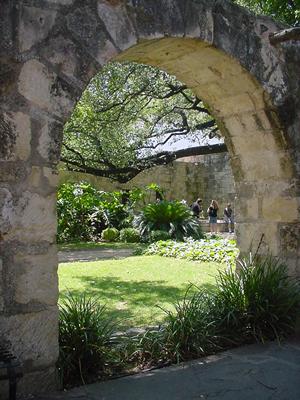
Alamo Courtyard
Te photo, 2006
|
The
Daughters of the Republic of Texas—the ‘li’l ol’ blue-haired ladies’—made
that possible. By efficient management and volunteer help, they’ve
made it free, for nearly a century, to visit our greatest shrine.
Recently some people in Austin
have been trying to take the Alamo
away from them. We might be moved to ask why.
As a fact, the Alamo
is the single most widely visited historical site in Texas. If it
were run by, say, the Parks and Wildlife Department, with—suppose—a
$2 entry fee for adults, 50¢ for children, it would furnish a sizeable
portion of the Parks side of the Parks and Wildlife Department’s budget
each year. That, perhaps, would be beneficial, but it would also mean
that the revenue from the Alamo
would be going to support other state parks and historical sites.
It’s entirely possible that the Alamo
and its park wouldn’t be anywhere near as well maintained as they
are today.
For nearly a century the Daughters of the Republic of Texas have made
the Alamo the best-run, most efficiently managed tourist attraction
in Texas and probably in the United States. Instead of thinking about
taking it away from them, maybe we ought to consider making the DRT
custodians of all our historical sites. From all indications, they’d
do a better job than has been done to date.
I tip my hat—be it Panama or John B.—to the ladies of the DRT. Ladies,
you have done a truly magnificent job of preserving and protecting
one of the most significant historical sites in the world. You’ve
made it where any schoolchild can enter the Alamo
and walk where Travis, Bowie, and Crockett fought and died—and it
won’t cost them a cent to do it. About no other site in Texas—nor
in the US and probably not in the world—can that be said. You haven’t
cost the taxpayers of Texas a cent in the process. May your shadows
on Alamo Plaza never diminish.
© C. F.
Eckhardt
"Charley Eckhardt's Texas"
September 4 , 2007 column |
Forum:
Subject: Alamo is NOT best run, it is sadly neglected
In 2007, preservation architect Carolyn Peterson, with the firm of
Ford Powell Carson identified all of the problems at the Alamo,
but the DRT do not have the funds to correct them. The estimated costs
for the Shrine, Long Barracks, and Centennial Museum totaled about
$6.5 million. A $1 million grant from the Ewing Halsell Foundation,
obtained by DRT member Erin Bowman for pressing preservation needs,
will be used to fix the roof leaks. The remaining $5.5 million is
unfunded, and dependent upon money raised by a fundraising campaign
that isn't being launched until 2010. THREE YEARS AFTER THE MASTER
PLAN.
Other work on peripheral buildings, and the construction of a large
auditorium, bring the grand total to $35.5 million. This is all outlined
in the Master Plan approved by the DRT in 2007.
I feel that the Texas Historical Commission should take over the custodianship
of the Alamo. They are
acquiring responsibility of historical structures across the state.
Preserving the Alamo
is a priority for all of us - not just us San Antonians, but Texans
everywhere. We can’t wait for the DRT to raise the funds. They should
have gone to the governor years ago to get assistance, and retain
professional preservationists to monitor the Alamo.
We need to act now to save this sacred shrine, the symbol of our liberty.
My website has the pages from the Master Plan that outline the problems.
www.picturetrail.com/sfx/album/view/22617709
- Sarah
Reveley, November 15, 2009 |
|
|
 HOME
HOME