|
|
Annual Event:
Clay County Pioneer Reunion and Rodeo (September)
Photo courtesy Barclay
Gibson, April 2009 |
History in
a Pecan Shell
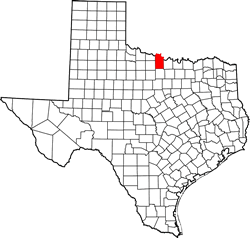
When Cooke County
was separated into two counties, the day before Christmas 1857, Clay
County needed a seat of government. The centrally located town
of Henrietta is the result – even though no one knows for sure the
origin of the name. One stretched (but somewhat believable) theory
is that since the county was named after Henry Clay, a feminized version
of his first name was in order. (Ships, cities, and countries were
once referred to as feminine.)
There wasn’t a fight for county seat, since it was the only real contender
for the title. With just a store and about ten residences, and less
than 110 people, tiny Henrietta had nowhere to go but up. In 1860,
it was the North
Texas frontier. Although it was granted a post office in 1862,
it was still a wild place and open to Indian attacks.
Abandonment and Resettlement
When the Civil War demanded the troops that were stationed there,
residents moved into Cooke
and Montague counties, and by 1862 Clay
County was, for all intents and purposes, a ghost county. Indians
had reportedly left "strange” markings on the town buildings, prompting
a purifying fire by troops. This may have sent the spirits on their
way, but now the town would be starting from scratch if and when people
decided to resettle here. One attempted resettlement in 1865 was a
little too early. Several members of the group were killed and the
rest retreated. A second attempt by a Quaker group (1870) met a worse
fate. The leader, Goodleck Koozer was killed and his wife and daughters
taken as captives (but eventually released). That same year fifty
soldiers and 300 Kiowas fought a pitched battle in the foundations
of the former town.
In time, settlers returned and the post office was reopened in July
of 1874. The isolation of the settlers made the town the judicial
“capital” of the region. The railroad arrived in 1882 (the Fort Worth
and Denver City) with the Gainesville, Henrietta and Western Railway
becoming the towns second rail connection in 1887. Travelers would
arrive by train and then ride stages to their final destinations.
During the buffalo
slaughter of the 1880s, Henrietta was an outfitting center and a shipping
center for the bones of the slain animals.
During this period, Henrietta, dwarfed the town of Wichita
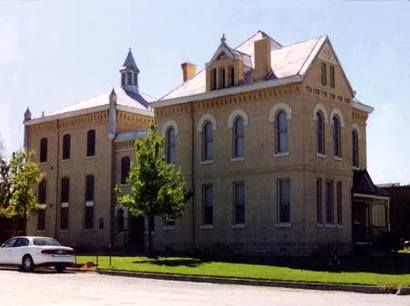
Falls. Clay
County's first permanent courthouse was built in 1884 and is still
standing. By 1890 the population was over 2,000 and the town had all
the amenities of a large town – and then some – including hotels,
five churches, two newspapers, and a 400-seat Opera House.
The population stayed about the same, but dropped slightly during
the Great Depression to just over 2,000. Growth was slow, and by the
1970s it had peaked with 3,600 people calling Henrietta home. By 1990
the population had declined to 2,896, growing to 3,264 for the 2000
census. |
 |
Henrietta Landmarks/Attractions
|
Henrietta Chamber
of Commerce Office
Photo courtesy Barclay
Gibson, April 2009 |
| Texas
Escapes, in its purpose to preserve historic, endangered and vanishing
Texas, asks that anyone wishing to share their local history, stories,
landmarks and recent/vintage photos, please contact
us. |
|
|
 HOME
HOME

 Texas
Gulf Coast
Texas
Gulf Coast East
Texas
East
Texas Central
Texas North
Central
Texas North Central
Texas South
Central
Texas South Texas
Panhandle
Texas
Panhandle South
Texas
South
Texas Texas
Hill Country
Texas
Hill Country West
Texas
West
Texas Texas
Ghost Towns
Texas
Ghost Towns Texas
Counties
Texas
Counties