|
|
|
|
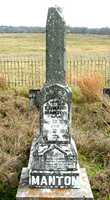
The centerpiece of the cemetery -
the Manton Obelisk
Photo by John Troesser |
|
The site of
what would've been Colorado City is now private property, so no
directions are furnished. The Manton Family cemetery, an iron fence
and a few historical markers are now the only things in the area.
Colorado City was on the route known as La Bahia Road or Trail.
Today La Bahia Road is officially marked as FM
390 from Burton
to (near) Washington-on-the-Brazos.
|
|
|
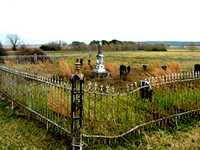
A
Winter view of the Manton cemetery with the Colorado River behind
the distant tree line.
TE photo |
|
|
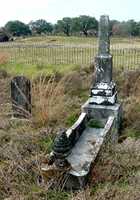
Another view
of the Manton obelisk'
TE photo
Readers' Comment: "Attached to the back of the Manton obelisk
is a sarcophagus in which the coffin would have been placed. It
appears the coffin may have been removed for reburial else where.
The damage done to it could be due to weather conditions or vandalism."
- Holly Hilpert, Nov. 21, 2003
|
The Brief Story
of Colorado City
In the late
1830s, while La Grange
was little more than a group of cabins, John W. S. Dancy and others
were platting Colorado City.
Colorado City was a planned grid of 156 blocks on the West bank
of the Colorado River just north of present day La
Grange. The town was to be on the low water crossing on the
Colorado known as the La Bahia crossing - one of the few spots on
the river that had equally sloping banks.
The site was a major crossing on the original La Bahia trail.
Even before surveyors got started, the Congress of the Republic
of Texas voted unanimously to make it the capital. Sam
Houston, as president, however, vetoed the proposal since he
wanted his namesake city to be the capital. Colorado City still
might have become the capital after Houston's term expired, except
that the next president of the Republic - Mirabeau
B. Lamar - preferred Austin.
Frequent flooding also dampened enthusiasm for the location and
soon Colorado City was more or less forgotten - existing only on
paper. The 5,000 acres that might've been the capital eventually
became farms. The unpredictable nature of the Colorado still prevents
it from being developed - in this day and age - a good thing.
|
| A
little West of the Colorado River is the Manton family cemetery -
a tidy well-tended cemetery on high ground that also contains graves
of other early settlers. |
|
|
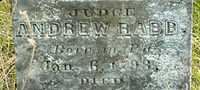
A
stone from the Rabb Family plot
TE photo |
Thomas
J. Rabb (1801-1846)
Thomas J. Rabb, soldier and member of Stephen F. Austin's Old Three
Hundred, was born in Fayette County, Pennsylvania, about 1801. The
family arrived in December of 1821. Initially, the entire family settled
on the west side of the Colorado River a short distance above the
site of present La Grange.
In early 1824 the Rabb family moved to the area around Egypt
in Wharton County
to escape Indian harassment. Rabb was appointed Captain of Company
F, First Regiment of the revolutionary army. During the Runaway
Scrape (with General Houston's permission), Rabb left to rescue
his family, thus missing the battle
of San Jacinto. After the war he settled on Rabb's Prairie - Fayette
County land that had been granted to his father. Rabb also served
as Captain of a Ranger company under the command of Col. John Moore.
He died in Fayette
County, Texas on October 29, 1846.
His original tombstone (shown above) is inscribed with his title as
Judge. A more recent marker has devices showing him as both a Citizen
of the Republic
of Texas and one of "Austin's
Original 300." |
John
Winfield Scott Dancy (1810 -1866) was named after his cousin General
Winfield Scott. Growing up in Decatur, Alabama and receiving a license
to practice law in Tennessee, he moved to Texas after the death of
his wife - arriving on December 28, 1836.
Dancy became a citizen of Texas on January 13, 1837, purchasing 640
acres in Fayette
County the following year. He introduced long-staple cotton to
Texas and in 1841 served as the Fayette
County representative to the Sixth Congress of the Republic of
Texas. He unsuccessfully ran for governor in 1853.
Dancy proposed selling public lands to finance railroad expansion
and was called the "Father of Texas Railroads" for his enthusiastic
promotion of railroads. He practiced law in La
Grange and was a founding trustee of Rutersville College. He edited
the Texas Monument, from July 1850 to June 1851. Dancy died in La
Grange on February 13, 1866, and was buried in La
Grange Cemetery. He is mentioned here for his role in developing
Colorado City. |
Excerpts
from
The Diary of John Winfred Scott Dancy,
Barker Texas History Center,
University of Texas at Austin:
In early January of 1838 Darcy wrote: "We crossed the Colorado to
day and reached Colorado City - our destination. At Colonel Manton's
the weather was quite pleasant. "
February :
"This was the day appointed by congress for the opening of the Land
Office. The boat was sunk at the ferry last night, there had been
a considerable rise in the river and Colonel Manton's canoe had by
accident gone down the river, so that people from this side of the
river were unable to go to La Grange."
February: "The canoe arrived last night and today Mathews (Thomas
Mathews of the Colorado City Land Company) crossed the river and for
the first time saw the site of Colorado City. He was highly pleased
and acknowledged that it equaled his most sanguine expectations."
19th February: "This was a beautiful day and we began to lay off Colorado
City."
In March of 1838 Darcy wrote: The Commissioners came over to Colorado
City and examined the surrounding country. They were well pleased
with the country about the La Bahia Crossing and had reserved all
the vacant land within nine miles of it for the use of the government
if Congress should locate the seat of government in this vicinity."
Darcy's diary goes on to mention the decision not to establish the
capital in Colorado City - and although it may have been a severe
personal disappointment - it was treated in a most matter-of-fact
manner in his diary. |
|
|
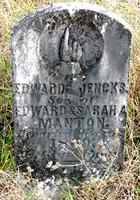
The
tombstone for Edward Jencks Manton
TE photo |
Edward
T. Manton (1820-1893)
Born at Johnston, Rhode Island in 1820, Edward T. Manton came to Texas
in 1833 at the age of 13. He received a 640-acre bounty grant of land
after joining Captain Rabb's company of Fayette
County volunteers in 1842. General Rafael Vásquez's invading troops
were forced back into Mexico. In September of that same year, when
Gen. Adrián Woll invaded San Antonio, Manton joined Capt. Nicholas
Dawson's Fayette
County volunteers to pursue the Mexican forces. Manton was one
of only fifteen prisoners to survive the Dawson
massacre at Salado Creek - just east of San
Antonio. It was Manton's written account that supplies the details
of that fight. Manton was released in 1844 and he returned to his
farm in Fayette
County where he lived until his death on August 20, 1893. |
|
|
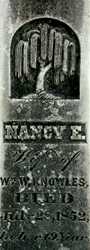
For some reason,
the handsomely carved tombstone for 19 year-old Nancy Knowles is the
only grave marker outside of the iron enclosure.
TE photo |
|
Editor's
Note:
Texas Escapes would like to express thanks to Fayette County historian
Gary McKee for his contribution of time and his services as guide.
- John Troesser
|
| Texas
Escapes, in its purpose to preserve historic, endangered and vanishing
Texas, asks that anyone wishing to share their local history, stories,
landmarks and recent or vintage photos, please contact
us. |
|
|
 HOME
HOME

 Texas
Gulf Coast
Texas
Gulf Coast East
Texas
East
Texas Central
Texas North
Central
Texas North Central
Texas South
Central
Texas South Texas
Panhandle
Texas
Panhandle South
Texas
South
Texas Texas
Hill Country
Texas
Hill Country West
Texas
West
Texas Texas
Ghost Towns
Texas
Ghost Towns Texas
Counties
Texas
Counties