|
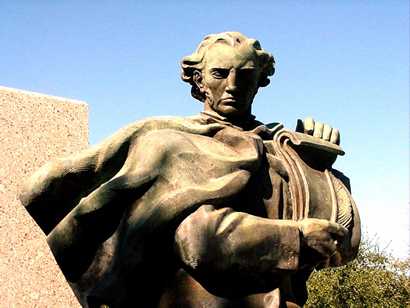
The dramatic
statue of Childress
(by Raoul Josset)
in front of the Star of the Republic Museum.
TE photo, November 2002 |
 |
Barrington
Living History Farm
21300 Park Rd.
12 Washington TX 77880 936/878-2214
barrington1850@earthlink.net
http://www.tpwd.state.tx.us
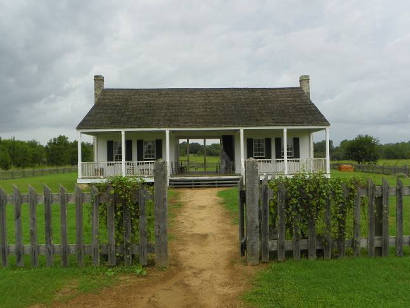
The plantation home of Anson
Jones, last President of the Republic
of Texas. The main house at Barrington served as the last "white
house" of the Republic and was originally four miles west of Washington
on the road to Independence.
Barrington Farm today is a hands-on educational facility demonstrating
early 19th Century Texas life/ agriculture and animal husbandry. |
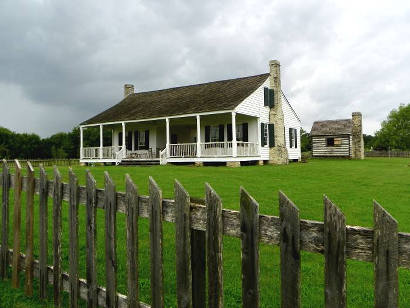
Barrington Farm
- Anson Jones Home
Photo courtesy Barclay
Gibson, September 2010 |
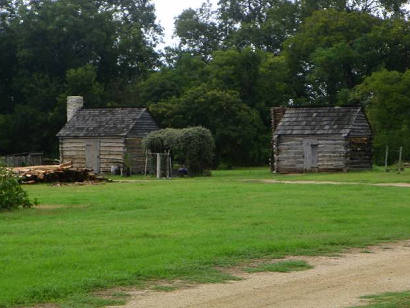
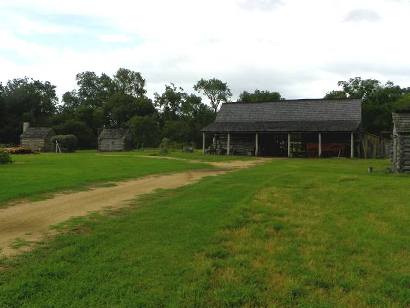
Handcrafted reproduction
log cabins
Photo courtesy Barclay
Gibson, September 2010 |
More views of
Barrington Farm
Photo courtesy Barclay
Gibson, September 2010 |
Star of the
Republic Museum
Exhibits
and artifacts of life as it was on the Brazos in the early 1800s.
Early newspapers, a press, a forge, and rare personal items are displayed.
There is something for the most incurious visitor - should you happen
to have one in your party. |
A Brief History
of Old Washington-on-the-Brazos
The
first settlers of Stephen
F. Austin's Colonists arrived in late 1821. Andrew Robinson settled
on the west side of the Brazos with his son in law John W. Hall and
built a ferry in 1822. Robinson was given a grant by Baron Bastrop
and Stephen
F. Austin in 1824 which included a league of land and the authority
to operate the ferry. The town was surveyed and platted in 1833.
Dr. Asa Hoxie named the town Washington
- after a town in Wilkes County, Georgia - said to be the first town
in the United States to be named after George Washington.
The town has been described as "little more than a collection of rough
log buildings scattered on a bluff about half a mile back from the
Brazos River. Colonel William Gray, a land agent from Virginia succinctly
described it as a "disgusting place."
After the fledgling government of the Republic
of Texas evacuated the site at the approach of Santa
Anna's army, it was said that "the glory of the town had departed
with the government." When people started moving back, it was described
as such:
"the highly respectful resident population of 250 watched with impotent
disapproval the doings of the hundred or so gamblers, horse racers
and sports who had most of the money." Another observed: "there was
a decrepit air about the place - except for racing season."
In 1842 when Washington
became the capitol for the second time - prosperity was apparent in
the brick buildings and additional homes.
Washington prospered
as river traffic increased and there were sometimes as many as three
stern-wheeled boats tied up at the docks. An 1854 flood left a boat
high and dry in a cotton field where it was eventually dismantled.
Captains took note - and moved their ships to deeper and more predictable
waters.
The most momentous event since the signing of the declaration of independence
occurred in 1845 when the Congress met at Washington on June 16, 1845
and Texas ceased to be a Republic and joined the United States.
Washington at zenith in the 1850s had a population of 1,500 - a figure
it never saw again. The town refused to pay a bonus to the approaching
Houston and Texas Central Railroad and became one of the first of
many Texas towns to experience "death by railroad bypass."
Cartoon
March
2, 1836: Texas Declaration of Independence first draft by Roger
T. Moore |
Tourist
Information
Washington-on-the-Brazos State Historic Site
Box 305 Washington TX 77880-0305
936/878-2214
Washington.Brazos@tpwd.state.tx.us
http://www.tpwd.state.tx.us
http://www.birthplaceoftexas.com |
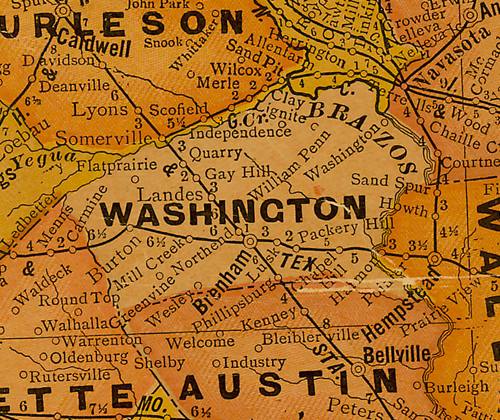
Washington
County 1920s map
From Texas state map #10749
Courtesy
Texas General Land Office |
|
|
 HOME
HOME