|
|
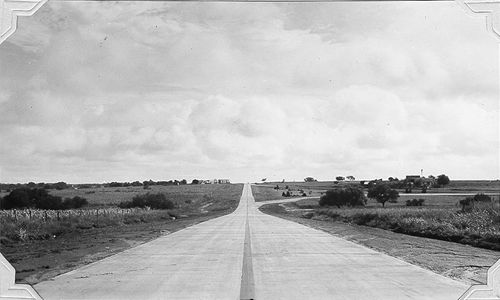
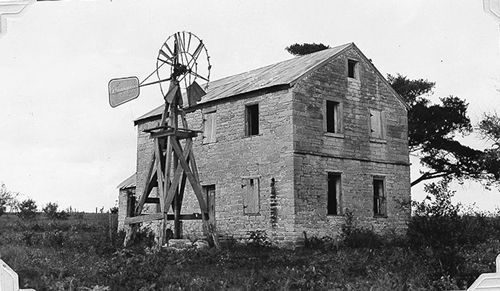
View of Hochheim
from the road
Vintage photo courtesy TXDoT |
History
in a Pecan Shell
Immigrating to Texas was often a tragedy.
Such was the case with Valentine Hoch who bought a homesite in DeWitt
County even before leaving his home in Alsace-Lorraine. The man's
name is German for "high" so it can be translated as "Hoch's Home"
or "High Home" which corresponds to the geographic location of Mr.
Hoch's residence.
One of Hoch's children died a few days before they left for America
and upon arrival in Indianola,
Mrs. Hoch died - leaving Valentine a widower with three surviving
children. Arriving at his property in 1856, Valentine spent the next
two and a half years building his two-story house from stone gathered
from the Guadalupe
River. Hoch remarried a woman with three children of her own and
soon other families were arriving. The community became known as Hocheim
to the German speaking residents and as "Dutchtown" by the Anglo settlers.
The community prospered since it was the Indianola-Austin
stageline and a post office was granted in 1870. Hochheim had most
essential business in the 1880s including at least two stores, a blacksmith,
a Masonic lodge and a druggist. Daily stages to Gonzales
and Cuero
(the nearest railroad
connection) made life a little easier for the 200 citizens - half
of which were German-speaking. The population peaked with 261 residents
in 1904. It declined to around 100 in the 20s and remained there for
the next 40 years. After a brief climb back to 175, it dipped down
to 70 where it remained for the 2000 Census.
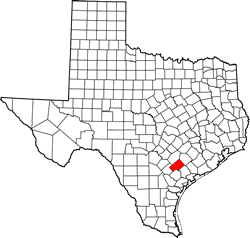
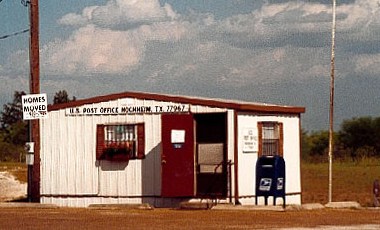
The town remains on the state map and retains a post office on the
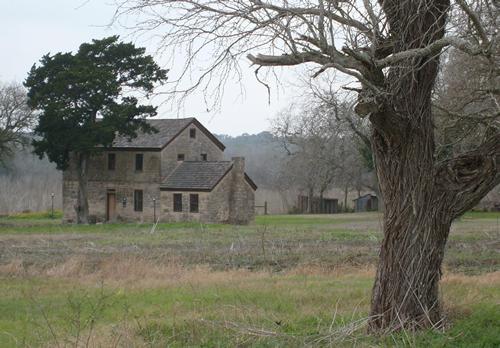
highway. Valentine Hoch's stone house still stands just south of town
- a mile from the Guadalupe
River. |
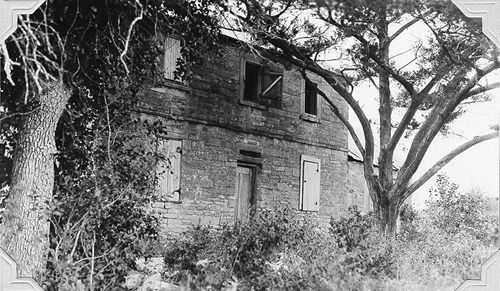
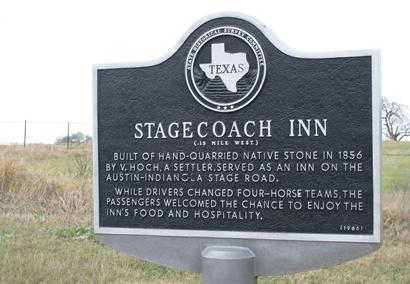
STAGECOACH
INN
Then and Now
|
| Vintage
photo courtesy TXDoT |
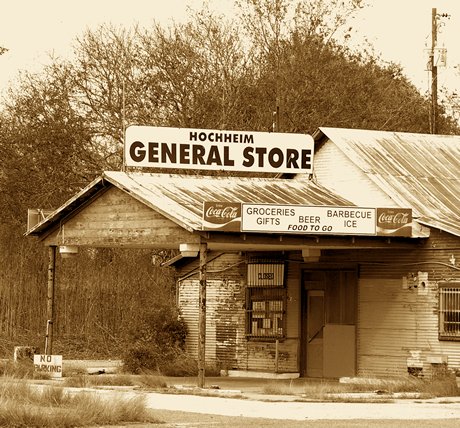
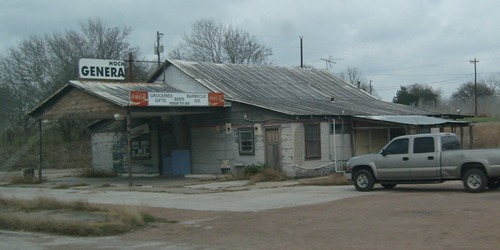
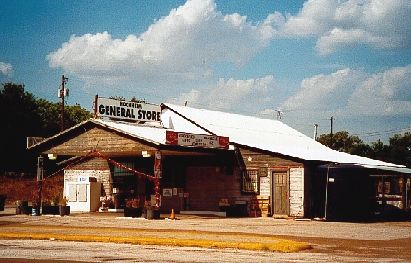
Hochheim General
Store
Then and Now
|
 |
 |
 |
Hochheim, Texas
Forum
Subject: Valentin
Hoch
Valentin Hoch was a German settler who travel from Germany in the
fall of 1845 looking for a better life for his family in America.
As the Hoch family finished their preparation for their voyage to
their new home in Texas and said their goodbyes to friends and neighbors,
tragedy, the first of many, struck the family. They had a baby who
sickened and died prior to boarding the ship in Bremen and another
child took ill and die aboard the ship on the journey to America.
Valentin’s wife, Margarethe made it to the shores of their new homeland
and died in Indianola. Valentin was among a group of new settlers
who were to receive a land grant and escorted to his new land upon
arrival in America, but circumstances led to the new immigrants being
left stranded without transportation, little food, and no shelter
on an island where disease and death were spreading rapidly. Many
immigrants, such as Valentin set out on their own. On February 17,
1848 a deed was filed in Gonzales County, Texas recording Valentin
Hoch purchasing 45 ½ acres of land in what is now DeWitt County, Texas.
The community at the time was known as Dutchtown and later became
known as Hochheim meaning “high home”. It is said that when “the lonely
German traveler came to the rolling rocky hills and the wooded hollows
of this uninhabited spot, he pulled his old gray horse to a halt and
said to his son, August, ‘Here we shall build our home’.” In 1854,
Valentin was single and raising his children on his own. It is said
that a “neighbor came to him one day and said ‘Volentine you need
a housekeeper. I hear that there is a lady stranded at Indianola who
would probably come to work for you. She has two children and has
recently lost her husband. You might see if you can get her to come’”.
“So Volentine went to see the lady, a Mrs. Fleming, who had come to
the new country with the same high hopes and plans that Volentine
had held, only to become hopelessly bewildered when death took the
husband and father of the family.” Perhaps, Valentin, hearing of Johanna’s
plight, recalled his own voyage to America, the loss of his two children
and his wife, and the overwhelming feeling of arriving in a new country
and having his own ‘high hopes and plans’ shattered. Whatever his
reasons were “he saddled up and went to Indianola to see the widow.”
“What arrangements they made concerning their respective families
were not known”, but Valentin returned in a few days with the young
German widow and her two children. The “mother’s name, however, had
been recently changed to Mrs. Volentine Hoch. History relates that
with no more courtship than that, they were married.” To this union
four more children would be born to Valentin. It is unknown exactly
when Valentin began the preparations to build a home for his family,
but it is assumed that the project was a long and intense one. Valentin
“spent several years quarrying his stone and bringing his material
to the spot where his house was to stand”. “There were no modern,
tools, no giant crane to lift the heavy stones, no one to quarry the
stone from the Guadalupe river banks, except Volentine himself.” “He
hauled the rock on a slide. The old gray horse pulled the slide.”
It is assumed that the home that Valentin labored over for his family
was completed in 1857. “The sturdy two-story rock house that Hoch
built was near the regular stage line between Indianola and Austin.
Although Hoch did not build his house for a stage stop, it soon became
known that one could partake of a good meal and if need be, spend
a night.” “People hauling freight from Indianola to Gonzales and Austin
would stop there and eat, take their teams out and water and feed
them.” “August Hoch, Valentine’s son, was learning to repair harness
and make saddles, a service always needed by the horse-drawn freighter
that passed by the Hoch place. The old home still stands today and
is recognized as a Texas Historical Landmark. The story of the Hoch
Home is best summed up in the article written in the Yoakum newspaper
in 1936, “Today, an old stone house stands on the old Hochheim-Cuero
road, about a mile and a half out of Hochheim, and about a mile from
the Guadalupe river, with its ancient roof beaten by the rains and
buffeted by the winds of eighty years, and its still sturdy walls
holding memories of the heart-aches and disappointments, the joys
and achievements, the births, marriages, and deaths, of three generation
of Hochs who made it their home.” - Thanks, Debbie Hoch, March 03,
2008 |
| Texas
Escapes, in its purpose to preserve historic, endangered and vanishing
Texas, asks that anyone wishing to share their local history, stories,
landmarks and vintage/historic photos, please contact
us. |
|
|
 HOME
HOME

 Texas
Gulf Coast
Texas
Gulf Coast East
Texas
East
Texas Central
Texas North
Central
Texas North Central
Texas South
Central
Texas South Texas
Panhandle
Texas
Panhandle South
Texas
South
Texas Texas
Hill Country
Texas
Hill Country West
Texas
West
Texas Texas
Ghost Towns
Texas
Ghost Towns Texas
Counties
Texas
Counties