|
When
I first started researching this chapter, I wasn’t quite sure about
it being a bona fide ghost story. I had been told about the spirit
of an Indian in full battle dress appearing on a horse, and a mysterious
fog that appeared even on warm, sunny days. I thought that I’d investigate
anyway, and it turned out to be one of the most interesting journeys
that I made during this book. It all started when I was putting together
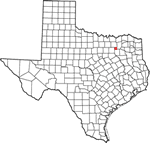
some information for another chapter. I heard about a huge monument
in the pineywoods of East
Texas that marked one of the worst Indian massacres in the history
of this part of the state.
The story starts in December of 1837, well over a year after Sam
Houston and his men soundly defeated General Santa Anna at the
battle
of San Jacinto, which won independence for Texas.
Issac Killough, Sr., moved his family from Talladega, Alabama to East
Texas and purchased land from the newly formed Republic. The property
had originally been part of a treaty settlement between the Texas
Revolutionary Government and the Cherokee Indians negotiated by John
Forbes, John Cameron and Sam
Houston. In December of 1837, however, the Senate of the new nation
of Texas nullified the treaty. The Cherokee weren’t all that happy
with the treaty because it greatly reduced their lands – since they
were led to believe that it would give them a permanent home, however,
they accepted the terms. Some bitterness still existed among many
tribe members, and the nullification of the treaty only exacerbated
those feelings. The stage was set for an inevitable clash between
the Texans and the Cherokee.
On Christmas Eve of 1837, Issac Killough didn’t know about this rising
animosity with the natives. His four sons, two daughters and their
husbands, and two single men, Elbert and Barakias Williams all settled
on the land. Over the next several months they built houses, and planted
crops to sustain their families.
The corn was ready to harvest by August, but word had reached the
settlers of a growing threat by the Indians. The Killough party joined
with other settlers and fled to Nacogdoches
for safety.
In a month or so, the threat seemed to have dissipated, or so the
Killoughs thought. They struck a bargain with the Indians to allow
them to return to the land to harvest their crops, promising to leave
before the first frost of winter.
Apparently not all of the Cherokees respected the arrangement, however,
because on the afternoon of October 5, 1838, a renegade band attacked
and killed or kidnapped eighteen unarmed members of the Killough party,
including Issac Killough, Sr., himself.
The survivors, which included Issac’s wife Urcey, began a harrowing
journey to Lacy’s Fort, forty miles south of the Killough settlement.
When they arrived there safely, an enraged General Thomas J. Rusk
organized a militia and rode out in search of the Indians. Rusk’s
men caught up with them near Frankston, and defeated them in a skirmish
in which eleven of the Indians were killed.
The Killough Massacre
was the largest Indian depredation in East
Texas. The bodies that were found were buried at the site, and
in the 1930s the W.P.A. erected an obelisk made of stone to mark the
location. In 1965 the cemetery was dedicated as a Texas Historical
Landmark, and the area is now enclosed by a fence with a small parking
lot beside it. |
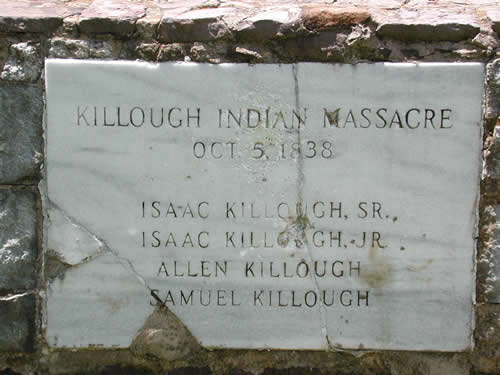 |
Killough Indian
Massacre
October 5, 1838
Photo courtesy Janet Gregg, 2005 |
Before
I actually visited the monument, I’d heard quite a bit about supernatural
activity there, including the aforementioned sighting of a Cherokee
warrior and the mysterious fog. Several paranormal investigators who’d
been there had regaled me with stories of odd temperature readings,
electric fields, and other scientific measurements often associated
with ghosts. I wanted to see the place for myself, though, both for
the historical aspects, as well as the spirits that might be showing
up there.
I drove through Jacksonville,
then headed north on highway 69. It wasn’t long until I saw a sign
that said, “Killough Monument” with an arrow pointing to the west.
I followed FM 855 a short distance until I came to an identical sign
pointing south to FM 3405. I turned my vehicle in that direction,
and started looking for the monument. Almost an hour later, I was
still looking for it. There was a maze of little Farm/Market roads
and I covered most of them; more than a few times I was sure that
I was lost. I even stopped and asked people how to find the Killough
Monument, but those few that had even heard of it couldn’t tell me
where it was. One gentleman offered the observation that, “I think
it’s around here somewhere, though.”
I finally gave up, and pressed on to other destinations. By then it
had become a quest for me, though, so I knew that I’d return with
a more detailed map and much better instructions.
In a few weeks’ time, I’d found someone to give me precise driving
directions, and I followed them on an online map before ever leaving
home. If the monument was where they said it was, I’d been all around
it on my previous visit, and had even driven past the turn-off road.
Armed with that information, I set out for Jacksonville
once again. Sure enough, I drove straight to the monument. |
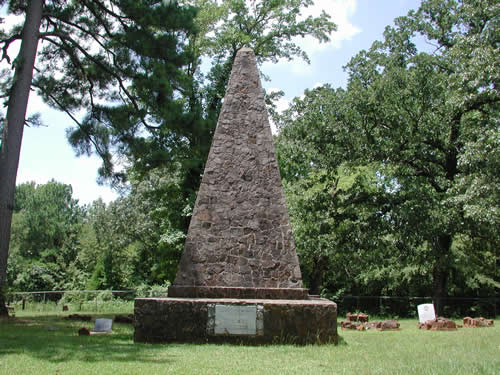 |
Killough Massacre
obelisk
Photo courtesy Janet Gregg, 2005 |
I
have to say that when you first see it, the stone obelisk
is quite impressive – the stone composition has the same look as W.P.A.
buildings from the 1930’s. The graves of those who were found dead
are around its base, and the entire area is surrounded by a fence
with a historical marker near the entrance. It is beautifully kept,
and on that particular day, very serene. When I got out of my car
I noticed one thing that truly turned my stomach – someone had spray-painted
a pentagram on the parking lot. If I live to be three hundred years
old, I will still never understand how some people can bring themselves
to vandalize property like that… especially at a sacred place such
as a cemetery.
I just shook my head, sighed, and continued on. I walked through the
gate, and walked around to take a good look at the place. As I walked
around inside the fence, a rush of emotion hit me – it was as if I
was feeling an overwhelming sense of fear. I think that this was one
of the strongest impressions that I had in the course of writing this
book. It was literally all that I could do to keep from running back
to my car and locking the doors.
There was certainly no rational reason for the feeling. The place
seemed to be very safe, and although it was far out in the country,
there were many homes within a short distance. I simply couldn’t explain
the feeling that I was experiencing, and the longer I stayed, the
more intense it became.
The scientific side of me was questioning whether or not my imagination
could simply be getting the best of me, but I dismissed that notion
immediately. It was too strong a sensation, and try as I wanted, I
couldn’t get rid of the sense of dread.
As I snapped a few photos, I realized that I’d had as much as I could
stand. Something was urging me to get away from there very quickly,
so I did. I managed to keep from running, but I did walk rather quickly.
I also couldn’t help but look back over my shoulder again and again,
since I was sure that something was coming for me.
I almost jumped into the car, slammed the door shut, and then hit
the electric locks. I felt better, but not that much. It wasn’t until
I was several miles down the road that I was feeling like myself again.
Whether I had been influenced by supernatural forces at the massacre
site, or I’d just picked up on the residual feelings from that terrible
event, I’ll probably never know. I want to go back though, if for
no other reasons than to pay my respects to the settlers who are buried
there. It was an experience that I want to explore further.
If you visit Killough Monument, please remember that is a memorial
to a family who died in a very tragic way. As with any cemetery or
sacred ground, be respectful, and please do not take anything out
with you but photographs. |
Killough
Monument is not the most intuitively obvious place to find, and in
fact, I had to make a couple of trips there before I ran across it
myself. Here are the directions to make it a little easier on you:
- From the
intersection of Highway 69 & Farm/Market (FM) Road 855 go west
on FM 855 until you reach FM 3405. There is a sign there (or was
at one time) that reads “Killough Monument” and points to the
left.
- Turn left
on FM 3405 and go just about .4 miles to FM 3411.
- Turn right
on FM 3411 and go .6 miles until you reach a road with a green
gate with a huge boulder on either side. That is actually FM 3431,
but there is no sign there.
- Turn left
and proceed through the gate – the monument and cemetery are at
the end of the road.
|
©
Mitchel Whitington
Excerpted from "Ghosts of East Texas and the Pineywoods"
Published with permission, October 8, 2005 |
|
| Texas
Escapes, in its purpose to preserve historic, endangered and vanishing
Texas, asks that anyone wishing to share their local history, stories,
landmarks and vintage/historic photos, please contact
us. |
|
|
 HOME
HOME