|
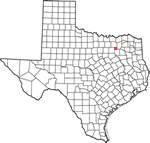
| Located
in the Pendleton Harbor Subdivision on Hwy. 21 (Highway 6 on the Louisiana
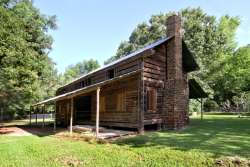
side) near the Pendleton Bridge, the Gaines-Oliphint House has been
acknowledged by the Texas Historical Commission as the oldest standing
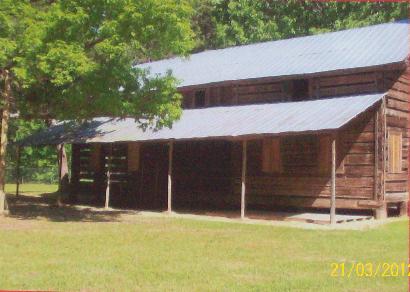
hand hewn log structure in the state. The building is a double pen
planked log story and a half building with a dog trot. |
|
|
Gaines-Oliphint
House - "Oldest standing hand hewn log structure in Texas" |
The
Gaines-Oliphint House was given to the James Frederick Gomer Chapter
of the Daughters of the Republic of Texas in 1999 by the SRT (Sabine
District Chapter 33 of the Sons of the Republic of Texas). As of May,
2008, the DRT received a master plan for the restoration of the house
and stabilization was completed in the fall of 2008. The Texas Historical
Commission requires that in order to preserve the house we must replace
the existing roof with a historically correct roof which is a fire
retardant cedar shake roof. Funds for this project are actively being
sought at this time.
Chartered on March 8, 1984, the Sons of the Republic of Texas, Sabine
District Chapter 33 were gifted in December, 1984 with the Gaines-Oliphint
House by Mrs. Tom Foster of Center.
|
The
Oliphint House is one of the earliest Pre-Republic, Anglo-American
structures in Texas. This house is the only surviving structure of
the early settlement of Gaines Ferry. It was located on James Gaines'
large plantation and ferry-tavern enterprise on the Sabine River crossing
of the El
Camino Real. James was born Richard T. Gaines in 1776 in Culpepper
City, VA.
Many historians say the 2-story, double pen log structure was built
about 1818 by James T. Taylor Gaines; Tree ring dating done as part
of the master plan in 2007 indicates the house might have been constructed
as late as 1849. Identical to the Gaines Ferry house that he built
for himself around 1815 by slave labor at the Sabine Crossing, the
Oliphint House was apparently built for his teenage wife's parents,
the Edmund Norris', so they might live in the vicinity. Later his
cousin Susan Jackson lived with her family in the house. The Gaines
Ferry site was inundated by waters of the Toledo
Bend Reservoir in the late 1960's and the Oliphint House, an exceptionally
fine example of early Texas
architecture, is all that remains of this early nineteenth century
settlement. |
 |
 |
One
of Texas' first Anglo settlers, Gaines first came to what is now Texas
in 1812, crossing the Sabine
River and traveling to Nacogdoches.
This was prior to Stephen
F. Austin's first 300 Angle colonists in 1812. Speculating that
other settlers would choose to colonize west of the Sabine
River, Gaines purchased an existing ferry in 1819 on the river
in Sabine County. From this grew a mercantile establishment and later
the town of Pendleton. Gaines lived in the home at Pendleton from
1819 to 1843. The property on which the Gaines-Oliphint House stands
was sold to Wilford Oliphint by James Gaines about 1840; the bargain
seems to have fallen through. The deed validly conveying the house
and 61 acres of land was made by James Gaines and his son, John B.
Gaines, to Martha A. Oliphint on February 17, 1843.
James Gaines’ influence on Texas’ development
is significant, for he built a large plantation on the edge of the
frontier and was continually involved in Texas’
growth. After participating in two Mexican expedition, he held office
as the first judge (Aildae) of the municipality of Sabine in 1823
or 1824 and operated a post office at the ferry for a time in 1863.
Like his grandfather, Edmond Pendleton, who inspired Henry Lee to
author a Virginia resolution calling for American Independence in
1776, James Gaines participated in the creation of the new Texas Republic
as a delegate from Sabine County to the Convention of 1836. He was
placed on the committee to draft the Constitution of the Republic
of Texas and went on to serve as Senator in the 4th, 5th, and 6th
Texas Congress. Further, he was a signer of the Texas Declaration
of Independence.
Several architectural features of the house indicate the carpenter
to have been from the tidewater areas of the Carolinas and Virginia;
the logs having square notched gravity corners and the house is built
on high piers, both being features of early southern building in the
U.S. Built of longleaf pine logs which were shaped into planks with
an adze and broadax, the house was completely stacked before the windows
and doors were cut into the walls. Archeological findings indicate
the bricks for the chimney were manufactured on the site from native
red clay.
The Gaines-Oliphint house provided lodging for Sam
Houston, Davy Crockett, and Stephen
F. Austin, among others. According to legend, it is the site where
pirate Jean LaFitte
held his auctions to sell slaves and goods he had taken from captive
ships.
DIRECTIONS:
From Milam, Texas
(junction Highway 21 and Highway 87) - Go East on Highway 21 for 6.4
miles to Pendleton Harbor Subdivision (Cedar Grove Road). Turn North
on Cedar Grove Road and go 0.1 mile to the STOP sign. Turn East (right)
on Harbor Blvd. and go 0.1 mile to Ensign Drive. Turn North (left)
on Ensign Drive and proceed 0.2 miles to the Gaines-Oliphint House
on the right.
Submitted by Nina Gooch, President, "James Frederick Gomer" Chapter,
Daughters of the Republic of Texas |
 |
| White Oak Tree
(over 325 years old) at the Gaines-Oliphint House |
| Texas
Escapes, in its purpose to preserve historic, endangered and vanishing
Texas, asks that anyone wishing to share their local history, stories,
landmarks and new or vintage/historic photos, please contact
us. |
|
|
 HOME
HOME