|
Sabine
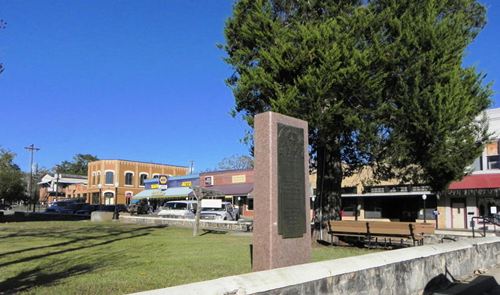
County courthouse square & Texas Centennial Monument
Photo courtesy Barclay
Gibson, November 2010 |
HEMPHILL
by Archie P. McDonald,
PhD
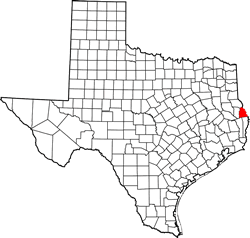
Few find the community of Hemphill, county seat of Sabine
County, by accident unless they are lost. One generally has a
purpose for visiting this old town. A good one might be finding a
place to fish or to retire since the completion of Toledo
Bend Reservoir provided the area with a fine 'fishing hole' not
far away.
Milam served as the seat of local government
in Sabine County
until 1858, when voters decided to move the courthouse to a more central
location. E.P. Beddoe drew the assignment of finding the right spot
and platting a town there. They named it Hemphill in honor of John
Hemphill, former chief justice of the Supreme Court of the Republic
of Texas and of the State of Texas.
Hemphill assumed its role as a government center in 1859, and Michael
Watson became postmaster there the same year. Despite its promising
beginning as a central location of the Sabine
County, the county itself lay in the grip of dense forest.
With the Sabine
River on one side and trees all around, Hemphill was not benefited
by the Houston, East and West Texas Railway, the first constructed
in East Texas in 1882-1883.
In 1884, Hemphill had a population of only 350 souls, few retail businesses,
a cotton gin, and a lumber mill. Population declined to less than
300 in 1900, rose to 400 by World
War I, and reached perhaps 1,500 or so by the 1920s before declining
again during the Depression. In 1990 the official count stood at 1,182
residents. A significant portion of the present population resulted
from the economic stimulation of Toledo
Bend Reservoir.
I have some fond memories of Hemphill. On many weekends back in the
1960s, we drove from Nacogdoches
to the southern part of Sabine
County to help my father-in-law, Bert Barrett, clear brush from
a lakeside subdivision he and his partners were developing. Our route
followed Highway 21 to Milam, then south,
through Hemphill, to the subdivision.
We rarely stopped, unless it was at the old Peddy's Restaurant, for
a cup of coffee or a meal. On one trip my wife wanted to stop in town
for a purchase, and my then four-year-old son and I strolled around
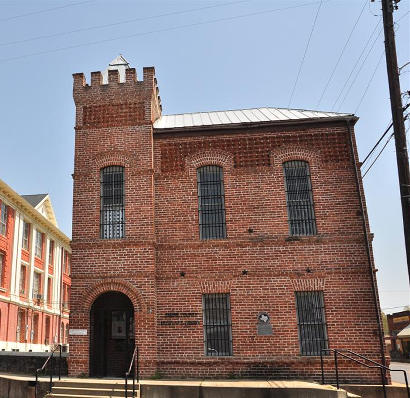
the square while she shopped. We received a guided tour of the old
jail, just then unoccupied, that shares the square with the seat
of justice in Sabine
County. I had never seen the inside of a jail before, and determined
that this would be my last visit. So far, that has turned out to be
the case.
© Archie P. McDonald, PhD
All
Things HIstorical July,
2002 Column |
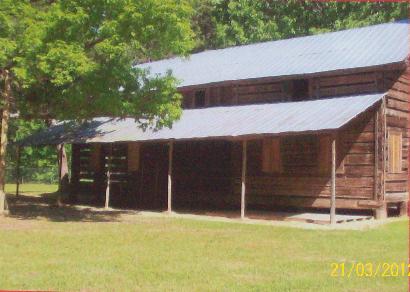
Historic
Gaines-Oliphint House
Acknowledged by the Texas Historical Commission as the oldest standing
hand hewn log structure in the state. A double pen planked log story
and a half building with a dog trot... |
Historical Marker
(201 Main St, Hemphill) Text:
Hemphill
In 1858, Sabine
County organized the community of Hemphill, named for Texas Supreme
Court Justice John Hemphill (1803-1862). An election determined that
the county seat would be moved from Milam
to this new settlement in the center of Sabine
County. Earl Percy Beddoe surveyed and laid out the town site
on an 80-acre tract owned by Richard Fendall Slaughter and his wife,
Anna (Holman). A post office was established in Hemphill in 1859.
Builders constructed the first courthouse in Hemphill shortly after
the community’s establishment; it was replaced in 1864 by another
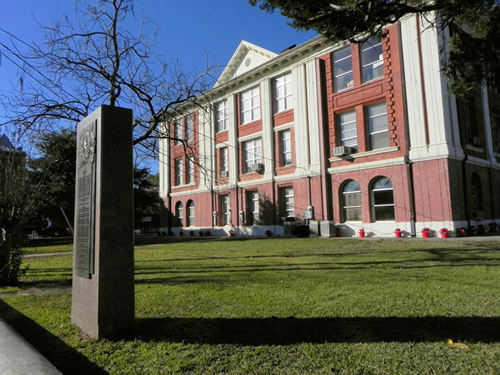
building, which burned down in 1875. Builder completed another courthouse
in 1877, which was eventually replaced by the current structure in
1906. Other significant early institutions included Sabine Valley
University, established in 1879, and First National Bank, which opened
in 1907 and closed during the Great Depression. Hemphill Common School
District No. 1 organized in the late 1800s, and by 1890 listed three
trustees, two teachers and eighty-eight students.
The population of Hemphill increased steadily between 1850 and 1930,
due in great part to the presence of the Knox Sawmill in the western
part of town. Temple Lumber Company later bought the mill, which burned
in 1937. Combined with post-World
War II rural-to-urban migration trends and the lack of major thoroughfares
in the town, the closing of the sawmill promoted a decline in the
community’s population. Today, Hemphill remains the seat of the Sabine
County government, and is home to several national, state and
local offices, remaining a community of vital importance in the state
of Texas. |
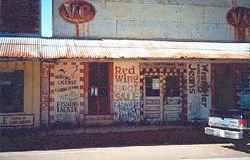 |
A feed store
in Hemphill
TE photo |
Hemphill,
Texas Chronicles
A
gunfight in Hemphill by Bob Bowman
With deep roots in East Texas, John Wesley Hardin was our most famous
outlaw and gunfighter, but many of his raids and shootings in the
pineywoods have remained unchronicled. A little-known incident in
which he won a gunfight with a Sabine County deputy sheriff at Hemphill...
The
Mystery of Lady Bountiful by Bob Bowman
November 22 will mark the 85th anniversary of an East Texas murder
that created a still-lingering mystery and put a timber baroness
in a pauper’s grave.
Saving
Sallie's Home by Bob Bowman
Today, more than a few Hemphill townspeople are convinced Sallie's
prayers 95 years ago have protected her house from the wrecker's
ball and will lead to its eventual restoration.
A
Personal Hero by Bob Bowman
My favorite East Texans are the senior citizens whose agile memories
have helped me write columns such as this. Leon Herman Adickes,
88, who was high on my list, died recently at Hemphill -- a place
where he helped make history by simply doing things to make his
community a better place. Most of what he did were acts like making
sure Hemphill had a doctor, a hospital, a nursing home and a Lions
Club.
The
Twirler by Bob Bowman
When Audrey Dean Leighton passed away in mid-2005, East Texas lost
one of its most entertaining and colorful characters.
Outlaw
with two faces by Bob Bowman
To those who knew Wright, his appearance and demeanor were far removed
from the days when he was a prominent newspaper editor, attorney,
and aspiring legislator in Little Rock. But they would soon learn
that he was also an escaped murderer, forger, arsonist and jail
breaker named Pete Loggins from East Texas.
|
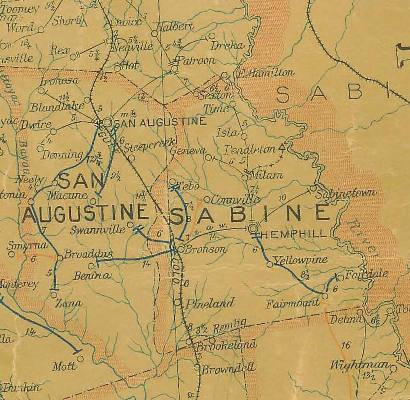 |
Sabine
County 1907 postal map
From Texas state map #2090
Courtesy
Texas General Land Office |
| Texas
Escapes, in its purpose to preserve historic, endangered and vanishing
Texas, asks that anyone wishing to share their local history, stories,
landmarks and recent or vintage photos, please contact
us. |
|
|
 HOME
HOME