Historical Marker:
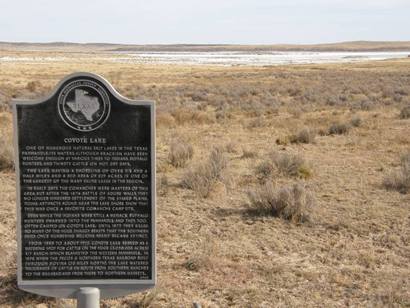
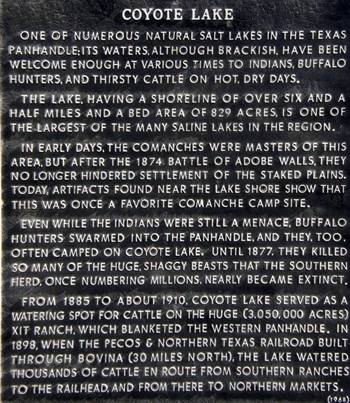
Coyote Lake
One of numerous
natural salt lakes in the Texas
Panhandle. Its waters, although brackish, have been welcome
enough at various times to Indians, buffalo
hunters, and thirsty cattle on hot, dry days.
The lake, having a shoreline of over six and a half miles and a
bed area of 829 acres, is one of the largest of the many saline
lakes in the region.
In early days, the Comanches were masters of this area, but after
the 1874
Battle of Adobe Walls, they no longer hindered settlement of
the Staked Plains. Today, artifacts found near the lake shore show
that this was once a favorite Comanche camp site.
Even while Indians were still a menace, buffalo
hunters swarmed into the Panhandle,
and they, too, often camped on Coyote Lake. Until 1877, they killed
so many of the huge, shaggy beasts that the southern herd, once
numbering millions, nearly became extinct.
From 1885 to about 1910, Coyote Lake served as a watering spot for
cattle on the huge (3,050,000 acres) XIT
Ranch, which blanketed the western Panhandle.
In 1898 when the Pecos and Northern Texas Railroad built through
Bovina (30
miles north), the lake watered thousands of cattle en route from
southern ranches to the railroad, and from there to northern markets.
|
 HOME
HOME