|
|
They
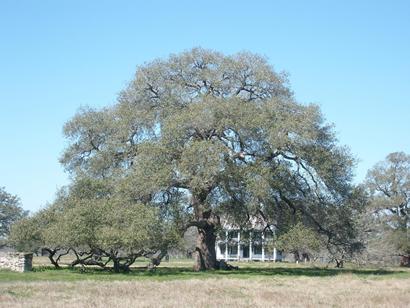
call it Sam Houston's oak.
The ancient tree shades a wide area just east of Peach Creek, 8.5
miles from Gonzales.
In the vicinity of the tree on March 14, 1836, Sam
Houston and several hundred Texas citizen-soldiers spent one of
the worst nights of their lives, albeit a very short night. |
 |
The day before,
Houston had dispatched
from Gonzales three
of his best scouts, Erastus
"Deaf" Smith, Henry Karnes and Robert Handy, on a dangerous mission.
They had orders to ride to Bexar to learn how Col. William B. Travis
and the other defenders of the Alamo
were doing. With Smith
in charge, the scouts made it only 20 miles west of town before they
rode up on Susannah
Dickinson, her infant daughter Angelina and Joe, Travis' slave.
Dickinson
passed on the grim news that her husband and all the others had died
early on the morning of March 6, their mission fortress overwhelmed
by soldiers under Gen. Antonio
Lopez de Santa Anna. Karnes raced back to Gonzales
to report to Houston
while Smith
and Handy stayed behind to escort the survivors.
The
word Karnes carried threw Gonzales
into a panic. Twenty-five of Houston's
soldiers deserted, an enraged Houston
ordering their arrest. Houston's
next order, made shortly after Smith
and the survivors arrived about 11 p.m., was to torch the town and
retreat.
Houston said that
women and children should leave immediately, assuring the townspeople
that his troops would serve as a rear guard to protect them from the
advancing Mexican army.
Led by Houston,
374 citizen-soldiers marched eastward all night, crossing Peach Creek
at Bartholomew D. McClure's plantation. In the pre-dawn darkness,
the general called a stop for breakfast and rest.
To the west the Texans could still see the orange glow of the burning
town. Soon they started new fires, and began boiling coffee and cooking
breakfast.
"While we were sipping our unsweetened coffee," private James Kuykendall
later wrote, "two or three loud explosions in quick succession were
heard in the direction of Gonzales."
The soldiers grimly assumed the booms came from Mexican field pieces,
but Sidney Sherman had another theory: Houston
had said something about leaving poisoned liquor behind in the hope
of killing some unsuspecting Mexican soldiers. They were hearing the
barrels of booze blowing up in the fire, he suggested.
Their bellies full, even the strong coffee did not prevent most of
the men from sinking into an exhausted sleep.
Meanwhile, stragglers continued to arrive from the burned town - men,
women and children on foot, in oxcarts or on makeshift, horse-drawn
sleds to more easily traverse the mud left by recent rains.
"It was a sad thing to see the women and children plodding their way
across the prairie," later wrote David Kokernot, one of the volunteer
soldiers. "No tongue can express the sufferings those fleeing families
were called upon to endure." |
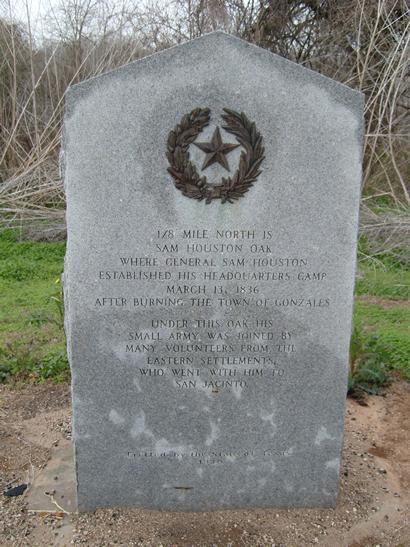 |
A gray granite
historical marker placed nearby in 1936 says the oak that was there
when all this happened briefly served as the "headquarters" of Houston's
army. While that is technically true, Houston
did not linger. Two hours after arriving, the weary general, longer
days ahead of him, commanded the soldiers to fall in and continue
their eastward march.
At least he had more men than he had arrived with. A volunteer company
organized in San
Felipe by Capt. John Bird had been camped at the creek and readily
joined Houston's
army. Now the general had an addition 90 men.
The
owner of the land along Peace Creek, McClure, had settled there in
1831 with his 19-year-old bride, Sarah. They lived in a cabin and
made a living off the land and by providing food to travelers. The
McClures fled with the rest of Gonzales
County's residents, but returned after the revolution.
When McClure died in 1841, Sarah kept the place. "A braver or grander-hearted
woman never trod the soil of Texas," historian John Henry Brown later
observed.
Two years after being widowed, Sarah married Charles Braches, a merchant.
Not far from the huge oak where Houston
and his soldiers had napped, Braches built a two-story Greek Revival
plantation-style house for his new wife. |
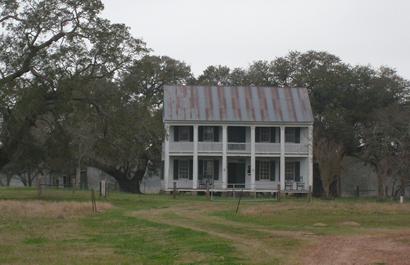 |
The McClure-Braches
House built in 1843
Photo courtesy Sarah
Reveley, February 2008 |
Sarah outlived
her second husband, staying in the house until her own death in 1894.
A century later, the old house still stood, but it was vacant and
endangered.
The old house is still owned by descendants of the Braches family.
In 1995, the house was restored -- a gift to the Braches family and
to posterity from an adjacent property owner.
© Mike Cox
"Texas Tales" March
12 , 2004 column |
Directions
to the Sam Houston Oak
Photographer's
Note:
From the Gonzales
County Courthouse (414 St. Joseph St.) in Gonzales,
go north on St. Louis St. for 2.0 miles. Turn right (east) onto US
Alt. 90. and go 8.0 miles (cross Peach Creek), then left on CR 361
(a centennial marker is here). Go 0.3 mi. to the entrance for the
McClure-Braches House on the left. The tree, also known as the "Sam
Houston Oak," is on the left of the drive to the old house.. - Sarah
Reveley, February 2008 |
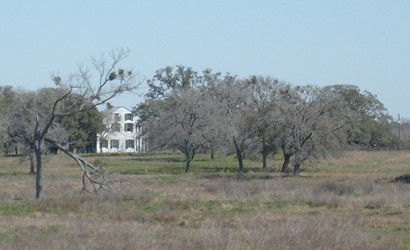
View of the McClure-Braches
House from Hwy 90A right before you reach the marker where you turn
left, head down that road a bit to the house.
Photo courtesy Sarah
Reveley, 2008 |
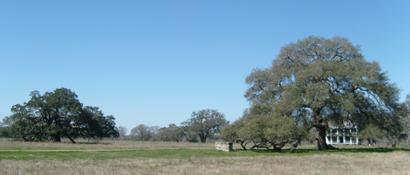
Sam Houston Oak
and McClure-Braches House
Photo courtesy Sarah
Reveley, 2008 |
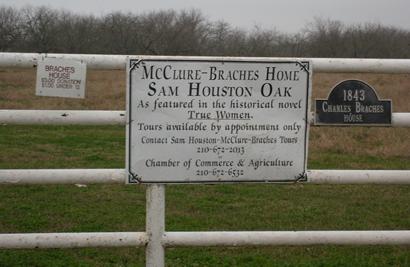
McClure-Braches
House Sam Houston Oak sign
Photo courtesy Sarah
Reveley, February 2008 |
|
|
 HOME
HOME