|
Texas
| Architecture
| Courthouses
Dignity, Decorum
and Justice
Mark Texas' Courthouse Histories,
Except for the Fights, Arsons, Thefts, etc
by Bill Morgan
Page 3
‹ Page
2
One Man,
One Vote (Maybe Two)
|
‹
Page 2
Why
all the fuss over getting the county-seat designation? It was a magnet
for growth. A town boasting a railroad and a courthouse was the equivalent
of today's cities with a large airport hub and a convention center-sports
complex. There's a good chance that any county seat you visit today
has the courthouse because of a bitter, divisive election or even
despite a bitter, divisive election.
A prime example of the latter is Newton
County. In the late 1800s, Burkeville
successfully challenged incumbent Newton
for the seat. Well, not exactly successfully - Burkeville
won the election, 114 votes to 102, but lost, three votes to zero,
where it mattered. The sheriff, county clerk and county treasurer
all lived in Newton
and refused to move, even after being fined. Finally, the Texas Legislature
called another election. Newton
won this one, but now it was Burkeville's
turn to be obstinate: officials living there refused to surrender
county records it had accumulated.
More intrigue: some unverified accounts have it that Newton citizens
sneaked into Burkeville
and captured them under cover of darkness. |
 |
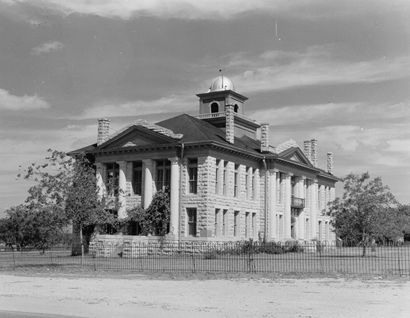
The 1916 Blanco
County Courthouse in Johnson
City
1939
photo courtesy TXDoT |
If
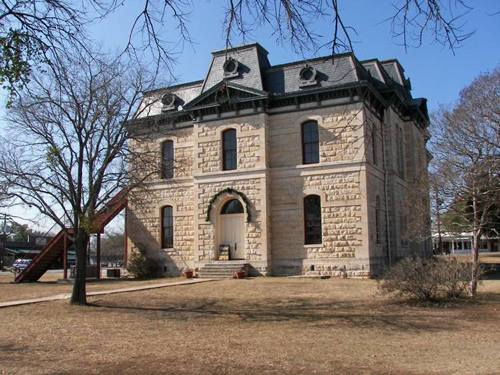
you drive along U.S. 281 through Blanco,
you'll see a beautifully restored Second Empire building on the east
side of the highway. It was so impressive that it lasted five years
as the courthouse. Johnson
City beat bigger, established Blanco
in an 1890 election to move the county seat. In his book, The Texas
Courthouse Revisited, author June Rayfield Welch reports that
he asked the old courthouse's then owner, Mrs. Thurman Roberts, how
the smaller town pulled off such an upset. Her answer: "The dead came
out to vote." Need we be reminded that Johnson
City's favorite son, Linden Baines Johnson, won a 1948 Democratic
senatorial primary election amid charges that the same thing happened
in Duvall County?
A few other examples of county-seat piracy: Citizens of Panola
County seat Pulaski awoke one morning in 1848 to find that folks
from Carthage had
stolen all the county records during the night. Carthage
became a thriving little Northeast Texas town; Pulaski became
a ghost town; The town of El
Paso trounced Ysleta
in an 1884 El Paso County seat election by turning out seven times
more votes than it had voters. Real people voted, too - they happened
to be Mexican citizens crossing the border to work or shop. El Paso
vote-getters stood at the frontera and signed them up as soon as they
stepped on U.S. soil; And a story long in circulation tells of Henrietta
and Cambridge
both claiming to be the Clay
County seat through the late 1880s. They supposedly hit on a more
civilized way of settling the issue - they held a mule race with the
winner getting the courthouse. |
 |
When it comes to county-seat wars, none hold a cannon to Lavaca.
An election between Hallettsville
and Petersburg
on June 14, 1852 set off a chain reaction. Loser Petersburg contested
the election, then several of its citizens stormed into the courtroom
during the hearing and tore up the ballots. The presiding judge resigned
on the spot. Two more elections followed with Hallettsville
winning both. Petersburg
refused to surrender any county documents, so Hallettsville officials
went to get them.
Instead, they got arrested and jailed. When they were released they
rallied 200 Hallettsville partisans (one account says 500) and invaded
Petersburg
to free the hostage court papers. They found Petersburg folks cooking
up a barbecue feast, a little quick on the draw in celebrating their
victory. The surprised and outnumbered Petersburg revelers fled in
disarray and Hallettsville
forces returned as home as conquering heroes, with the spoils of victory
in tow - both the county records and the barbecue.
Page 4
Anybody Got a Match?
What's in a Name?
The Artists in Brick, Stone and Mortar
But
arson was hard to beat for reliable courthousetrashing. When the courthouse
wars heated up, so did a lot of courthouses. I counted 106 Texas courthouses
destroyed or badly damaged by fire from the first in 1848 to the latest
in 2001. Page
4 › |
©
Bill Morgan
June
9, 2005
More
Texas Courthouses |
Recommended
Book
Texas Courthouse Revisited |
|
|
|
 HOME
HOME


