|
|
 |
History in
a Pecan Shell
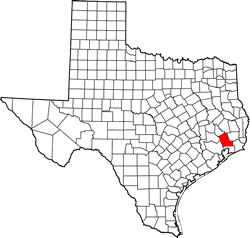
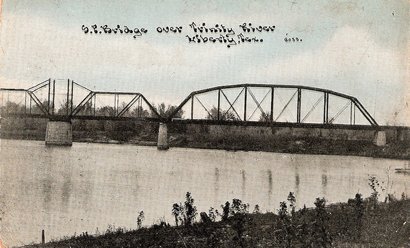
Liberty once stood
at the head of navigation on the Trinity River. Founded near a 1756
Spanish settlement called Atascosito American squatters began arriving
around 1818. The new arrivals petitioned to be included in Stephen
F. Austin's colony, but were refused. Under Mexican law, land commissioner
José Francisco Madero established a new municipality, Villa de la
Santísima Trinidad de la Libertad which the Americans shortened to
Liberty, some say after Liberty, Mississippi, the former residence
of some settlers. The town was granted a post office in 1836.
Sam Houston practiced
law in Liberty and maintained two plantation homes in Liberty
County until his death. During the Texas Revolution, Andrew Briscoe's
Liberty Volunteers fought at the
siege of Bexar and the battle of Concepción. After San
Jacinto, officers of the Mexican army were held for a time in
Liberty at a location now known as Mexican Hill.
Liberty was incorporated in 1837 and became the county seat. The town
became an important port, having steamship connections to Galveston
and providing access to stage routes across the Trinity.
A school was founded in 1838. The town cemetery was marked off in
1848. In the 1850s, as the community expanded, additional industry
developed around its gristmills, cattle shipping docks, and two sawmills.
The Texas and New Orleans Railroad reached Liberty in 858. The railroad
suspended operations during the Civil War, but resumed operations
by 1875. Liberty was hit by smallpox and yellow fever epidemics in
1866 and 1867.
By 1900 the town was a sleepy river community where livestock roamed
the streets legally. The towns proximity to the Batson-Old oilfield
made it a boomtown for awhile after 1903 and a second boost came in
1925 when the the South Liberty oilfield was discovered. The Trinity
Valley and Northern Railway Company arrived in 1907.
Attempts were made to make the Trinity navigable - and some 236 miles
of waterway had been completed, linking barge traffic to the Houston
Ship Channel.
Liberty's population for various years:
200 in 1845, 497 by 1880, 865 in 1900, 3,087 in 1940, 4,161 in 1950,
5,591 in 1970, and 7,733 in 1990.
During World War
II, a camp for German POWs was constructed at the Liberty fairgrounds.
Highway 146 was completed in 1950 and the Sam Houston Regional Library
and Research Center opened in 1977. |
Liberty, Texas
Landmarks / Attractions
|
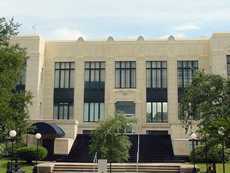
Geraldine D.
Humphreys Cultural Center - 936-336-8901
1710 Sam Houston St., downtown Liberty
Museum, library and performing arts theater.
Historical
Sites - Historical monument and markers identifying historic sites,
old homes and structures. Visit Liberty-Dayton Chamber of Commerce
for information. 1801 Trinity St. 936-336-5736
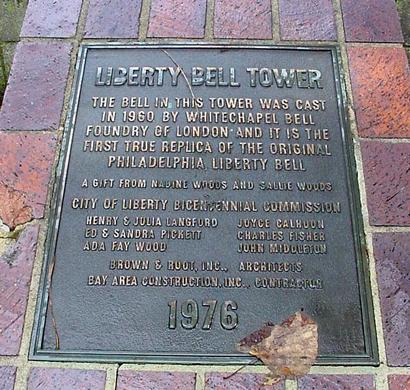
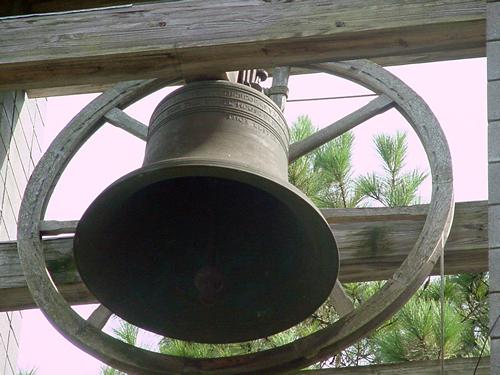
Liberty Bell
Tower - adjacent to Cultural Center above
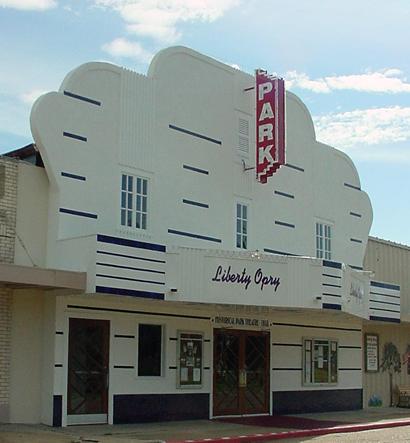
Liberty Opry
on the Square - Live shows. 936-336-5830
Sam Houston
Regional Library & Research Center -
936-336-8821. Free admission.
FM1011 off Hwy 146. Three miles north of Liberty
Liberty
Hotels
Liberty-Dayton Chamber of Commerce - 936-336-5736
1801 Trinity Street
P.O. Box 1270, Liberty, Texas 77575
http://www.libertydaytonchamber.com/
|
Liberty Opry
on the Square in the former Park Theater
TE
Photo, 9-04-04 |
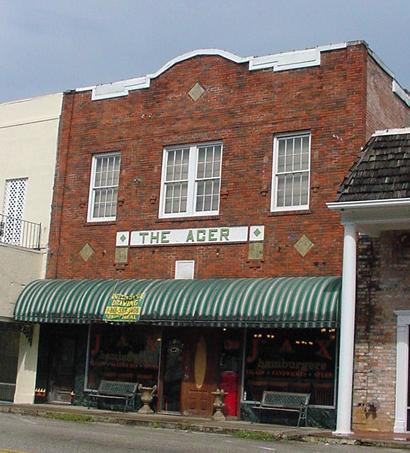
Former theater
in Liberty, east side of the square
TE
Photo, 9-04-04
More Texas Theatres
|
Liberty Bell
plaque
TE photo, 9-04-04 |
 |
 |
 |
 |
Liberty, Texas
Chronicles
A
Moving History by Bob Bowman ("All
Things Historical")
The recent death of Bill Daniel of Liberty removed from East Texas
one of its most colorful personalities, a bigger-than-life rancher
and politician who, according to one of his eulogists, "squeezed
a lot out of life."
...Bill Daniel is best remembered by some admirers for one of the
strangest events in East Texas--the move of an entire town from
Liberty to Waco, a distance of more than 200 miles, in October of
1986 during the Texas sesquicentennial celebration..." more
Champ
D’Asile by Clay Coppedge
If a few Frenchmen and their allies could have had their way, Texas
might have become part of a new Napoleonic empire. Two of Napoleon’s
generals seem to have had this in mind when they founded a colony
called Champ D’Asile (Place of Asylum) at a site about three miles
up the Trinity River near the present-day town of Liberty...
Liberty
treated POWs well in 1830s and 1940s by Wanda Orton
With the Germans in the 1940s and Mexicans in the 1830s, the people
of Liberty treated the prisoners humanely and with dignity...
more
French
Connection by Wanda Orton
While watching a TV history program about Napoleon’s exile on St.
Helena, I kept thinking about Liberty County...
The
July 29, 1878 Solar Eclipse in Texas by Mike Cox
|
 |
| Texas
Escapes, in its purpose to preserve historic, endangered and vanishing
Texas, asks that anyone wishing to share their local history
and vintage/historic photos, please contact
us. |
|
|
 HOME
HOME

 Texas
Gulf Coast
Texas
Gulf Coast East
Texas
East
Texas Central
Texas North
Central
Texas North Central
Texas South
Central
Texas South Texas
Panhandle
Texas
Panhandle South
Texas
South
Texas Texas
Hill Country
Texas
Hill Country West
Texas
West
Texas Texas
Ghost Towns
Texas
Ghost Towns Texas
Counties
Texas
Counties