|
ORANGE,
TEXAS
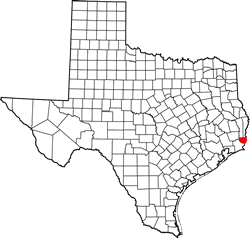
Orange County Seat,
Texas Gulf Coast
/ East Texas
30° 6' 33" N, 93° 45' 33" W (30.109167, -93.759167)
Highway 90 and 87
Dangerously close to Louisiana
On the Intra-coastal Waterway
113 miles E of Houston
24 miles E of Beaumont
Population: 19,324 (2020)
18,595 (2010) 18,643 (2000) 19,381 (1990)
Book Hotel Here › Orange
Hotels |
The former depot
in Orange
TE Photo, 2003 |
| Orange, is considered
a point of what is known as the "Golden Triangle" - the other points
being Port Arthur and Beaumont
|
History in
a Seashell
Orange
had several names before 1858 - the year it officially became Orange.
Originally called Green's Bluff after an early Sabine River
boatman, it was renamed Madison in 1840, but it sometimes delayed
mail - which was sent to Madisonville
(Madison County)
in error.
The town's post office was granted in 1850 and two years later, Orange
County was organized with Madison as county seat.
The final name change took place in 1858 when it finally became Orange
- to the great relief of postmasters and the mail-receiving public.
The name reportedly comes from a local orange grove owned by a man
named George Patillo.
Outlaws used Orange as a temporary residence while they waited for
the heat to cool down in Louisiana. The town became a major port on
the Sabine from the 1840s through the 1890s.
The railroad (Texas and New Orleans) arrived in 1860, but service
was disrupted when the rails were torn up during the Civil War. After
the war the town was occupied by troops from Illinois.
At the peak of East Texas
lumber production, Orange was the center of the Texas lumber industry
- having seventeen sawmills within the city limits. It was Orange's
zenith.
A timeline of selected or significant events in Orange's history
1897: The Kansas City Southern Railroad reaches Orange
1902: Six large lumber companies acquire ownership of 17 smaller lumber
mills
1914: Population reaches 7,000
1916: Port dredged - making Orange a deep water facility.
WWI: Orange serves as
a major shipbuilding center for both world wars
1920s: East Orange becomes famous for its 1920s nightclubs - crime
rampant between wars.
1938: Rainbow
Bridge opened across the Neches
River between Orange and Port
Arthur.
WWII: Shipyards
increase population to 60,000 people. After the war, ships were mothballed
on the Sabine
River and the population decreases to a manageable 21,100 in 1950.
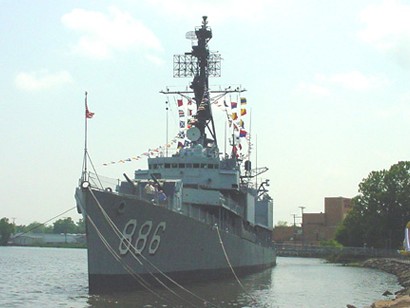
In August, 2000 the USS Orleck, after having served in the Turkish
Coast Guard returned to the port where she was built in 1945.
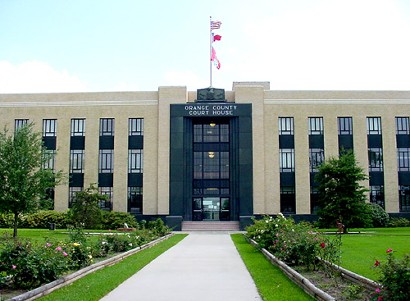
See Orange Historical Marker:
|
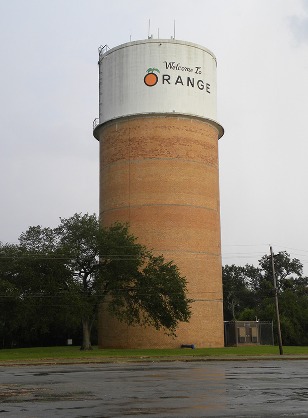 |
"A brick-based
water tower.
You need this for your
collection."
- Bob Finch, Ed.D., August 2010 photo |
Historical Marker
- on 803 W. Green Ave.
ORANGE
The first known
settlers in what is now the city of Orange were John and Elizabeth
Harmon, who arrived in 1828 with their three children. Known first
as Green's Bluff, the small farming community that developed
along a bend in the Sabine River was selected as the seat of government
when Orange County
was created in 1852. The town was called Madison from 1852
until 1858, when the name Orange was adopted.
The early Orange economy was based on the lumber and shipbuilding
industries. Led by prominent pioneer area lumbermen and aided by the
advent of the Texas and New Orleans Railroad in 1876, Orange was recognized
as the leader in East Texas
sawmill activity by the 1880s. The deep water port and the availability
of lumber made the city an ideal location for the shipbuilding industry,
which reached its highest production levels during World
Wars I and II.
For many years the city of Orange has maintained a full range of services
for its citizens. Public schools have operated since the 1880s and
electricity was instituted in 1890. Orange's shipbuilding and petrochemical
industries continue to make the city a leading commercial center in
southeast Texas. |
Orange, Texas
Attractions / Landmarks:
|
The
Hanging Tree of Orange Texas
by W. T. Block ("Cannonball's Tales")
Cross-cut Saw Thwarted Judge Lynch
"On the afternoon of July 7, 1892, two men wielding a cross-cut
saw hurried to fell the mighty pin oak tree which shaded the front
entrance of D. Call and Sons Grocery at Fourth and Front Streets,
on the waterfront at Orange, Texas." more
|
U.S.S. Orleck
- On Front Avenue on the water
TE Photo, 2003 |
Historical Marker
- Front Ave. and 3rd St.
U. S. S. Aulick [sic]
On September 9, 1940, a federal contract worth $82 million was issued
to the Consolidated Steel Company to construct 12 Fletcher class naval
destroyers here in Orange, Texas. This and other contracts coupled
with the subsequent building of major shipyard facilities along the
city's riverfront lifted the city out of a prolonged and deep economic
decline which began in the early 1930s with the closing of area sawmills.
The community celebrated the laying of the keels of the U. S. S. Aulick
[sic] and U. S. S. Charles Ausburne on May 14, 1941. The Aulick [sic]
became the first naval destroyer to be built in Texas and on Texas
Independence Day, March 2, 1942, it was christened and launched amid
a crowd of 6,000 people.
The Aulick [sic] represented the second U. S. Naval warship to be
named after War of 1812 Navy veteran John H. Aulick [sic] (1787-1861).
By 1946 all 12 destroyers and over four hundred other ships had been
completed here at a cost of over $876 million. Orange's well-developed
shipyards encouraged major companies to build plants along the riverfront.
Several petrochemical and industrial concerns followed suit in the
1950s and 1960s. Wartime shipyards operated by Consolidated, Levingston,
and Weaver converted to peacetime activities.
1993 |
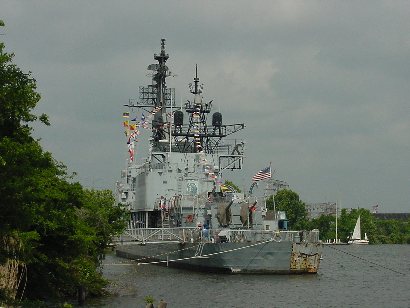 |
Back view of
U.S.S. Orleck
TE photo 2003 |
First Presbyterian
Church - Lutcher Memorial Building
902 W. Green Avenue
Recorded Texas Historic Landmark
TE Photo,
2003
More Texas Churches |
Historical Marker
Lutcher
Memorial Church Building
Founded in 1878, the First Presbyterian Church initially
occupied a frame structure built in 1883 at Market and Polk Street.
In 1912 the congregation moved to this church building which Frances
Ann (Mrs. Henry Jacob) Lutcher (1841-1924) had erected as a gift from
the Lutcher family. H. J. Lutcher (1836-1912) amassed a fortune in
the Lutcher & Moore Lumber Company. The Lutchers and their two daughters
Carrie (Mrs. E. W.) Brown and Miriam (Mrs. William H.) Stark were
philanthropists and community leaders. Mrs. Lutcher asked that the
cost of the building never be publicized. She and her descendants
set up a permanent endowment to maintain the facility. Fine workmanship
and materials appear throughout the structure. The beautiful art glass
windows were made by Lamb Studios of New York. For the upper foyer,
Mrs. Lutcher chose three prize-winning windows from the 1893 Chicago
World's Fair. The marble came from Italy and the granite was shipped
by rail from Llano,
Texas. The dome is topped by a copper cupola. Decorations on the
sanctuary ceiling and walls have gold leaf overlay. The pews and wood
paneling in the organ loft are mahogany. Mosaic work adorns the pulpit,
marble communion table and baptismal font.
Recorded Texas Historic Landmark - 1978
Cartoon
by Roger T. Moore:
1912:
the First Presbyterian Church of Orange is the worlds' 1st public
air-conditioned building. |
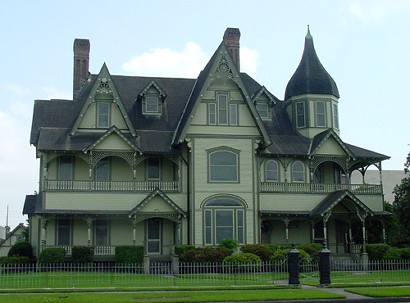 |
W. H. Stark House
c. 1894 - 610 West Main Street
Recorded Texas Historic Landmark
TE Photo,
2003
More Texas Historic Homes |
Historical Marker
W. H. Stark House
Eastlake detailing decorates the porches and gables
of this ornate Queen Anne style residence, built in 1893-94 for William
Henry (1851-1936) and Miriam (Lutcher) (1859-1936) Stark. A financial
and industrial pioneer, Stark headed several lumber and petroleum
companies. His son H. J. Lutcher Stark (1887-1965) was noted for his
cultural and educational philanthropies. Both men served as regents
of the University of Texas. The Nelda C. and H. J. Lutcher Stark Foundation
restored the house.
Recorded Texas Historic Landmark - 1976 |
Orange Chamber
Commerce
TE photo, 2003 |
Orange, Texas
Chronicles
The
not-so-aptly named steamship War Mystery
by Mike Cox
"The East Texas-built steamship War Mystery qualifies as one
of the least-aptly named vessels in maritime history.
That’s because there wasn’t a darn thing mysterious – and certainly
nothing secret – about this giant World War One-era, yellow pine
steamship built in Orange in 1917-1918... " more
|
Orange Tourist
Information
Orange Convention & Visitors Bureau
803 W. Green Avenue Orange, Texas 77631-0520
P.O. Box 520 Orange, Texas 77630
409-883-1011 or 1-800-528-4906
http://www.org-tx.com/chamber/
Book Hotel Here > Orange
Hotels |
| Texas
Escapes, in its purpose to preserve historic, endangered and vanishing
Texas, asks that anyone wishing to share their local history, stories,
landmarks and recent or vintage photos, please contact
us. |
|
|
 HOME
HOME